Best Venture Capital Portfolio Support Services in 2026: 8 Services Compared

- Venture capital portfolio support covers hiring, fundraising, operations, and reporting, and the right tools depend on fund size and portfolio stage.
- Carta leads on equity and portfolio management, while Affinity leads on relationship and dealflow tracking for investors.
- AngelList suits funds that want fund administration plus talent and fundraising support in one place.
- Visible and Harmonic help funds track portfolio performance and find talent or follow-on opportunities.
- Our pick for most funds is Carta for equity and reporting, paired with Affinity for relationship management.
Disclaimer: This article is for information only and is not financial or investment advice.
Quick comparison
| Product | Ideal for | Price from | Free version | |
|---|---|---|---|---|
 Carta | Equity and portfolio management | See website | No | Visit |
 Affinity | Investor relationship management | See website | Free trial | Visit |
 AngelList | Fund admin and talent | See website | No | Visit |
 Visible | Portfolio reporting | See website | Free trial | Visit |
 Harmonic | Startup data and sourcing | See website | No | Visit |
 Allocations | Fund administration | See website | No | Visit |
 Foundersuite | Fundraising support | See website | Free trial | Visit |
 PitchBook | Market and portfolio data | See website | Free trial | Visit |
The best venture capital portfolio support services
Venture capital firms support portfolio companies with hiring help, fundraising introductions, operational advice, and reporting to limited partners. The services below were compared on portfolio management, hiring and fundraising support, reporting, data quality, and fit for different fund sizes.
Carta
Ideal for: Equity and portfolio management
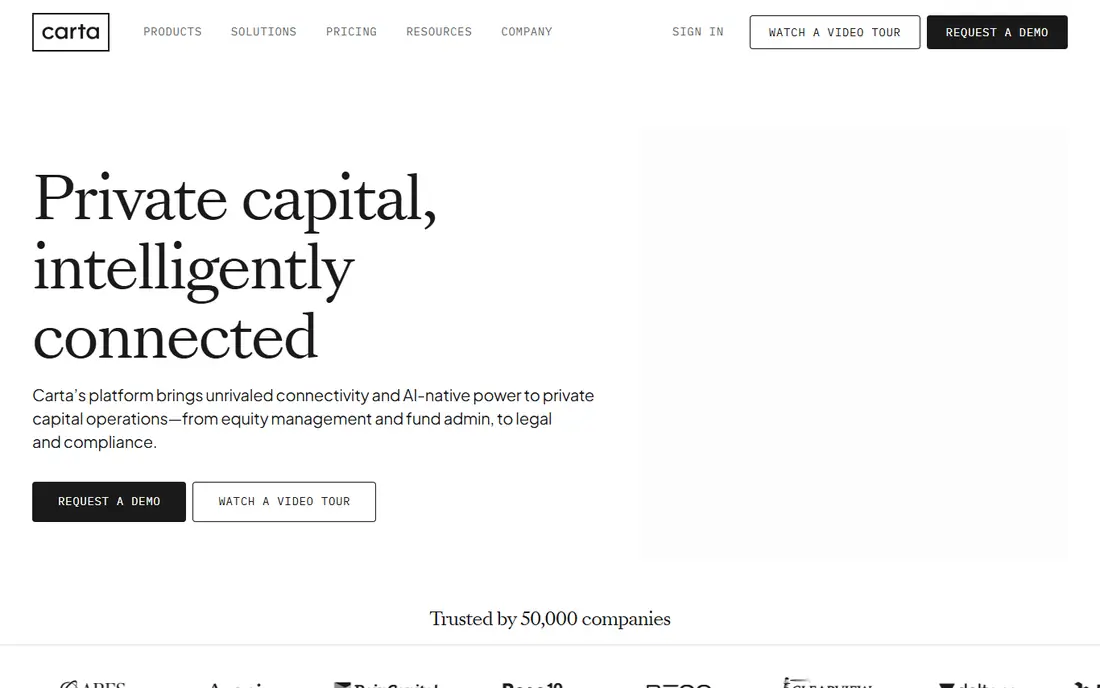
Carta is the standard platform for startup equity management, handling cap tables, option grants, valuations, and investor reporting. For a venture fund, it gives a clear view of portfolio ownership and performance, and its widespread use by startups means data flows more easily than with a niche tool. Limited partner reporting and fund administration features add further value.
Pricing scales with the number of companies and stakeholders, which can add up for large portfolios. Very small funds may find it more than they need at first. For most venture firms, though, Carta is the foundational portfolio platform.
- Leading cap table and equity management
- Portfolio reporting for funds
- Widely used by startups
- Pricing scales with portfolio size
- Complexity for very small funds
Affinity
Ideal for: Investor relationship management

Affinity is a relationship-focused CRM for investors, automatically capturing interactions from email and calendar to build a picture of who knows whom and how deals are progressing. That relationship intelligence helps funds track dealflow, manage introductions, and support portfolio companies with the right contacts. For firms where networks drive value, it is a distinctive tool.
Pricing is quote-based, and the value depends on the whole team using it consistently. For a fund that treats relationships as its core asset, Affinity is a strong choice.
- Relationship intelligence from email and calendar
- Dealflow tracking
- Good for investor networks
- Pricing is quote-based
- Needs adoption by the whole investment team
AngelList
Ideal for: Fund admin and talent
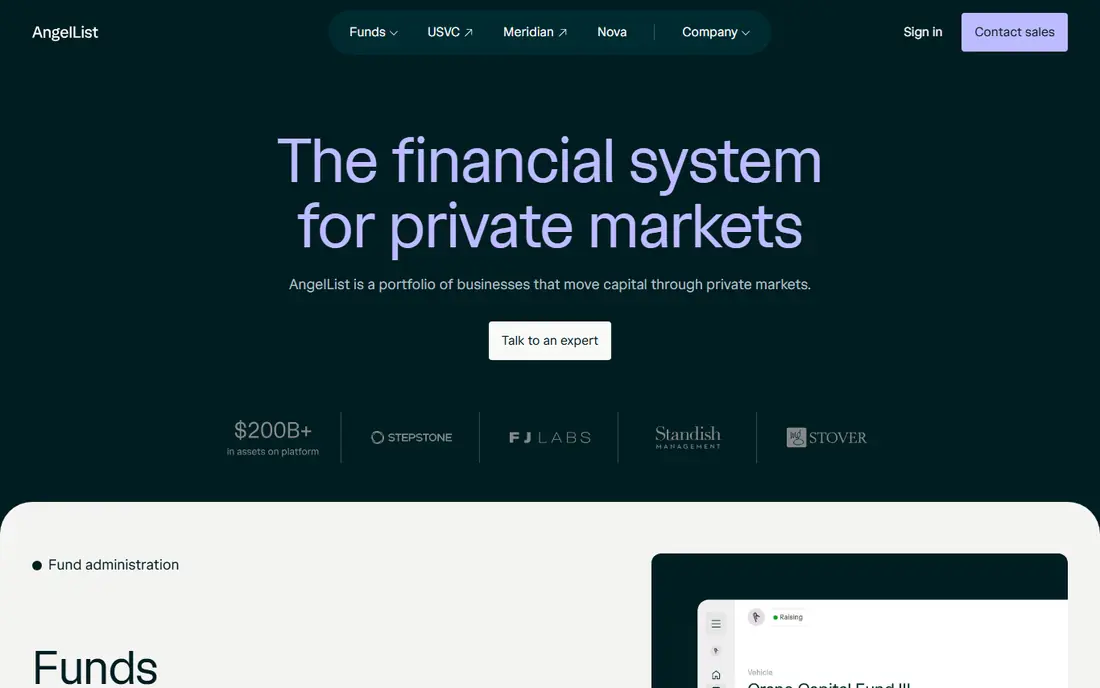
AngelList combines fund administration, including roll-up vehicles and special purpose vehicles, with a talent platform that helps portfolio companies hire. That combination suits emerging managers and smaller funds that want infrastructure plus hiring support without building both in-house. Its startup ecosystem also helps portfolio companies find candidates and investors.
Fees apply to its fund products, and very large traditional funds may prefer established administrators. For emerging managers and their portfolios, AngelList offers a practical all-in-one route.
- Fund administration plus talent platform
- Roll-up vehicles and SPVs
- Startup hiring reach
- Fees apply to fund products
- Less suited to very large traditional funds
Visible
Ideal for: Portfolio reporting
Visible helps funds collect updates from portfolio companies and turn them into clean reports for partners and limited partners. Its founder update tools make it easier for startups to share metrics regularly, and its dashboards give funds a current view of portfolio health. For a fund that struggles to get timely portfolio data, Visible solves a real pain.
It is narrower than a full fund administration platform, and its value depends on founders actually sending updates. Paired with Carta or a fund admin tool, Visible gives funds the reporting layer they often lack.
- Clean portfolio reporting and updates
- Founder update collection
- Investor dashboards
- Narrower than full fund admin
- Needs founder cooperation for best data
Harmonic
Ideal for: Startup data and sourcing
Harmonic provides startup data and AI-assisted sourcing, helping funds discover companies, track portfolio companies, and spot follow-on opportunities. Its database covers many startups with funding, hiring, and growth signals, which supports both new investments and portfolio monitoring. Funds that rely on data-driven sourcing benefit most.
Pricing is quote-based, and data quality varies, especially for very early-stage companies with little public information. For a data-driven fund, Harmonic is a useful sourcing and monitoring layer.
- Broad startup data coverage
- AI-assisted sourcing
- Portfolio monitoring features
- Pricing is quote-based
- Data quality varies by company stage
Allocations
Ideal for: Fund administration
Allocations offers fund and special purpose vehicle administration with streamlined investor onboarding, targeting emerging managers and smaller funds. Its platform handles fund formation, closings, and reporting with less overhead than traditional administrators. For a new manager launching a fund or SPV, that speed matters.
Fees apply, and large institutional funds may prefer traditional administrators with deeper compliance teams. For emerging managers, Allocations is a practical way to launch and run funds professionally.
- Fund and SPV administration
- Streamlined investor onboarding
- Good for emerging managers
- Fees apply
- Less suited to large institutional funds
Foundersuite
Ideal for: Fundraising support
Foundersuite helps founders manage fundraising with a CRM, investor database, and Kanban-style pipeline tracking, which makes it a useful support tool for portfolio companies raising their next round. Funds can recommend it to founders who need structure in a fundraise, and its investor data helps target the right firms. That fundraising focus is its strength.
It is not a full portfolio management platform, so funds still need Carta or a similar tool for equity and reporting. As a fundraising support tool for portfolio founders, Foundersuite is practical and affordable.
- Fundraising CRM and investor database
- Kanban-style deal tracking
- Useful for portfolio founders
- Focused on fundraising, not full portfolio management
- Smaller vendor
PitchBook
Ideal for: Market and portfolio data
PitchBook provides deep private market data on companies, deals, funds, and investors, with tools for benchmarking portfolio performance and researching markets. Its data quality and coverage are among the best in the industry, which is why large funds, banks, and advisors rely on it. For a fund that needs serious market intelligence, PitchBook is the standard.
Pricing is expensive, and its depth exceeds what a small fund needs day to day. For larger funds and for firms where market data drives decisions, PitchBook is worth the investment.
- Deep private market data
- Portfolio benchmarking
- Strong research and news
- Expensive
- Data depth exceeds what small funds need
How we picked these
We compared official product pages, pricing pages, and service descriptions for venture capital tools, focusing on portfolio management, hiring and fundraising support, reporting quality, data coverage, and fit for different fund sizes. We favored tools with real use by venture firms and included both fund platforms and founder-facing support tools.
What to check before you choose
Start with your fund's biggest support gap: equity and reporting, relationships, hiring, or fundraising. A tool that solves a gap you do not have is wasted money, no matter how good it is. Also check how the tool fits your existing stack, since portfolio data scattered across too many tools creates its own problem.
Ask about pricing at your portfolio size, since several tools scale with companies or users. Finally, confirm data privacy and security, since portfolio and limited partner data is sensitive and must be handled carefully.
It also pays to think about total cost, not just the headline price. Many services charge extra for additional users, higher usage, premium support, or features that turn out to be essential once you start using the product seriously. Add those extras to your comparison before deciding, and check whether discounts for annual billing are worth the commitment. A second cost is time: the hours your team spends learning, configuring, and maintaining a tool are real, even when they do not appear on an invoice. A slightly more expensive option that saves ten hours a month is often the cheaper choice in practice. Weigh both kinds of cost together, and pick the option whose full price, in money and time, you are comfortable paying for at least a year.
It is also worth checking recent reviews and community discussion before you commit, since products and services change faster than any single guide can track. Look for patterns rather than single complaints: repeated mentions of billing surprises, poor support, or declining quality are more telling than one angry review. At the same time, remember that every popular service attracts some negative feedback, so weigh the overall picture, including how the company responds to criticism. A vendor that answers problems openly and fixes them promptly is usually a safer bet than one that stays silent. Use that broader picture, together with your trial experience, to make a final decision you can feel good about.
Frequently asked questions
What is venture capital portfolio support?
It is the help a VC firm gives its portfolio companies beyond capital, including hiring, fundraising introductions, operational advice, customer connections, and reporting support, plus the tools that organize that work.
Which tool is most important for a new VC fund?
Carta is usually the first essential tool, since cap tables and equity management matter from the first investment. Affinity or a similar CRM becomes important as dealflow and relationships grow.
How do VC firms track portfolio performance?
They combine equity platforms like Carta, reporting tools like Visible, and market data like PitchBook, plus regular founder updates. No single tool covers every angle, so most funds use a small stack.
Can small funds afford these tools?
Some can, especially with entry plans or trials from Visible and Foundersuite. Larger platforms like Carta and PitchBook scale with portfolio size, so small funds should check pricing carefully and start with the most essential tool.
How does portfolio support help founders?
Good support connects founders to hires, customers, and follow-on investors, and gives them structure for fundraising and reporting. That practical help often matters as much as the capital itself.
How do I avoid picking the wrong option for best venture capital portfolio support services?
Avoid deciding on price or popularity alone, since the cheapest option can cost more in workarounds and the most popular option may be built for a different kind of user. Instead, test your top choices against your real workload, check the total cost including add-ons, and read recent user reviews for complaints that keep repeating. A pattern of complaints about support, billing, or reliability is a warning worth taking seriously before you commit.