6 Best Workforce Management Software for Retail Options for 2026

- Top of the list is Legion, which targets AI scheduling for large chains.
- Pricing for Legion, Deputy, UKG and others is quote-based, which adds a sales step before you can compare cost.
- Homebase stands alone as the one tool in this list with a free plan.
- The main caution on Homebase: advanced features need premium levels.
- WorkJam fits frontline digital workplace.
Direct answer
Our first pick is Legion, best for AI scheduling for large chains. Deputy fits mid-market scheduling and time; Homebase fits small retail teams. Details, prices and limits for the rest of the 6 tools are below.
Quick comparison
| Product | Ideal for | Price from | Free version | |
|---|---|---|---|---|
 Legion | AI scheduling for large chains | See website | No | Visit |
 Deputy | Mid-market scheduling and time | See website | No | Visit |
 Homebase | Small retail teams | Free for up to 10 employees | Yes | Visit |
 UKG | Enterprise retail workforce | See website | No | Visit |
 Schedulefly | Straightforward restaurant scheduling | See website | No | Visit |
 WorkJam | Frontline digital workplace | See website | No | Visit |
Our 6 picks for workforce management software for retail
This Ainotely guide covers 6 options for workforce management software for retail. Each profile lists a starting price, free plan details, strengths and drawbacks, so you can drop poor fits quickly.
Legion
Ideal for: AI scheduling for large chains
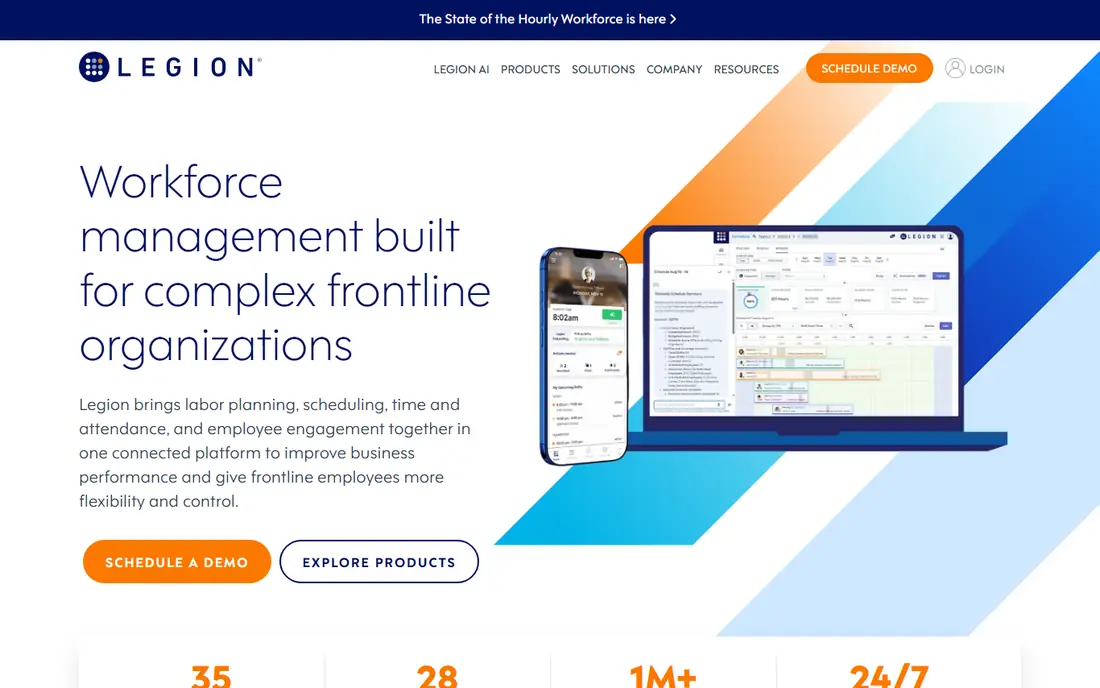
Legion is designed for AI scheduling for large chains. It is priced for chains, not corner keeps.
Legion suits large retailers and restaurant chains modernizing workforce management with AI. Pricing for Legion is not stated here, so ask the vendor for current figures. There is no free plan with Legion.
Points against: Enterprise pricing.
What works well: Solid labor efficiency and retention claims.
- AI-native schedule optimization
- Fast-growing product
- Newer vendor than UKG with a shorter track record
Deputy
Ideal for: Mid-market scheduling and time
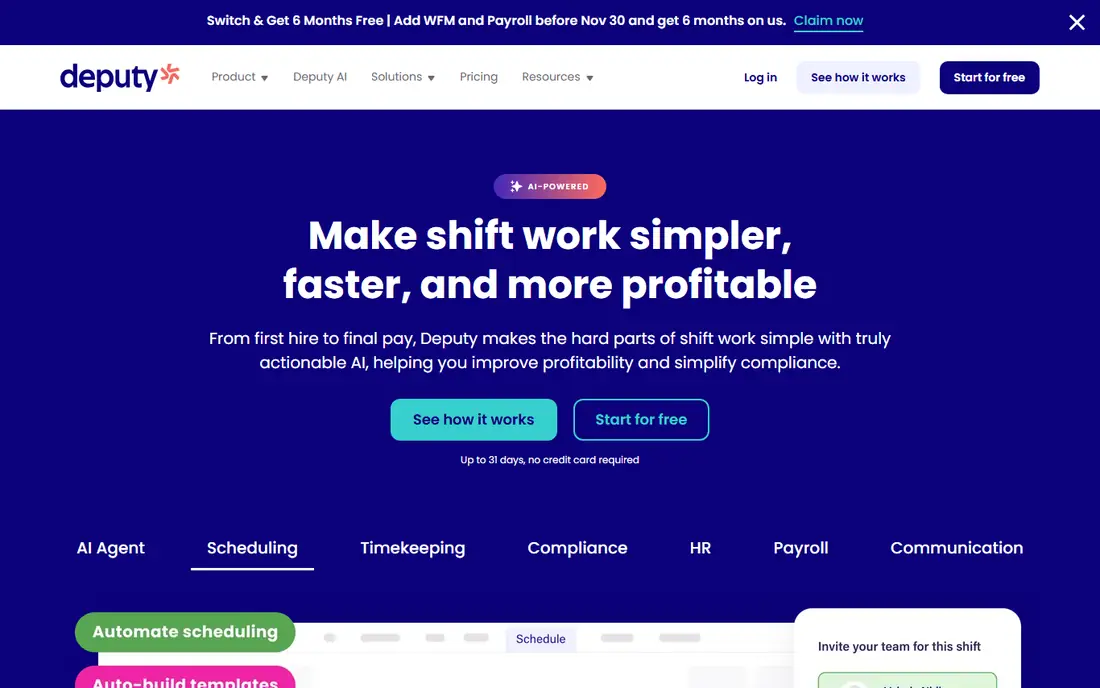
Deputy makes the most sense for mid-market scheduling and time. Deputy includes the full hourly workflow: build schedules in minutes, publish to the team, manage leave, track time and sync timesheets to payroll, with integrations across POS and payroll providers.
Highlights: 300-plus POS and payroll integrations.
On top of that, Deputy suits mid-sized retailers and hospitality companies standardizing scheduling across locations. Pricing for Deputy is not stated here, so ask the vendor for current figures. There is no free plan with Deputy.
Watch-outs: Per-user pricing brings up for large hourly teams.
- Quick schedule creation and publishing
- Solid mobile apps
- No free plan, only a trial
Homebase
Ideal for: Small retail teams
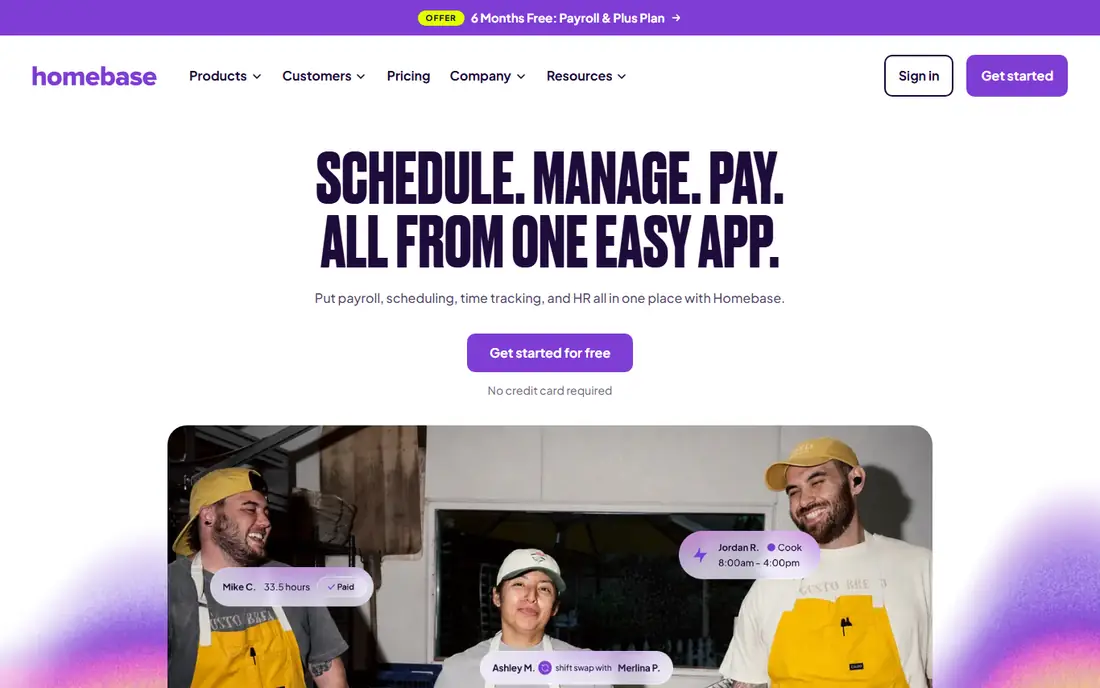
Homebase serves small retail teams. Homebase's free level handles scheduling and time tracking for teams up to 10, and premium plans add hiring, team communication and payroll.
Bigger operations will outgrow it. Homebase cost at the entry level: Free for up to 10 employees. Homebase includes a free tier.
Downsides: Advanced features need premium levels.
Where Homebase stands out: Scheduling; Built-in payroll add-on.
- Time tracking and payroll in one app
- Free Basic plan for up to 10 employees
- Best for smaller teams, not enterprise chains
UKG
Ideal for: Enterprise retail workforce
In short, UKG is for enterprise retail workforce. UKG Workforce Management serves large retailers with centralized scheduling, labor forecasting, compliance automation and analytics across regions and jurisdictions. More specifically, UKG suits large enterprises with complicated scheduling rules and multi-location operations.
Integration with UKG Pro brings together HCM, payroll and WFM. Small firms should look elsewhere. Check the vendor site for UKG pricing; none is listed in this comparison. UKG has no free tier.
Drawbacks to consider: Sales-led procurement. Main advantages: Fair workweek and union rule compliance.
- Deep workforce management for large shift-based workforces
- Demand forecasting
- Enterprise pricing and implementation timelines
Schedulefly
Ideal for: Straightforward restaurant scheduling
Schedulefly targets straightforward restaurant scheduling. Schedulefly does one thing: online employee scheduling that is simple for managers to build and staff to read. Worth adding: Schedulefly suits small restaurants and retailers that want straightforward scheduling without additional modules.
In daily use, the longevity speaks to reliability for its niche. Also, feature depth is minimal by design. This comparison lists no price for Schedulefly; ask the vendor. Schedulefly has no free tier.
What Schedulefly does well: Long track record since 2007; low-cost scheduling.
Watch-outs: No time clock or payroll depth; Entry-level feature set.
- Straightforward
- Simple for managers and staff
- Dated interface
WorkJam
Ideal for: Frontline digital workplace
WorkJam is built with frontline digital workplace in mind. WorkJam is a digital workplace for frontline staff: scheduling alongside shift swaps, task management, company communications and training, in over 50 languages.
It bridges HQ and store teams. This comparison lists no price for WorkJam; ask the vendor. WorkJam does not include a free plan.
Honest limits: Enterprise-oriented pricing.
- Tasks and learning in one app
- Merges scheduling with communication
- Broader than pure scheduling, which layers on complexity
How the list was put together
We compared the tools on published pricing, free plan or trial availability, feature coverage for workforce management software for retail, and the limits each vendor documents. Where a vendor does not publish a price, the entry says quote. Where a price depends on seats or billing term, the entry says so. Tools are placed by general fit for workforce management software for retail, with price clarity and free access as tie-breakers. A different team can reasonably rank them differently.
A buyer's checklist
- Ask Legion, Deputy, UKG and others for a written quote, since no starting price is shown.
- Look at the free plan from Homebase closely: its caps decide whether it is usable for real work.
- Read the limits listed for Legion first: enterprise pricing.
- Run a one or two week pilot of UKG with the people who will use it every day.
- Before you load data into Deputy, check what an export looks like and who can run it.
Frequently asked questions
What is workforce management software for retail?
Software that schedules hourly retail staff, tracks time and attendance, handles shift swaps and time off, forecasts labor demand and helps comply with labor laws.
Which options for workforce management software for retail have a free plan?
Homebase is the only tool in this list with a free plan. Free plans usually cap users, projects or features, so check the limits on the vendor page.
What is AI scheduling?
Algorithms that build schedules from demand forecasts, employee availability and preferences, labor rules and cost targets, replacing manual schedule construction. Legion concentrates on it.
How far in advance should retail schedules be posted?
Earlier is better for retention: workers with predictable schedules stay longer and request fewer changes. If your operation cannot plan two weeks out, that is normally a forecasting problem worth fixing instead of a scheduling constraint to accept.
Is Legion the right pick for everyone comparing workforce management software for retail?
No single tool suits every team. Legion comes first because it fits AI scheduling for large chains, while Deputy suits mid-market scheduling and time and Homebase suits small retail teams. Match the tool to your own size, budget and workflow before deciding.
Can I try these tools before paying?
Often, yes. Homebase has a free plan. Use your own data and a real task during the test, and check what the free tier or trial limits before you rely on it.