Which XDR Platform Fits You? 7 Tools Compared

- 1
 SentinelOne SingularityAutonomous response with ransomware rollbackVisit
- 2
 Cisco XDRCisco security suite customersVisit
- 3
 Microsoft Defender XDRMicrosoft 365 environmentsVisit
- 4
 Sophos Intercept X with XDRSMBs on the Sophos stackVisit
- 5
 CrowdStrike FalconCloud-native XDR with managed choicesVisit
- Number one here is SentinelOne Singularity, a fit for autonomous response with ransomware rollback.
- Before buying Microsoft Defender XDR, weigh this: best value needs Microsoft 365 E5 at $57/user/month.
- Neither SentinelOne Singularity nor Cynet, nor any of the other 5 tools, has a permanent free plan; trials and quotes are the norm.
- Starting prices begin at $5.20/device/month with Microsoft Defender XDR.
- Cynet suits lean teams wanting XDR plus MDR.
Direct answer
SentinelOne Singularity comes first here, mainly for autonomous response with ransomware rollback. For a different need, Cisco XDR covers Cisco security suite customers and Microsoft Defender XDR covers Microsoft 365 environments. The other 4 tools in the list cover narrower or pricier cases.
Quick comparison
| Product | Ideal for | Price from | Free version | |
|---|---|---|---|---|
| SentinelOne Singularity | Autonomous response with ransomware rollback | $69.99/endpoint/year | No | Visit |
| Cisco XDR | Cisco security suite customers | See website | Free trial (30 days) | Visit |
| Microsoft Defender XDR | Microsoft 365 environments | $5.20/device/month | Free trial (30 days) | Visit |
| Sophos Intercept X with XDR | SMBs on the Sophos stack | See website | Free trial (30 days) | Visit |
| CrowdStrike Falcon | Cloud-native XDR with managed choices | $59.99/device/year (billed annually) | Free trial (15 days) | Visit |
 Trellix XDR | Enterprises consolidating Trellix tools | See website | No | Visit |
 Cynet | Lean teams wanting XDR plus MDR | See website | Free trial | Visit |
The 7 tools in detail
If you are comparing XDR platform, this page covers 7 tools in one place: what each is best for, what it costs to start, whether it has a free plan, and the main limit to know about.
SentinelOne Singularity
Ideal for: Autonomous response with ransomware rollback
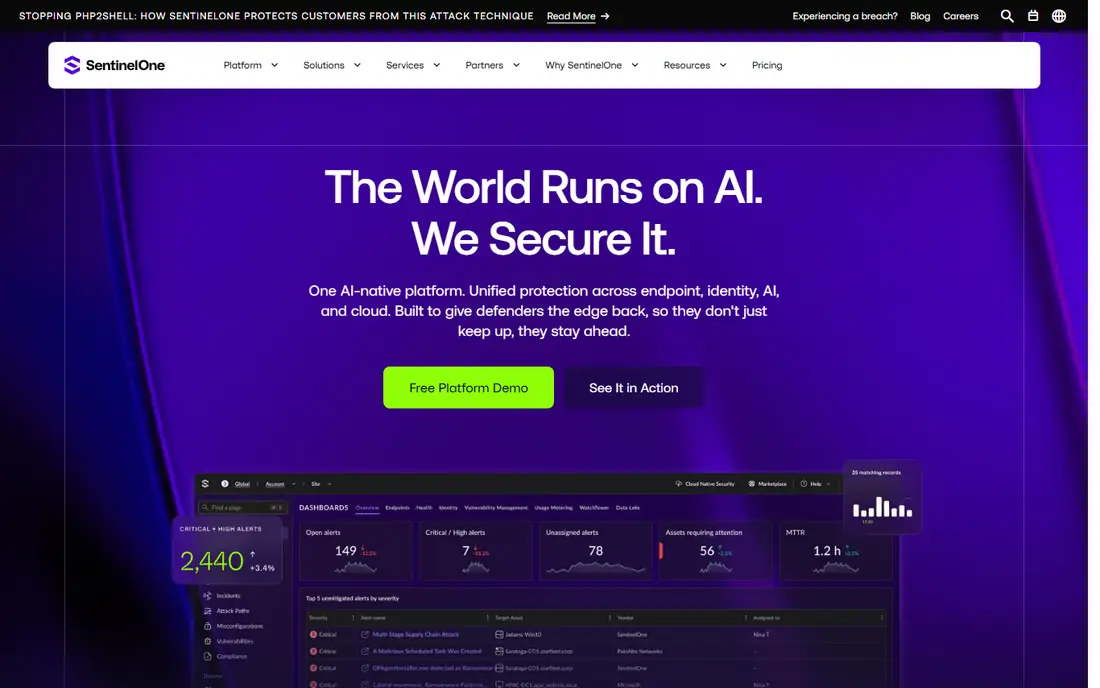
SentinelOne Singularity works best for autonomous response with ransomware rollback. SentinelOne's differentiator is autonomy. For organizations with remote endpoints on unreliable connections, that architecture is a real advantage over cloud-dependent rivals.
In daily use, note the trap: SentinelOne's own MDR is only available on Commercial and Enterprise, so buyers who want managed detection pay the step up from Complete. From a buyer's view, no free trial is published, so negotiate a proof of concept instead. The pricing page lists four of five levels: Core $69.99, Control $79.99, Complete $179.99, and Commercial $229.99 per endpoint a year, with Enterprise quoted. On cost, SentinelOne Singularity starts like this: $69.99/endpoint/year. No free plan comes with SentinelOne Singularity.
Where it is weaker: MDR requires the Commercial level at $229.99; a jump from Complete.
- Published level pricing from $69.99/endpoint/year
- One-click ransomware rollback without restoring from backup
- Partner-quoted pricing beyond small deployments
Cisco XDR
Ideal for: Cisco security suite customers
Cisco XDR makes the most sense for Cisco security suite customers. Cisco XDR's advantage is the network. A 30-day trial with full system access lets you validate the correlation before committing.
In daily use, the product story has matured substantially as Cisco consolidated its security portfolio. Beyond that, like Palo Alto's Cortex, this is a product whose value concentrates inside its own ecosystem. This comparison lists no price for Cisco XDR; ask the vendor. Free access: Free trial (30 days).
Upsides: external integrations. Points against: External integration story is decent but not best in class.
- Endpoint data
- Brings together network telemetry
- Most solid inside the Cisco security suite
Microsoft Defender XDR
Ideal for: Microsoft 365 environments
Microsoft Defender XDR is built with Microsoft 365 environments in mind. If your company runs on Microsoft 365, start here before you look anywhere else. Numerous organizations already own most of it inside Microsoft 365 E5 without realizing it.
A 30-day free trial lets you validate it. The pricing paths are published: Microsoft 365 E5 at $57 per user a month contains the full Defender stack, the E3 plus Security add-on route runs about $22 per user, and Defender for Endpoint Plan 2 standalone is $5.20 per device a month. Microsoft Defender XDR cost at the entry level: $5.20/device/month. Free plan details: Free trial (30 days).
Points against: Weaker outside the Microsoft ecosystem.
- Cheapest credible XDR for Microsoft shops
- Defender for Endpoint P2 standalone at $5.20/device/month
- Best value needs Microsoft 365 E5 at $57/user/month
Sophos Intercept X with XDR
Ideal for: SMBs on the Sophos stack
Pick Sophos Intercept X with XDR if this describes you: SMBs on the Sophos stack. If you are standardized on Sophos, the XDR add-on is a simple yes. In daily use, Intercept X Advanced with XDR layers on extended detection and response with 90-day telemetry retention, and Synchronized Security means the firewall and endpoint share intelligence in live: an infected endpoint gets isolated automatically.
Honest limits: No published pricing, quote only.
This is not the product for a sophisticated SOC doing advanced threat hunting. It is the product for a three-person IT team that needs solid protection without a dedicated security hire. A 30-day free trial handles the full endpoint product. In practice, Sophos is the pragmatic pick for small and mid-sized companies that already run Sophos firewalls or endpoint protection. No starting price is listed for Sophos Intercept X with XDR here; confirm pricing on the vendor site. Free access: Free trial (30 days).
- Solid anti-ransomware with CryptoGuard rollback
- Manageable for lean IT teams
- Best value needs the broader Sophos estate
CrowdStrike Falcon
Ideal for: Cloud-native XDR with managed choices
CrowdStrike Falcon is aimed squarely at cloud-native XDR with managed choices. CrowdStrike built the modern EDR market and its XDR extends the same cloud-native architecture across identity, cloud, and external telemetry through the Threat Graph. Also, pricing is published, which deserves credit: Go at $59.99 per device a year, Pro at $99.99, Enterprise at $184.99, all billed yearly, with monthly choices at higher rates.
Downsides: 15-day trial handles antivirus; not the full product.
A 15-day free trial handles the basics. The agent is famously light, the threat intelligence is genuinely best in class, and Falcon Complete provides you a managed SOC without building one. Entry price for CrowdStrike Falcon: $59.99/device/year. On free options: Free trial (15 days).
- Rare in this category
- Light cloud-native agent with solid threat intelligence
- Full XDR value needs the Enterprise level at $184.99/device/year
Trellix XDR
Ideal for: Enterprises consolidating Trellix tools
Trellix XDR was built for enterprises consolidating Trellix tools. Trellix XDR exists since McAfee Enterprise and FireEye merged. Its value proposition is consolidation: one XDR across the combined portfolio for enterprises already invested in those tools.
As a fresh evaluation against CrowdStrike or SentinelOne, it is a harder sell. This is a system you arrive at through existing investment, not one you generally choose on capabilities alone. More specifically, if your estate runs Trellix endpoint, email, and network products, the XDR layer ties them together with a single console and correlated detection. Trellix XDR shows no starting price here, so confirm the cost on the vendor site. Trellix XDR does not include a free plan.
Watch-outs: Primarily a consolidation play rather than a best-of-breed pick.
- Brings together the former McAfee Enterprise and FireEye portfolios
- Capable for organizations standardizing on Trellix
- Migration complexity for mixed estates
Cynet
Ideal for: Lean teams wanting XDR plus MDR
Cynet is a good fit for lean teams wanting XDR plus MDR. Deployment is famously quick, with the company claiming thousands of endpoints in under two hours. As for the details, a free trial is available.
Strengths: Deploys across thousands of endpoints in hours.
The tradeoffs are vendor size and ecosystem: fewer external integrations and less reporting depth than the enterprise systems. For a 50 to 500 person company without security staff, that tradeoff typically favors Cynet. Cynet shows no starting price here, so confirm the cost on the vendor site. Trial and free access: Free trial.
Honest limits: No published pricing, quote only.
- Designed for teams without dedicated analysts
- 24/7 MDR in one system and one price
- Smaller vendor with a narrower integration ecosystem
How the list was put together
We compared the tools on published pricing, free plan or trial availability, feature coverage for XDR platform, and the limits each vendor documents. Seat minimums, billing terms and add-ons can move the real cost, so the starting prices here are a guide and not a quote. The sequence is a judgement call: typical use case first, then pricing transparency, then free access. Use the profiles to check fit.
What to check before you buy
- Confirm the entry price on the vendor page. For Cisco XDR, Sophos Intercept X with XDR, Trellix XDR and Cynet that means a quote rather than a fixed price.
- Use real work to test the free trial from Cisco XDR, Microsoft Defender XDR, Sophos Intercept X with XDR and others, rather than a demo project.
- Read the limits listed for SentinelOne Singularity first: no free trial listed.
- Read the plan comparison for Trellix XDR carefully; key features often start on a higher tier.
- Ask whether CrowdStrike Falcon integrates with your current software, and whether that comes standard or as an add-on.
Frequently asked questions
How much does XDR cost per endpoint?
Published prices range from $5.20 per device a month (Microsoft Defender for Endpoint P2) to $59.99 to $69.99 per endpoint a year (CrowdStrike Go, SentinelOne Core), with full XDR levels running $180 to $230 per endpoint a year. Always model servers, retention, and MDR extras, not just the headline endpoint rate.
Do I need XDR if I already have Microsoft 365 E5?
Microsoft 365 E5 bundles the full Defender XDR stack: endpoint, identity, email, and cloud app protection with correlated incidents. Audit what you have before buying anything; the best XDR product is at times the one already in your licensing.
Does any tool for XDR platform here have a free plan?
No tool in this list, SentinelOne Singularity and Cynet included, has a permanent free plan. Cisco XDR, Microsoft Defender XDR, Sophos Intercept X with XDR, CrowdStrike Falcon, Cynet offer a trial. Trials and quotes are the usual route, so plan a short evaluation period.
Is SentinelOne Singularity the right pick for everyone comparing XDR platform?
No single tool suits every team. SentinelOne Singularity comes first because it fits autonomous response with ransomware rollback, while Cisco XDR suits Cisco security suite customers and Microsoft Defender XDR suits Microsoft 365 environments. Match the tool to your own size, budget and workflow before deciding.
What is MDR and do I need it with XDR?
MDR (managed detection and response) is a human-staffed SOC that watches your XDR alerts 24/7, investigates, and responds. If you have no dedicated security analysts, yes, you need it; otherwise alerts pile up unanswered. On top of that, Cynet bundles it, CrowdStrike and SentinelOne sell it as an add-on, and Microsoft gives you Defender Experts. Price it with the system from the start.
What is the cheapest option for XDR platform in this list?
On published monthly entry prices, Microsoft Defender XDR is the lowest here at $5.20/device/month. Entry price is only part of the cost, because seats, add-ons and billing terms can change the total.