8 Best Zero Trust Microsegmentation Platforms

- 1
 Illumio SegmentationWorkload segmentation without network changesVisit
- 2
 Akamai Guardicore SegmentationAgent-based segmentation across data centersVisit
- 3
 Zscaler Workload SegmentationCloud workload segmentationVisit
- 4
 VMware NSXVMware shops with VCFVisit
- 5
 Cisco Secure WorkloadData center segmentation with deep telemetryVisit
- Every vendor in this list hides its price, so all 8 tools are quote only and you must talk to sales to build a budget.
- Illumio Segmentation, Akamai Guardicore and ColorTokens Xshield are the most focused products here, while the rest bundle segmentation inside a wider platform.
- Zscaler, Palo Alto Networks and Cisco tie segmentation to their own cloud or network stack, so fit depends on what you already run.
- VMware NSX is now sold inside VMware Cloud Foundation, and its advanced security is a vDefend attach priced per host core.
- Only Palo Alto Networks shows a vendor trial, 30 days for Prisma Cloud, and Illumio offers a 14-day trial for Insights only, not for Segmentation.
Quick comparison
| Product | Ideal for | Price from | Free version | |
|---|---|---|---|---|
| Illumio Segmentation | Workload segmentation without network changes | quote only | No | Visit |
| Akamai Guardicore Segmentation | Agent-based segmentation across data centers | quote only | No | Visit |
| Zscaler Workload Segmentation | Cloud workload segmentation | quote only | No | Visit |
| VMware NSX | VMware shops with VCF | quote only | No | Visit |
| Cisco Secure Workload | Data center segmentation with deep telemetry | quote only | No | Visit |
 ColorTokens Xshield | Fast rollout with EDR integration | quote only | No | Visit |
 Palo Alto Networks Prisma Cloud | Cloud-native microsegmentation | quote only | Free trial (30 days) | Visit |
 Fortinet FortiGate | Network firewall based segmentation | quote only | No | Visit |
The best zero trust microsegmentation platforms
Illumio Segmentation
Ideal for: Workload segmentation without network changes

Illumio Segmentation, formerly sold as Illumio Core, is the most focused microsegmentation product in this list. It labels every workload by what it is, such as a web server or a database, and writes policy from those labels instead of from IP addresses, so rules keep working when addresses change. The agent sits on the workload and enforces policy at the host, which means you can segment a flat network without re-architecting VLANs or firewall zones. Visibility maps show which workloads talk to each other before you enforce anything, so you can test policy in a safe mode first.
The limits matter for container teams. In Kubernetes and OpenShift, only Pods can be segmented, not individual containers inside a Pod, according to Illumio Core docs. There is no published price, so budgeting needs a sales conversation, and the only vendor trial is a 14-day trial for Illumio Insights, a sandbox with demo data, not for Segmentation itself. The product page loaded on 12 Nov 2026 and showed Illumio Segmentation branding.
- Labels workloads by role and environment instead of IP addresses
- Policy is independent of network topology
- In Kubernetes and OpenShift only Pods can be segmented, not individual containers inside a Pod
- No published price list
Akamai Guardicore Segmentation
Ideal for: Agent-based segmentation across data centers
Akamai Guardicore Segmentation enforces policy with a lightweight agent on each workload, and it works the same way in a data center, a public cloud or a hybrid setup. The agent watches process-level activity, so policy can name the application and the process, not just the port. The console shows a live map of traffic between workloads, and you can move from visibility to enforcement one application at a time, which lowers the risk of breaking a live service on day one.
The main limit is on Linux. Guardicore agents support L4 visibility only on Linux systems, while Windows gets fuller visibility, according to an Akamai comparison guide. There is no published price and no free plan or trial on the vendor page, only a demo request, so you must talk to sales to get any figure. The vendor product page loaded on 12 Nov 2026 and showed Akamai Guardicore branding.
- Agent enforces policy on the workload in any cloud or data center
- Strong visibility into east-west traffic
- For Linux systems, Guardicore agents support L4 visibility only, unlike fuller visibility on Windows
- No free plan or trial
Zscaler Workload Segmentation
Ideal for: Cloud workload segmentation
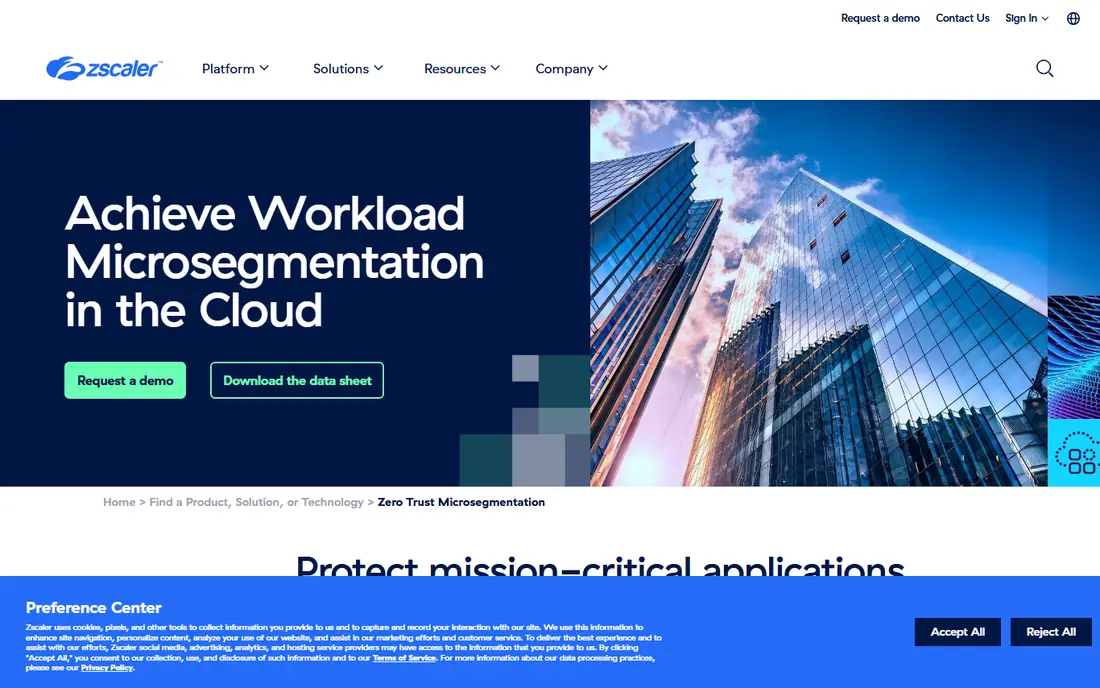
Zscaler Workload Segmentation, now presented under Zero Trust Cloud and Zero Trust for Workloads, brings identity-based policy to cloud workloads. Instead of trusting a network address, it checks the identity of the workload and the user before it allows a connection, which fits the zero trust model of never trusting a request by default. It runs across cloud environments and connects to the wider Zscaler Zero Trust Exchange, so teams already on Zscaler can add workload segmentation to the platform they know.
The trade-off is platform lock-in. Segmentation is host-based, so it needs a Zscaler agent or Cloud Connector on the workload, and it sits inside the wider Zscaler platform rather than working as a standalone point product. There is no dollar price for Workload Segmentation on the vendor pricing page, which lists platform bundles and modules without prices, and no free plan or trial length was found on the vendor pages checked. Both the product page and the pricing page were opened on 12 Nov 2026.
- Identity-based policy for cloud workloads
- Ties into the wider Zscaler Zero Trust Exchange
- Host-based segmentation needs a Zscaler agent or Cloud Connector on the workload
- No standalone point product
VMware NSX
Ideal for: VMware shops with VCF
VMware NSX puts a distributed firewall into the hypervisor, so policy attaches to the virtual machine and follows it when it moves between hosts. That makes segmentation part of the platform itself rather than a box on the network edge. NSX is now presented as the networking layer inside VMware Cloud Foundation, and the editions page lists what each edition includes, from basic networking up to advanced security features. For teams already standardized on VMware, NSX is the natural way to segment without adding a separate product.
The cost model is the hard part. Broadcom publishes no NSX rate card. NSX networking comes with VMware Cloud Foundation, and advanced security is a vDefend attach priced per host core, with a 16-core minimum per CPU, so dense hosts pay for all cores even with a small firewall policy. There is no free plan or trial, and no standalone NSX marketing homepage exists under Broadcom, so the Broadcom techdocs editions page is the verified vendor page, opened on 12 Nov 2026.
- Distributed firewall built into the VMware stack
- Policy follows the virtual machine wherever it moves
- Tied to the VMware and Broadcom stack, with vDefend priced per physical host core and a 16-core minimum per CPU
- No standalone pricing page
Cisco Secure Workload
Ideal for: Data center segmentation with deep telemetry
Cisco Secure Workload, formerly Tetration, watches every workload in the data center and builds policy from what it actually sees. It collects telemetry on processes, ports and traffic, then suggests rules that match real behavior, which cuts the guesswork out of writing segmentation policy by hand. It supports both cloud and on-premises deployment, and it ties into the wider Cisco security portfolio, so teams already on Cisco can feed workload data into the same dashboards they use for the rest of the network.
The on-premises route has a hardware cost. It requires a hardware appliance in a small or large form factor, and older M5 and M6 appliances have end-of-sale announcements, so buyers face a hardware refresh and appliance sizing exercise. Pricing is per workload equivalent with a flexible model described on the vendor page, but no dollar figure is published, and there is no free version or trial. The vendor product page loaded on 12 Nov 2026 and showed Cisco Secure Workload branding.
- Deep telemetry from every workload with behavior-based policy suggestions
- Strong on-premises deployment option
- On-premises deployment requires a hardware appliance, and older M5 and M6 appliances have end-of-sale announcements
- No free version or trial
ColorTokens Xshield
Ideal for: Fast rollout with EDR integration
ColorTokens Xshield is built for a fast rollout. It enforces policy with an agent on each workload, and it can reuse an existing EDR sensor instead of adding another agent, which shortens the deployment and keeps the agent count down. The console maps traffic, suggests policy and enforces it in one place, and the vendor positions it as a platform that a small team can run without a large professional services engagement. For teams that need segmentation live in weeks rather than quarters, that speed is the main selling point.
The limit is coverage of assets that cannot run an agent. Xshield is administered from a SaaS console and full enforcement is agent-based, so agentless coverage depends on integrations or an appliance for OT and legacy assets, according to the Xshield data sheet. There is no published price on the vendor product page, only a demo request, and no free plan or trial. Marketplace figures such as $360 per server for 12 months are not vendor prices and were not used here. The vendor product page loaded on 12 Nov 2026.
- Agent-based enforcement with fast time to value
- Can reuse an existing EDR sensor instead of adding another agent
- Administered from a SaaS console and full enforcement is agent-based, so agentless coverage depends on integrations or an appliance for OT and legacy assets
- No free plan or trial
Palo Alto Networks Prisma Cloud
Ideal for: Cloud-native microsegmentation
Palo Alto Networks offers identity-based microsegmentation inside Prisma Cloud, which is now being rebranded as Cortex Cloud. Policy is based on the identity of the workload, so it works for containers and hosts in cloud environments where IP addresses change constantly. It sits alongside cloud security posture, workload protection and runtime defense in the same platform, so a team that already uses Prisma Cloud can add segmentation without a new console or a new agent.
The catch is that microsegmentation is only one module inside a wide cloud-native application protection platform, not a standalone product, and it operates at container and host level. Prisma Cloud is licensed in credits consumed per module and resource, with the price set by quote, so buyers pay for the full platform and credit model. Reseller figures such as about $9,000 per 100 credits per year are not vendor prices and were not used here. The vendor offers a 30-day trial for Prisma Cloud, the only vendor trial in this list. The network protection page and the Prisma Cloud page were opened on 12 Nov 2026.
- Identity-based microsegmentation for containers and hosts
- 30-day trial for Prisma Cloud
- Microsegmentation is only one module inside the wider Prisma Cloud and Cortex Cloud platform, so you pay for the full platform and credit model
- No dollar price published
Fortinet FortiGate
Ideal for: Network firewall based segmentation
Fortinet treats microsegmentation as a capability of the FortiGate next-generation firewall rather than a separate product. If you already run FortiGate firewalls, you can segment with FortiOS policy, internal segmentation firewall rules and FortiGuard threat feeds, without putting an agent on every workload. That makes it the cheapest route for teams that already own Fortinet hardware, since the segmentation is a feature of a box that is already in the rack.
The setup has real dependencies. The documented L2 microsegmentation setup with proxy ARP, FortiGate, FortiSwitch and vCenter requires VMware vCenter Enterprise Plus for the virtual distributed switch, plus specific FortiOS versions, so it is not a standalone, hypervisor-free option. Fortinet publishes no single starting price, since the price varies by FortiGate model and FortiGuard and FortiCare bundle and is quoted via partners, and there is no free plan or trial. The Fortinet glossary page loaded on 12 Nov 2026 and names the FortiGate NGFW as the product for microsegmentation.
- Uses the FortiGate NGFW you may already own, with FortiOS policy and FortiGuard threat feeds
- No extra agent on workloads
- The documented L2 microsegmentation setup needs VMware vCenter Enterprise Plus for the virtual distributed switch, plus specific FortiOS versions
- No standalone microsegmentation product
How we chose
We compared vendor product pages, pricing pages and docs for each platform, and we checked the price and trial status on the vendor site on 12 Nov 2026. Every vendor in this set hides its price, so all 8 tools are quote only, and we did not use marketplace or reseller figures as list prices. We looked at whether segmentation is a standalone product or a module, whether it needs an agent or runs on a firewall, and which environments it covers. We did not run hands-on tests, and we did not count review scores or user counts.
| Your environment | First pick | Why | Watch out | | Data center, mixed OS | Akamai Guardicore | One agent, any cloud or data center | Linux visibility is L4 only | | Data center, Cisco shop | Cisco Secure Workload | Telemetry-based policy | Needs a hardware appliance | | VMware estate | VMware NSX | Firewall in the hypervisor | vDefend priced per host core | | Cloud workloads, Zscaler shop | Zscaler Workload Segmentation | Identity-based cloud policy | Needs a Zscaler agent | | Cloud-native, Prisma Cloud shop | Palo Alto Networks Prisma Cloud | Container and host segmentation | Full platform and credit model | | Fast rollout, small team | ColorTokens Xshield | Reuses EDR sensor | Agentless OT coverage needs an appliance | | No network changes wanted | Illumio Segmentation | Label-based policy, no VLAN work | Containers limited to Pod level | | Already own FortiGate | Fortinet FortiGate | Segmentation from existing firewalls | Needs vCenter Enterprise Plus for L2 |
What to check before you buy
Check whether the tool is a standalone product or a module. Illumio Segmentation, Akamai Guardicore and ColorTokens Xshield are focused segmentation products, while Zscaler, Palo Alto Networks, Cisco, VMware and Fortinet bundle segmentation inside a wider platform. A module can be the right call when you already run that platform, but it can also mean paying for a full platform when you only need one feature.
Check the agent and platform requirements. Illumio, Guardicore, Zscaler and Xshield need an agent on the workload, while FortiGate works from the firewall and NSX works from the hypervisor. Ask whether your workloads can run an agent at all, since OT and legacy assets often cannot, and check the container limits: Illumio segments Pods, not containers inside a Pod.
Check the pricing model before you sign. All 8 vendors are quote only, so get a written quote that states the unit, such as per workload, per host core or per credit, and the minimums, such as the 16-core minimum per CPU for vDefend or the workload equivalent model at Cisco. Ask whether the quote covers enforcement, visibility and support, or whether some of those are separate line items.
Check the trial and demo route. Only Palo Alto Networks shows a vendor trial, 30 days for Prisma Cloud, and Illumio offers a 14-day trial for Insights only. The other six offer a demo or a scoping call, so plan for a guided proof of concept rather than a self-serve trial.
Frequently asked questions
What is zero trust microsegmentation?
Zero trust microsegmentation splits a network into small zones and checks every connection against policy, even inside the data center or cloud. Nothing is trusted by default because of its network location. Policy is based on workload identity, labels or application names, so rules keep working when IP addresses change.
How much does microsegmentation cost?
No vendor in this list publishes a price, so all 8 tools are quote only. Expect a sales conversation and a quote based on workload count, host cores or credits, depending on the vendor. Ask for the unit price and the minimums in writing, since models such as per-core vDefend licensing can change the total a lot.
Do I need an agent on every workload?
It depends on the tool. Illumio, Guardicore, Zscaler and Xshield enforce policy with an agent on the workload. NSX enforces in the hypervisor, and FortiGate enforces at the firewall, so neither needs a workload agent. OT and legacy assets that cannot run an agent need an appliance or integration instead.
Which microsegmentation platform is best for cloud workloads?
Zscaler Workload Segmentation and Palo Alto Networks Prisma Cloud are the strongest cloud picks here, since both use identity-based policy for cloud workloads. Zscaler fits teams already on the Zero Trust Exchange, while Palo Alto Networks fits teams already on Prisma Cloud or Cortex Cloud. Both are quote only and both need their own platform.
Can I try microsegmentation before I buy?
Only Palo Alto Networks shows a vendor trial, 30 days for Prisma Cloud. Illumio offers a 14-day trial for Insights, a sandbox with demo data, but not for Segmentation itself. The other six vendors offer a demo or a scoping call, so ask for a guided proof of concept on your own workloads before you commit.
Sources
- https://www.illumio.com/illumio-segmentation
- https://www.akamai.com/products/akamai-guardicore-segmentation
- https://www.zscaler.com/products-and-solutions/microsegmentation
- https://techdocs.broadcom.com/us/en/vmware-cis/nsx/vmware-nsx/4-0/feature-and-edition-guide/nsx-editions.html
- https://www.cisco.com/site/us/en/products/security/secure-workload/index.html
- https://colortokens.com/products/xshield-microsegmentation-platform/
- https://www.paloaltonetworks.com/static/content/pan/en_US/prisma/cloud/network-protection.html
- https://www.fortinet.com/resources/cyberglossary/microsegmentation