Best Blackbaud Alternatives in 2026: 8 Nonprofit Tools Compared

- 1
 Salesforce Nonprofit CloudLarge nonprofit platformsVisit
- 2
 BloomerangDonor retentionVisit
- 3
 DonorPerfectSmall and mid-size fundraisingVisit
- 4
 Neon OneAll-in-one nonprofit suiteVisit
- 5
 Little Green LightLow-cost donor trackingVisit
- Salesforce Nonprofit Cloud suits large nonprofits that want a full platform with deep customization.
- Bloomerang and DonorPerfect are the friendliest picks for small and mid-size fundraising teams.
- Neon One bundles fundraising, events, and memberships for organizations that want one system.
- Little Green Light and DonorSnap offer strong donor tracking at lower prices.
- Aplos fits nonprofits that also need fund accounting, while Virtuous focuses on donor relationships.
Quick comparison
| Product | Ideal for | Price from | Free version | |
|---|---|---|---|---|
| Salesforce Nonprofit Cloud | Large nonprofit platforms | See website | Free trial | Visit |
| Bloomerang | Donor retention | See website | Free trial | Visit |
| DonorPerfect | Small and mid-size fundraising | See website | Free trial | Visit |
| Neon One | All-in-one nonprofit suite | See website | Free trial | Visit |
| Little Green Light | Low-cost donor tracking | See website | Free trial | Visit |
 DonorSnap | Simple affordable CRM | See website | Free trial | Visit |
 Aplos | Fund accounting plus donors | See website | Free trial | Visit |
 Virtuous | Relationship-focused fundraising | See website | Free trial | Visit |
The best Blackbaud alternatives
Blackbaud has served nonprofits for decades, but its cost, complexity, and contract terms push many organizations to look elsewhere. The tools below cover the same core jobs, which are tracking donors, running fundraising campaigns, and reporting results, at a range of prices and sizes. The right pick depends on your budget, your team size, and how much accounting you need in the same system.
Salesforce Nonprofit Cloud
Ideal for: Large nonprofit platforms
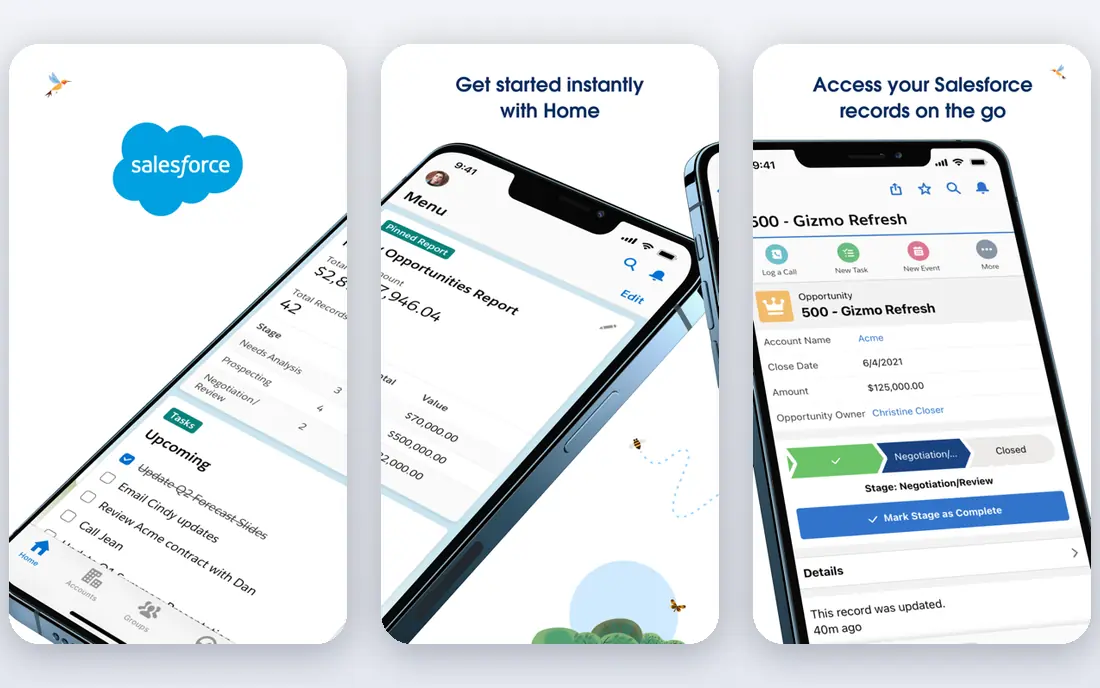
Salesforce Nonprofit Cloud is the most capable platform here, and also the most involved to set up. It tracks donors, gifts, programs, grants, and volunteers in one system, and its reporting can answer detailed questions about fundraising performance. Because so many consultants know Salesforce, help is easy to find.
The trade-off is effort. Nonprofit Cloud is not a tool you set up in an afternoon, and smaller teams may find it more than they need. For large nonprofits with complex programs and a budget for implementation, it is the most powerful option on this list.
- Very flexible with a huge integration library
- Strong reporting and program tracking
- Widely supported by consultants
- Needs setup help and training
- Total cost rises with add-ons and seats
Bloomerang
Ideal for: Donor retention
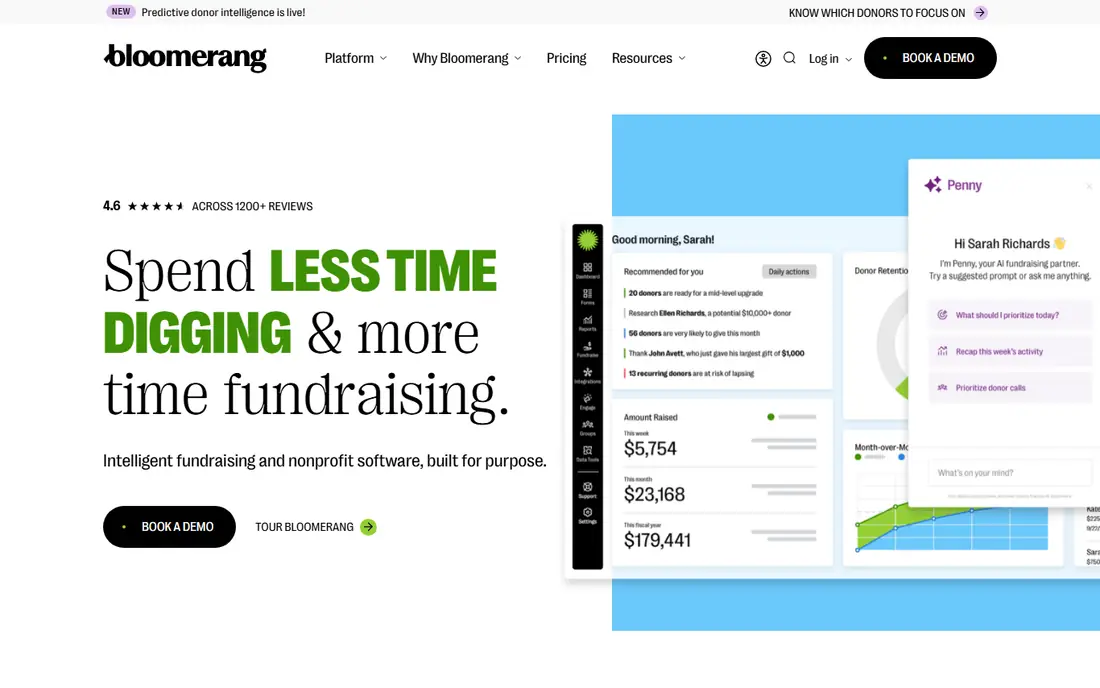
Bloomerang focuses on the donor relationship. Each donor gets a timeline of gifts, emails, and interactions, plus an engagement score that flags who is drifting away. That focus helps small and mid-size teams improve retention, which is often cheaper than finding new donors.
Bloomerang is less suited to organizations that need deep program or grant tracking, and it does not replace accounting software. For fundraising teams whose main job is keeping donors close, Bloomerang is our pick for most small and mid-size nonprofits.
- Clear donor timelines and engagement scoring
- Easy email and reporting
- Built for retention
- Less depth for large program management
- Accounting needs a separate tool
DonorPerfect
Ideal for: Small and mid-size fundraising
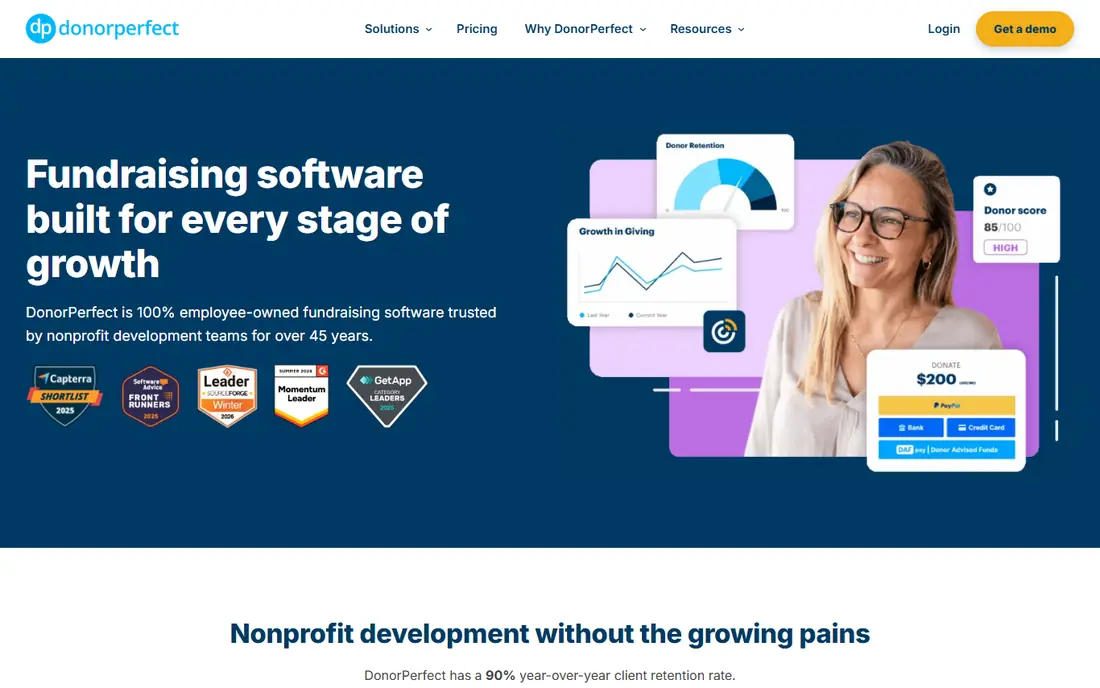
DonorPerfect has been around for years and covers the fundraising basics well: gift entry, pledge tracking, receipts, mailings, and reports. Its support team is known for helping nonprofit staff, which matters for teams without a dedicated database manager.
The interface is more traditional than Bloomerang or Neon One, and some advanced features sit on higher plans. If you want a proven, dependable fundraising system with good human support, DonorPerfect is a safe choice.
- Long track record with nonprofits
- Strong gift processing and receipts
- Good training and support
- Interface feels older than newer rivals
- Some features cost extra
Neon One
Ideal for: All-in-one nonprofit suite
Neon One bundles several nonprofit jobs into one platform. You can run donation forms, ticketed events, memberships, and peer-to-peer campaigns, and see the results in shared reports. That breadth suits organizations that would otherwise juggle three or four separate tools.
Pricing depends on which modules you choose, so get a full quote before deciding, and plan setup time if you adopt the whole suite at once. For nonprofits that want one system for most of their public-facing work, Neon One is a strong option.
- Fundraising, events, memberships, and forms in one system
- Good reporting
- Flexible modules
- Pricing varies by module, so quotes need care
- Setup takes time for the full suite
Little Green Light
Ideal for: Low-cost donor tracking
Little Green Light is a favorite of small nonprofits because it covers the essentials at a modest price. You can track donors, gifts, pledges, and mailings, and produce the reports a small board needs, without paying for features you will never use. Staff usually learn it quickly.
It has fewer built-in tools for complex campaigns and automation than Neon One or Salesforce, so larger teams may outgrow it. For a small nonprofit moving off spreadsheets, Little Green Light is excellent value.
- Affordable pricing
- Simple donor and gift tracking
- Quick to learn
- Fewer built-in fundraising campaign tools
- Limited advanced automation
DonorSnap
Ideal for: Simple affordable CRM
DonorSnap keeps things simple and affordable. Many plans include unlimited users, which helps volunteer-heavy organizations, and the built-in donation forms and email tools cover daily fundraising work. Support is responsive, which small teams value.
Reporting and integrations are thinner than on Bloomerang or Salesforce, so organizations with complex analysis needs should check the reporting carefully during a trial. For a straightforward, low-cost donor system, DonorSnap is hard to beat.
- Low cost with unlimited users on many plans
- Easy donation forms
- Good support
- Reporting is less deep than bigger systems
- Fewer integrations
Aplos
Ideal for: Fund accounting plus donors
Aplos is different from the rest of this list because it starts with accounting. Nonprofits can track funds, budgets, and donations in one place, and produce the fund-based reports that boards and auditors expect. Donor records sit next to the financial data, so gift and fund information stay in sync.
If fundraising campaigns are your main job, a donor-first tool such as Bloomerang may serve you better. If clean fund accounting matters as much as donor tracking, Aplos is the best combined option here.
- True fund accounting built in
- Donor tracking alongside finances
- Reports for boards and auditors
- Fundraising features are lighter than donor-first tools
- Learning curve for accounting terms
Virtuous
Ideal for: Relationship-focused fundraising
Virtuous focuses on growing donor relationships through automation. It tracks signals such as giving patterns and engagement, then suggests next steps and automates follow-up tasks. Built-in marketing tools let teams run email and text outreach without a separate platform.
Pricing is not published, so small organizations should ask for a quote early. For mid-size and larger nonprofits that want a modern, relationship-driven system, Virtuous is a strong alternative to Blackbaud.
- Donor journey automation and signals
- Marketing tools built in
- Modern interface
- Pricing is quote-based and can be high for small teams
- Setup benefits from onboarding help
How we picked these
We compared official feature pages, pricing pages, documentation, and public reviews for each tool, and we checked that each product is actively offered in October 2026. We favored tools that handle donor records, gifts, and fundraising reporting, and we kept a mix of low-cost, mid-range, and enterprise options. We left out generic CRMs with no nonprofit features and accounting tools with no donor tracking.
What to check before you switch
Moving donor data is sensitive work, so test with care before committing.
Data migration
Ask each vendor how your donor history, gifts, pledges, and notes will move over, and test the import with a sample file. Check that gift dates, funds, and soft credits survive the move, since rebuilding history by hand is slow and error-prone.
Gift processing and fees
Compare donation form fees, payment processing costs, and receipt handling. A lower subscription can hide higher per-gift fees, so model the total cost on your real donation volume before choosing.
Reporting needs
List the reports your board and auditors actually require, then build one of each during the trial. Fund reports, donor retention reports, and campaign summaries are the ones that most often disappoint after a switch.
Donor data migration is the hardest part of switching, so ask how gift history, pledges, recurring gifts, and soft credits transfer, and what happens to records that do not match cleanly. Test the gift entry workflow with real scenarios, including split gifts, matching gifts, and event registrations, since small friction there adds up across thousands of donations. Fund accounting needs vary, so confirm that restricted funds and grant reporting work the way your finance team expects. Also check the learning curve for volunteers and part-time staff, because a system only administrators understand will produce inconsistent records.
Reporting is where many nonprofit tools disappoint, so build your most common reports during the trial, including year-end summaries, campaign totals, and lapsed donor lists. Check whether reports export cleanly to spreadsheets for board packets, and whether scheduled reports can be emailed automatically. Also ask about support hours and response times, since donation problems often surface on weekends during campaigns, when slow support costs real gifts.
Frequently asked questions
What is the best Blackbaud alternative for small nonprofits?
Bloomerang, Little Green Light, and DonorSnap are the best small-nonprofit picks. Bloomerang leads on retention features, Little Green Light on price, and DonorSnap on simple setup with unlimited users on many plans.
Can these tools replace Raiser's Edge?
For most fundraising work, yes. Bloomerang, DonorPerfect, Neon One, and Virtuous cover donor tracking, gifts, and campaigns. Organizations with very complex Raiser's Edge setups should check custom fields, events, and reporting carefully during a trial.
Do these tools handle online donations?
Yes, all of them offer donation forms or payment integrations. Fees and features differ, so check processing rates, recurring gift support, and receipt options against your current setup.
Which alternative includes accounting?
Aplos is the only tool here with true fund accounting built in. The others pair with accounting software such as QuickBooks, so plan for that integration if you need fund-level financial reports.
How long does switching take?
Small nonprofits can often switch in a few weeks, while larger organizations with years of history may need one to three months for data cleaning, import testing, and staff training. Ask vendors for a migration timeline based on your record count.