Best Callrail Alternatives in 2026: 8 Options Compared

- 1
 CallTrackingMetricsall-round call attributionVisit
- 2
 WhatConvertslead tracking for agenciesVisit
- 3
 Invocaconversation intelligence at scaleVisit
- 4
 Nimbatasimple affordable call trackingVisit
- 5
 Phonexalead tracking and distributionVisit
- CallTrackingMetrics and WhatConverts are the most complete CallRail replacements, with call tracking, forms and reporting in one place.
- Invoca suits larger teams that need conversation intelligence and analysis of what happens during calls.
- Nimbata and Retreaver offer focused call tracking at a lower price, which suits small teams with simpler needs.
- Phonexa and Marchex fit lead-focused businesses that also need lead distribution and campaign management.
Quick comparison
| Product | Ideal for | Price from | Free version | |
|---|---|---|---|---|
| CallTrackingMetrics | all-round call attribution | See website | Free trial | Visit |
| WhatConverts | lead tracking for agencies | See website | Free trial | Visit |
| Invoca | conversation intelligence at scale | See website | Free trial | Visit |
| Nimbata | simple affordable call tracking | See website | Free trial | Visit |
| Phonexa | lead tracking and distribution | See website | Free trial | Visit |
 Retreaver | pay-per-call tracking | See website | Free trial | Visit |
 Marchex | call analytics for large teams | See website | Free trial | Visit |
 CallFire | voice and text campaigns | See website | Free trial | Visit |
The best Callrail Alternatives
Here are our picks for the best callrail alternatives, covering a mix of well-known leaders and strong smaller options. We compared official feature pages, pricing pages, app-store listings, privacy policies and public reviews to build this list.
CallTrackingMetrics
Ideal for: all-round call attribution
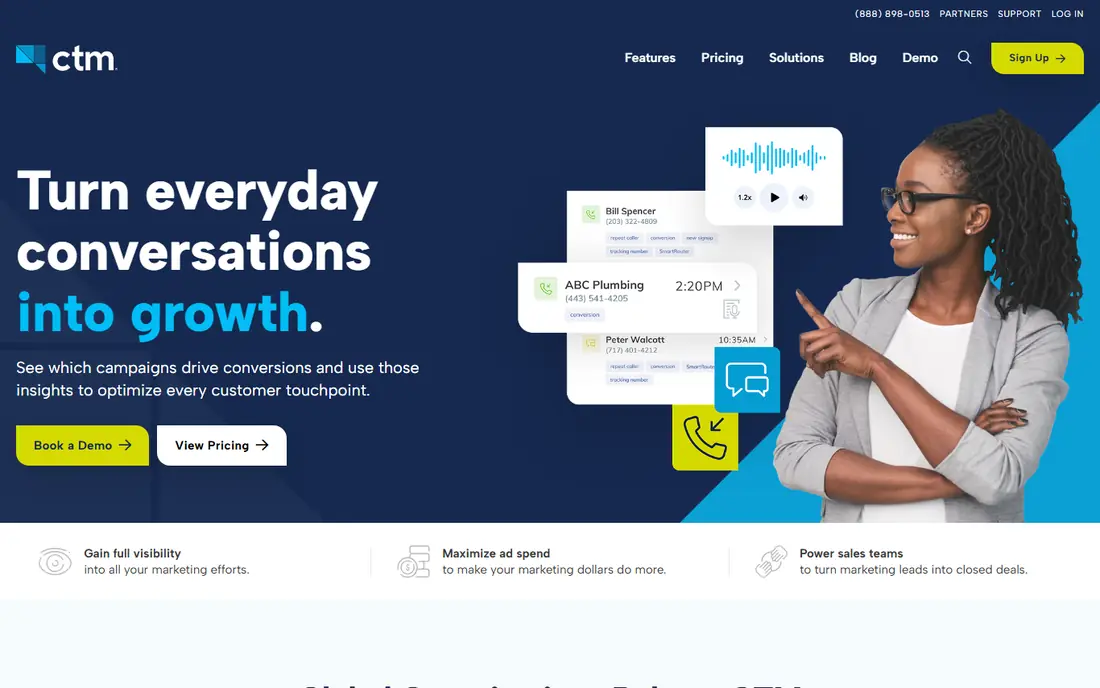
CallTrackingMetrics is the closest all-round CallRail replacement. It tracks calls, forms and chats in one system, links them to campaigns and keywords, and pushes the data into CRMs and ad platforms. For an agency or marketing team that reports on every lead source, that unified view is the main draw.
Pricing depends on numbers, minutes and features, so a busy account costs more than the entry price suggests. Setup also needs thought around number pools and campaign mapping. For teams that want one attribution system for calls and forms, it is the first tool to trial.
Bottom line: CallTrackingMetrics suits all-round call attribution best. Its strongest point is call, form and chat tracking together, while the main drawback to weigh is price rises with numbers and minutes. Check the current pricing page before deciding, since plans and limits change.
- Call, form and chat tracking together
- Strong integrations
- Good reporting
- Price rises with numbers and minutes
- Setup needs planning
WhatConverts
Ideal for: lead tracking for agencies
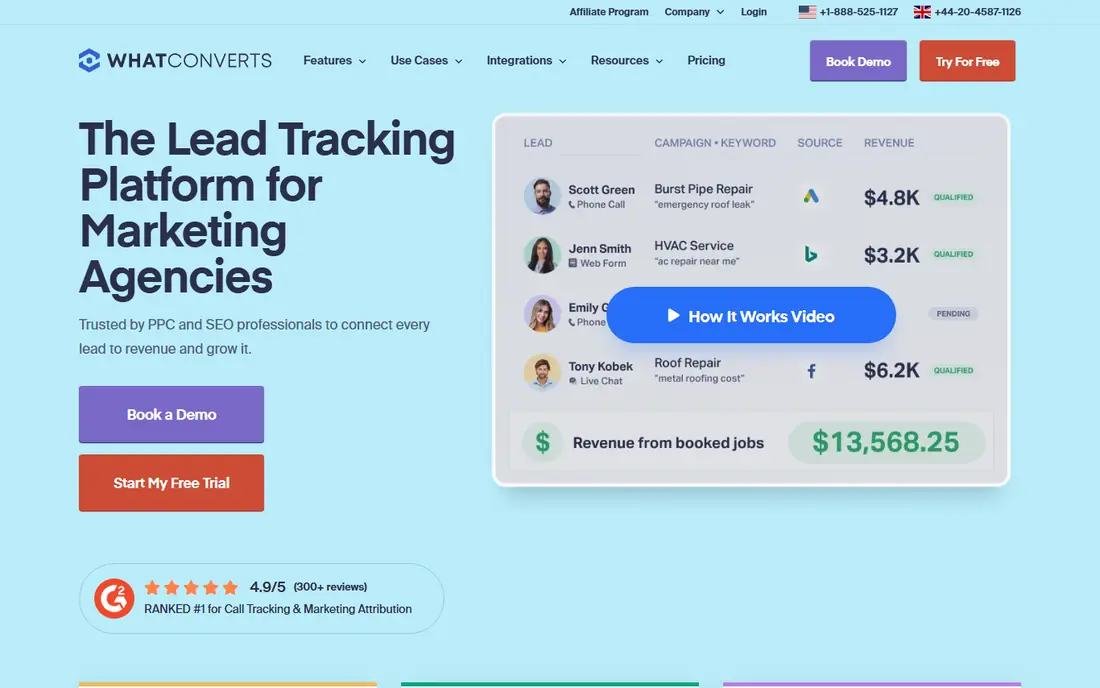
WhatConverts tracks calls, forms, chats and even walk-in leads in a single lead manager, which suits agencies that need to show clients every lead. Leads can be qualified, assigned a value and sent to a CRM, and reports are built for client presentation. That agency focus shows in the pricing and workflow.
The interface is practical rather than beautiful, and some newer analysis features sit on higher tiers. For an agency that needs to prove results across channels, WhatConverts is a strong, affordable CallRail alternative.
Bottom line: WhatConverts suits lead tracking for agencies best. Its strongest point is tracks calls, forms and chats, while the main drawback to weigh is interface is functional rather than polished. Check the current pricing page before deciding, since plans and limits change.
- Tracks calls, forms and chats
- Clear lead management
- Agency-friendly pricing
- Interface is functional rather than polished
- Advanced AI features cost more
Invoca
Ideal for: conversation intelligence at scale
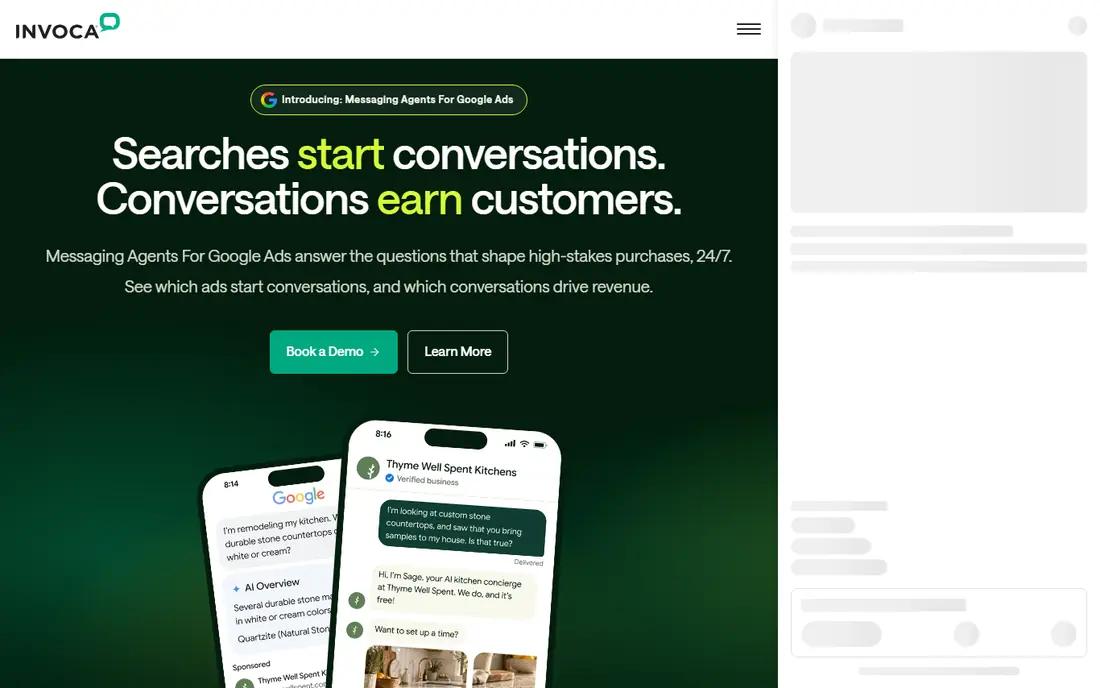
Invoca goes beyond tracking which ad drove a call, and analyses what happened during the call itself. Its conversation intelligence scores calls, flags outcomes and surfaces trends across thousands of conversations. Large teams in insurance, healthcare and automotive use it to connect marketing spend to real revenue.
That depth comes with enterprise pricing and an implementation project, so small teams will find it excessive. If your business handles high call volumes and needs to understand call outcomes at scale, Invoca is the most capable tool on this list.
Bottom line: Invoca suits conversation intelligence at scale best. Its strongest point is deep call analysis, while the main drawback to weigh is enterprise pricing. Check the current pricing page before deciding, since plans and limits change.
- Deep call analysis
- AI scoring
- Strong enterprise integrations
- Enterprise pricing
- More than small teams need
Nimbata
Ideal for: simple affordable call tracking
Nimbata is a straightforward call tracking tool that does the core job well without enterprise complexity. You provision numbers, link them to campaigns, and get clear reports on call sources and outcomes. Setup is quick, and pricing is transparent, which appeals to small teams.
The integration list is shorter than CallTrackingMetrics, and form tracking is not the focus. For a business that mainly needs to know which campaigns drive calls, Nimbata delivers that answer at a fair price.
Bottom line: Nimbata suits simple affordable call tracking best. Its strongest point is clear pricing, while the main drawback to weigh is fewer integrations than larger rivals. Check the current pricing page before deciding, since plans and limits change.
- Clear pricing
- Easy setup
- Good call analytics
- Fewer integrations than larger rivals
- No form tracking focus
Phonexa
Ideal for: lead tracking and distribution
Phonexa combines call tracking with lead management and distribution, which suits businesses that buy, sell or route leads. Calls and web leads flow into one system, can be scored and routed, and reports cover the full lead journey. That breadth is valuable for lead generation operations.
The platform covers a lot, so new users need time to learn it, and pricing is quoted rather than listed. For a standard local business, it may be more than needed. For lead-focused teams, Phonexa is a powerful option.
Bottom line: Phonexa suits lead tracking and distribution best. Its strongest point is call tracking plus lead distribution, while the main drawback to weigh is platform is broad and takes time to learn. Check the current pricing page before deciding, since plans and limits change.
- Call tracking plus lead distribution
- Good for lead buyers and sellers
- Platform is broad and takes time to learn
- Pricing is quoted
Retreaver
Ideal for: pay-per-call tracking
Retreaver is built for pay-per-call marketing, where publishers and advertisers are paid for calls rather than clicks. It routes calls in real time, tracks caller data and handles payout rules, which is exactly what performance marketing networks need. For that niche, it is a specialist rather than a generalist.
That specialisation means it is less suited to a local business that just wants campaign attribution. General reporting and integrations are thinner than in broader tools. If pay-per-call is your model, Retreaver is the tool designed for it.
Bottom line: Retreaver suits pay-per-call tracking best. Its strongest point is built for pay-per-call campaigns, while the main drawback to weigh is niche focus. Check the current pricing page before deciding, since plans and limits change.
- Built for pay-per-call campaigns
- Real-time routing
- Detailed call data
- Niche focus
- Less suited to general local marketing
Marchex
Ideal for: call analytics for large teams
Marchex provides call tracking and conversation analytics for large businesses, with a focus on turning call data into marketing insight. It handles high volumes, offers AI-based call scoring and integrates with major ad platforms. Industries like automotive and home services use it to link calls to revenue.
Pricing is quoted and aimed at larger accounts, so small teams will find it out of reach. Implementation also takes more effort than a simple tracker. For a large team that needs call analytics at scale, Marchex is a credible CallRail alternative.
Bottom line: Marchex suits call analytics for large teams best. Its strongest point is conversation analytics, while the main drawback to weigh is enterprise focus. Check the current pricing page before deciding, since plans and limits change.
- Conversation analytics
- Large-scale call handling
- Industry experience
- Enterprise focus
- Pricing not listed publicly
CallFire
Ideal for: voice and text campaigns
CallFire is better known for voice broadcasting and text messaging, but it also offers call tracking, which makes it useful for campaigns that mix calls and texts. Setup is simple, and the platform suits small businesses running promotions by phone and SMS together.
Call tracking depth is lighter than in dedicated tools, with fewer attribution and reporting options. Per-minute costs apply on top of the platform fee. For a business that wants tracking plus voice and text outreach in one place, CallFire is a practical pick.
Bottom line: CallFire suits voice and text campaigns best. Its strongest point is voice broadcasting and texting alongside tracking, while the main drawback to weigh is tracking features are lighter than dedicated tools. Check the current pricing page before deciding, since plans and limits change.
- Voice broadcasting and texting alongside tracking
- Simple setup
- Tracking features are lighter than dedicated tools
- Per-minute costs apply
How we picked these
We started from the original product and what people use it for, then compared official feature pages, pricing pages, app-store listings, privacy policies and public reviews for each candidate. We kept only products that exist, work in October 2026 and genuinely fit the topic, and we left out products that were discontinued, unrelated or too thin to recommend.
We weighed fit for the topic first, then price and free options, ease of setup and the honest downsides that show up in reviews and documentation. Prices are given as listed on the vendor's own site where we could verify them, and we wrote See website where a price was quoted, unclear or likely to change by plan.
We also left out products that no longer exist, that have been folded into a different product, or that only partly fit the topic. A longer list would have been easier to write, but a list padded with poor fits helps nobody choose, so we kept the list to products we can genuinely recommend for this use.
How to choose a call tracking tool
Start with how you want to attribute calls. The basic job is linking a phone number to a campaign or keyword, but tools differ in how they handle form fills, chats and multi-touch journeys. If you report on all lead sources together, pick a tool that tracks forms and calls in one dashboard rather than two separate systems.
Next, check call recording and transcription rules for your region. Some industries and states have consent requirements, and the tool should make it easy to play announcements and control who can listen to recordings. A tool that ignores this creates legal risk, not just admin work.
Finally, price the full setup. Most tools charge per number and per minute, plus a platform fee, so a quote based on your real call volume matters more than a headline price. Run a trial on live campaigns to check number provisioning and report accuracy before switching.
Test with your own data, not sample data. A tool can look excellent on demo content and still struggle with your volume, formats or edge cases, so load a realistic slice of your own work during the trial. Pay attention to speed, error messages and how easy it is to fix a mistake.
Think about who else must use it. A tool chosen by one person often fails when the wider team finds it confusing or slow, so invite two or three colleagues to try the shortlist and note where they get stuck. Their feedback is worth more than any feature checklist.
Frequently asked questions
What is the best CallRail alternative?
CallTrackingMetrics is the closest all-round replacement, with similar tracking, reporting and integrations. WhatConverts is a strong second choice, especially for agencies that also track forms and chats.
Is there a free call tracking tool?
Most call tracking tools are paid, since phone numbers and minutes cost money. Some offer free trials, and a few have very small free tiers, but a business that relies on call tracking should budget for a monthly plan.
Do I need dynamic number insertion?
If you run paid search or want keyword-level attribution, yes. Dynamic number insertion swaps the number shown to each visitor, so the tool can link a call to the exact ad or keyword. For a single local number on a brochure site, static tracking may be enough.
Can call tracking tools record calls?
Most of them can, with settings for announcements and consent. Check the recording laws that apply to your state or country, and make sure the tool lets you control access to recordings.
Will call tracking work with my CRM?
The main tools here integrate with popular CRMs and ad platforms, so calls can appear alongside other leads. Check the specific integration for your CRM before buying, since depth varies by tool.
Can I try these options before paying?
Yes, in most cases. Nearly every option on this list offers a free tier or a free trial, and we note that in the comparison table and in each product block. Use the trial for real work rather than a quick look, and check the renewal price before the trial ends so there are no surprises.