Cheaper Semrush Alternatives in 2026: 8 Options Compared

- 1
 AhrefsBacklink and keyword research depthVisit
- 2
 MozKeyword research with domain authorityVisit
- 3
 SE RankingAffordable all-in-one SEOVisit
- 4
 MangoolsSimple keyword research for beginnersVisit
- 5
 UbersuggestBudget keyword and site auditsVisit
- Ahrefs is our first pick for Backlink and keyword research depth, because it covers the core job well without a narrow focus.
- Moz is a strong second option for Keyword research with domain authority, and it suits buyers who want a different balance of features and price.
- Most options here use quote-based or trial-led pricing, so ask for current plan details before you compare totals.
- Mangools stands out for Simple keyword research for beginners, with kWFinder and SERPChecker are easy to learn as its clearest strength.
- Shortlist two or three options, test each with a real task, and compare the total cost and limits before you commit.
Quick comparison
| Product | Ideal for | Price from | Free version | |
|---|---|---|---|---|
| Ahrefs | Backlink and keyword research depth | See website | See website | Visit |
| Moz | Keyword research with domain authority | See website | Free trial | Visit |
| SE Ranking | Affordable all-in-one SEO | See website | Free trial | Visit |
| Mangools | Simple keyword research for beginners | See website | Free trial | Visit |
| Ubersuggest | Budget keyword and site audits | See website | Free trial | Visit |
 Serpstat | All-in-one SEO at a lower price | See website | Free trial | Visit |
 SpyFu | Competitor keyword and ad research | See website | See website | Visit |
 Keysearch | Low-cost keyword research | See website | Free trial | Visit |
The best cheaper Semrush alternatives
These 8 options cover the main ways to handle cheaper semrush alternatives, from well-known leaders to smaller tools that suit a narrower job. We compared official feature pages, pricing, app-store listings, privacy policies, and public reviews to sort out where each one earns its place.
Ahrefs
Ideal for: Backlink and keyword research depth
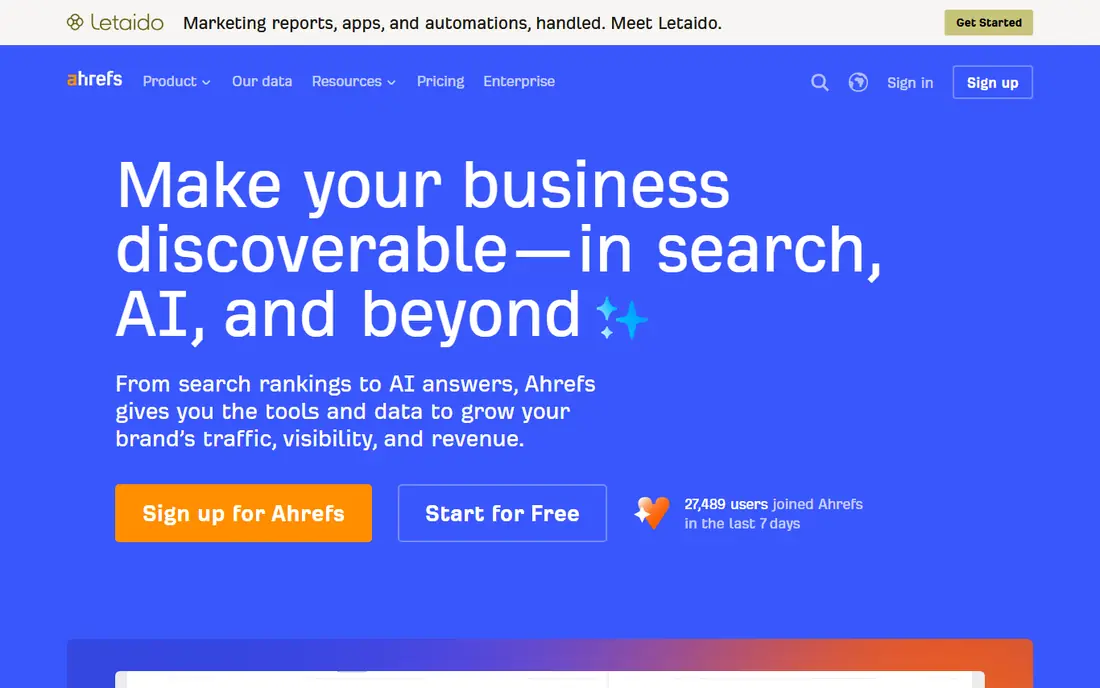
Ahrefs fits backlink and keyword research depth. Ahrefs fits SEOs who value backlink data above an all-in-one suite. Its strengths include large backlink index, Site Explorer and Keywords Explorer, and rank tracking.
The honest catch is not the cheapest option, but plans are simpler to compare, and some features need higher tiers. That matters most when your team relies on that area every day, so weigh it against the strengths above before you decide. A tool can still be the right pick with a clear weakness, as long as that weakness sits outside your main job.
We would shortlist Ahrefs if backlink and keyword research depth is your main priority. Check the current pricing page before you commit, since plans, limits, and terms change over time. Start small, test it with a real workload, and compare the result with one other option on this list before you commit.
- Large backlink index
- Site Explorer and Keywords Explorer
- Rank tracking
- Not the cheapest option, but plans are simpler to compare
- Some features need higher tiers
Moz
Ideal for: Keyword research with domain authority
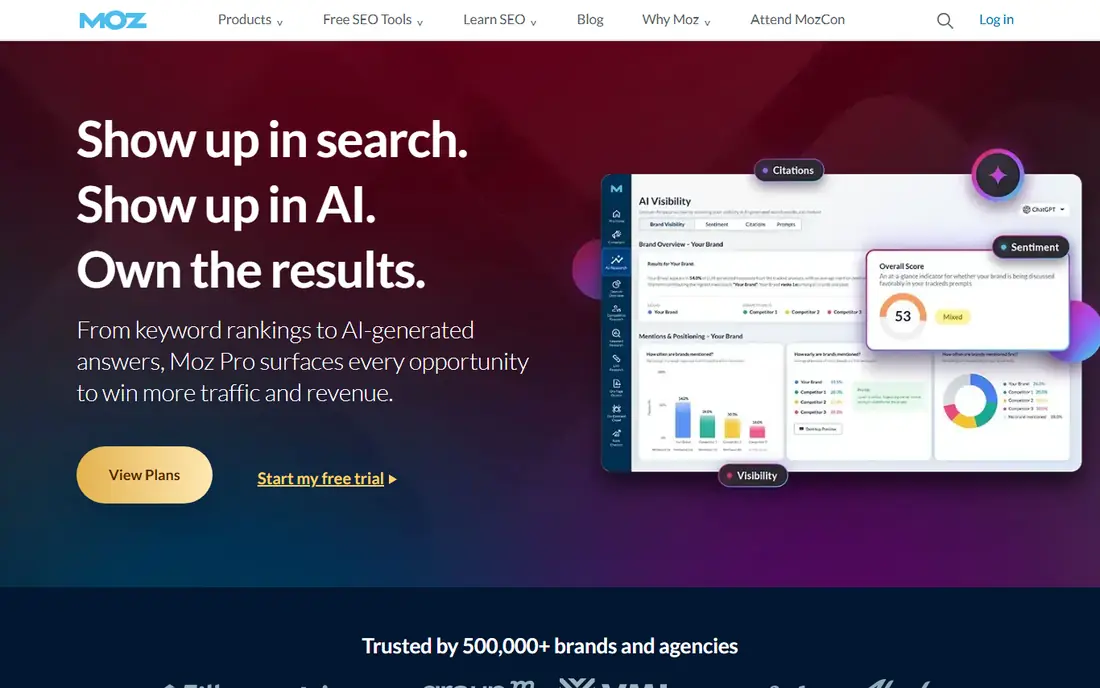
For keyword research with domain authority, Moz is a strong candidate. Moz suits marketers who want a familiar SEO toolkit with strong education. Its strengths include keyword Explorer and Link Explorer, domain authority metrics, and clear learning resources.
The honest catch is crawl and index depth trails larger rivals in places, and some tools feel dated. That matters most when your team relies on that area every day, so weigh it against the strengths above before you decide. A tool can still be the right pick with a clear weakness, as long as that weakness sits outside your main job.
We would shortlist Moz if keyword research with domain authority is your main priority. A free trial lets you test it with real work before you pay, so use that window properly. Start small, test it with a real workload, and compare the result with one other option on this list before you commit.
- Keyword Explorer and Link Explorer
- Domain authority metrics
- Clear learning resources
- Crawl and index depth trails larger rivals in places
- Some tools feel dated
SE Ranking
Ideal for: Affordable all-in-one SEO
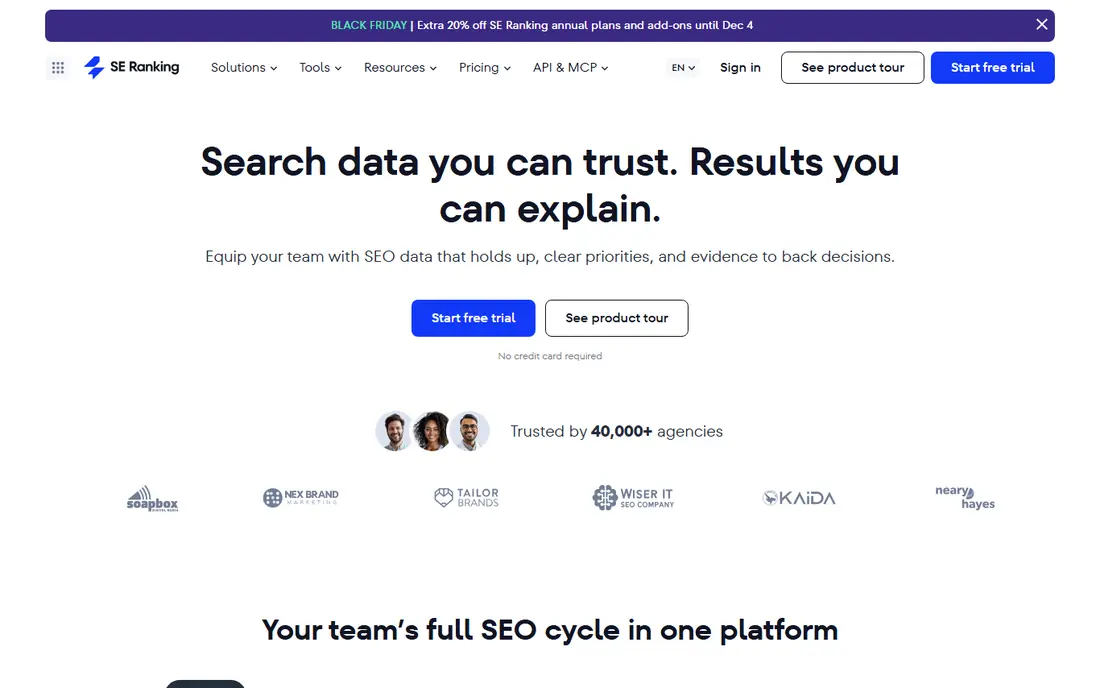
SE Ranking is built around affordable all-in-one SEO. SE Ranking fits agencies and small businesses that want most Semrush features for less. Its strengths include rank tracking, audits, and keyword research at lower prices, and white-label reporting.
The honest catch is backlink index is smaller than Ahrefs, and advanced data needs higher plans. That matters most when your team relies on that area every day, so weigh it against the strengths above before you decide. A tool can still be the right pick with a clear weakness, as long as that weakness sits outside your main job.
We would shortlist SE Ranking if affordable all-in-one SEO is your main priority. A free trial lets you test it with real work before you pay, so use that window properly. Start small, test it with a real workload, and compare the result with one other option on this list before you commit.
- Rank tracking, audits, and keyword research at lower prices
- White-label reporting
- Backlink index is smaller than Ahrefs
- Advanced data needs higher plans
Mangools
Ideal for: Simple keyword research for beginners
If simple keyword research for beginners is the priority, Mangools deserves a close look. Mangools suits beginners and small sites that want keyword research without complexity. Its strengths include kWFinder and SERPChecker are easy to learn, clean interface, and fair pricing.
The honest catch is depth is lighter than enterprise suites, and backlink data is thinner. That matters most when your team relies on that area every day, so weigh it against the strengths above before you decide. A tool can still be the right pick with a clear weakness, as long as that weakness sits outside your main job.
We would shortlist Mangools if simple keyword research for beginners is your main priority. A free trial lets you test it with real work before you pay, so use that window properly. Start small, test it with a real workload, and compare the result with one other option on this list before you commit.
- KWFinder and SERPChecker are easy to learn
- Clean interface
- Fair pricing
- Depth is lighter than enterprise suites
- Backlink data is thinner
Ubersuggest
Ideal for: Budget keyword and site audits
Ubersuggest fits budget keyword and site audits. Ubersuggest fits tight budgets where a basic keyword and audit toolkit is enough. Its strengths include keyword ideas, site audits, and content ideas at a low price, and lifetime options have existed.
The honest catch is data depth and accuracy vary by market, and interface carries upsell prompts. That matters most when your team relies on that area every day, so weigh it against the strengths above before you decide. A tool can still be the right pick with a clear weakness, as long as that weakness sits outside your main job.
We would shortlist Ubersuggest if budget keyword and site audits is your main priority. A free trial lets you test it with real work before you pay, so use that window properly. Start small, test it with a real workload, and compare the result with one other option on this list before you commit.
- Keyword ideas, site audits, and content ideas at a low price
- Lifetime options have existed
- Data depth and accuracy vary by market
- Interface carries upsell prompts
Serpstat
Ideal for: All-in-one SEO at a lower price
For all-in-one SEO at a lower price, Serpstat is a strong candidate. Serpstat suits teams that want an all-in-one suite without enterprise pricing. Its strengths include keyword, backlink, audit, and rank tracking tools, API access, and team plans.
The honest catch is interface can feel dense, and data coverage varies by country. That matters most when your team relies on that area every day, so weigh it against the strengths above before you decide. A tool can still be the right pick with a clear weakness, as long as that weakness sits outside your main job.
We would shortlist Serpstat if all-in-one SEO at a lower price is your main priority. A free trial lets you test it with real work before you pay, so use that window properly. Start small, test it with a real workload, and compare the result with one other option on this list before you commit.
- Keyword, backlink, audit, and rank tracking tools
- API access
- Team plans
- Interface can feel dense
- Data coverage varies by country
SpyFu
Ideal for: Competitor keyword and ad research
SpyFu is built around competitor keyword and ad research. SpyFu fits marketers whose main question is what competitors rank and bid on. Its strengths include long history of competitor keyword and ad data, and unlimited-style search on plans.
The honest catch is site audit and content tools are thinner than full suites, and interface is dated. That matters most when your team relies on that area every day, so weigh it against the strengths above before you decide. A tool can still be the right pick with a clear weakness, as long as that weakness sits outside your main job.
We would shortlist SpyFu if competitor keyword and ad research is your main priority. Check the current pricing page before you commit, since plans, limits, and terms change over time. Start small, test it with a real workload, and compare the result with one other option on this list before you commit.
- Long history of competitor keyword and ad data
- Unlimited-style search on plans
- Site audit and content tools are thinner than full suites
- Interface is dated
Keysearch
Ideal for: Low-cost keyword research
If low-cost keyword research is the priority, Keysearch deserves a close look. Keysearch suits hobby sites and new blogs that need keyword basics on a small budget. Its strengths include very affordable keyword research and rank tracking, and simple interface.
The honest catch is data depth is limited next to larger tools, and backlink features are basic. That matters most when your team relies on that area every day, so weigh it against the strengths above before you decide. A tool can still be the right pick with a clear weakness, as long as that weakness sits outside your main job.
We would shortlist Keysearch if low-cost keyword research is your main priority. A free trial lets you test it with real work before you pay, so use that window properly. Start small, test it with a real workload, and compare the result with one other option on this list before you commit.
- Very affordable keyword research and rank tracking
- Simple interface
- Data depth is limited next to larger tools
- Backlink features are basic
How we picked these
We started from the topic itself and kept only products that exist, work in October 2026, and truly fit the job in the title. For each option we checked official feature pages and pricing, app-store listings where relevant, privacy policies, and public reviews, and we left out products whose fit depended on stretching the definition. Where a price or free tier could not be verified from the vendor, we wrote See website rather than guessing a number.
We also weighed who each product is really for, not just its feature list. A broad platform can be the wrong pick for a small team, and a simple tool can be the wrong pick for a large operation, so the write-ups above name the audience, the strength, and the catch for each option. That is the comparison we would want before spending money or moving data.
How to choose an affordable SEO tool
Start with your main job
Write down the one job you need done every week, then judge each option against that job first. Extra features look good in a demo, but they add cost, training, and admin work when they sit unused. If two options both cover your main job, pick the one with the clearer pricing and the simpler setup for your team.
Check pricing and limits
Compare the total cost for your team size and usage, not just the headline plan. Check seat pricing, usage limits, add-ons, and contract terms, and ask what happens when you grow past a tier. A free plan or trial is useful, but read what it excludes, since the feature you need most is often the one held back for paid plans.
Test before you commit
Run a short trial with real data and a real task, and involve the people who will use the tool daily. Check support response, data export, and how easy it is to leave, because switching costs are part of the price. If a trial feels hard to set up, treat that as useful evidence about the product, not just about your team.
Frequently asked questions
What are cheaper semrush alternatives?
They are products and services that cover the same job as the original topic, in this case cheaper semrush alternatives. The list above includes Ahrefs, Moz, and SE Ranking, among others, each with a different balance of features, price, and audience. Start from your main job, then narrow the list to the two or three options that fit it best.
Which option is best for most people?
For most buyers, Ahrefs is a sensible starting point for Backlink and keyword research depth, because it covers the core job well. If your priority is different, Moz for Keyword research with domain authority or Mangools for Simple keyword research for beginners may fit better. There is no single winner for every team, so match the pick to your size, budget, and workflow.
Is there a free option?
Some options offer a free trial, while others use quote-based pricing, so the honest answer is to check each vendor page. Trials are the best way to test fit without committing, and they reveal setup effort as well as features. Do not assume a trial covers every feature you need.
How much do these options cost?
Costs vary by plan, team size, and usage, and several vendors use quote-based pricing, which is why some entries say See website. Compare the total for your actual use, including seats, add-ons, and contract length, rather than the lowest headline price. Ask each vendor for a written quote before you decide.
How do I switch from my current tool?
Start by exporting your data and checking what the new tool can import, since migration quality varies a lot. Run both tools side by side for a short period, move one team or project first, and keep the old tool until the new one proves itself. Ask the vendor for migration help in writing before you sign.