Best Citrix Endpoint Management Alternatives in 2026: 8 Options Compared

- 1
 Microsoft IntuneMicrosoft centred managementVisit
- 2
 Jamf ProApple device managementVisit
- 3
 VMware Workspace ONEMixed fleets and virtual desktopsVisit
- 4
 ManageEngine Endpoint CentralPatching plus managementVisit
- 5
 HexnodeAffordable unified managementVisit
- Microsoft Intune suits organisations already using Microsoft 365.
- Jamf Pro leads for organisations standardising on Apple devices.
- VMware Workspace ONE fits mixed fleets with strong virtual desktop links.
- Hexnode suits smaller teams that need solid management at a lower price.
Quick comparison
| Product | Ideal for | Price from | Free version | |
|---|---|---|---|---|
| Microsoft Intune | Microsoft centred management | See website | Free trial | Visit |
| Jamf Pro | Apple device management | See website | Free trial | Visit |
| VMware Workspace ONE | Mixed fleets and virtual desktops | See website | Free trial | Visit |
| ManageEngine Endpoint Central | Patching plus management | See website | Free trial | Visit |
| Hexnode | Affordable unified management | See website | Free trial | Visit |
 Kandji | Apple management with automation | See website | Free trial | Visit |
 Mosyle | Apple management for education | See website | Free trial | Visit |
 Ivanti Neurons | Enterprise endpoint management | See website | Free trial | Visit |
The best citrix endpoint management alternatives
We worked through the options below in detail, comparing what each one does well, where it falls short, and who it suits best. Our pick for most people depends on your budget and your main job, so read the shortlist with your own use case in mind. The order below starts with the strongest all round options and then moves to more specialised picks.
Microsoft Intune
Ideal for: Microsoft centred management

For organisations already invested in Microsoft 365, Microsoft Intune is a strong choice. Its integration with Microsoft identity and security tools makes policy enforcement consistent across devices. When we compared official feature pages, the difference showed up in everyday use, not in marketing claims, since the tools that look similar on a homepage often behave very differently once you set them up for a real task.
Apple heavy fleets may prefer a dedicated Apple manager for the deepest macOS and iOS controls. Try it with a real task from your own work before committing, since a short trial reveals friction that no feature list can show. That trade off is worth weighing against your main job, since the best tool on paper is not always the best tool for your team or your budget.
- Deep Microsoft 365 integration
- Conditional access
- Windows and mobile support
- Apple management is capable but less specialised than Jamf
- Licensing is complex
Jamf Pro
Ideal for: Apple device management
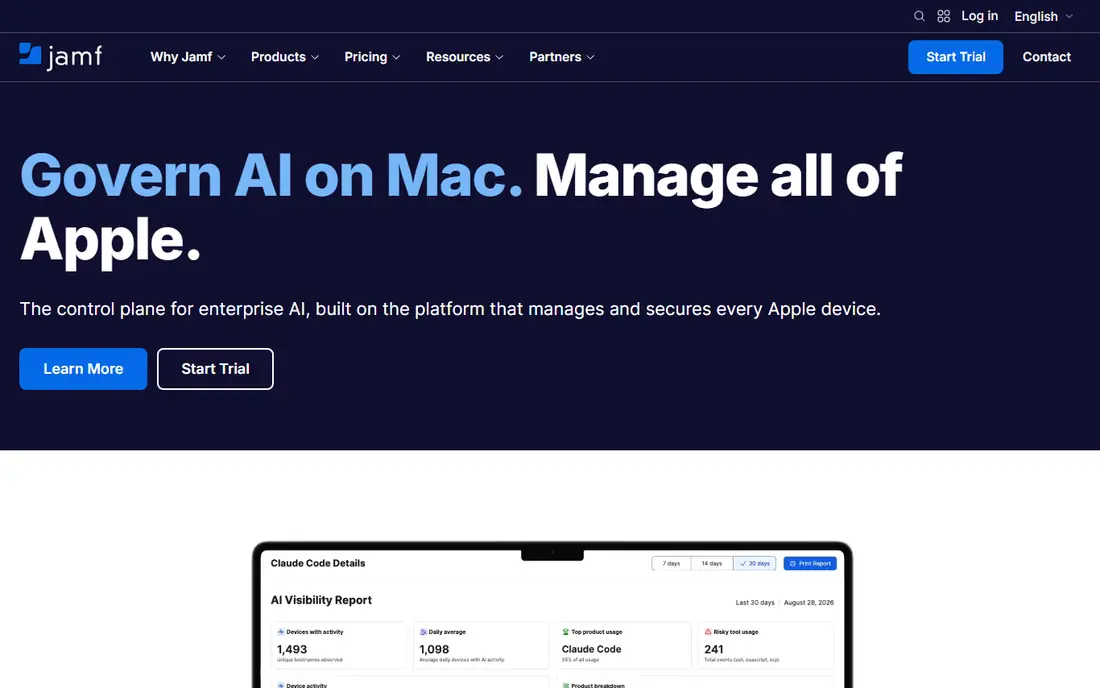
For schools and companies standardising on Apple hardware, Jamf Pro is a strong choice. Its Apple depth covers deployment, patching, and security in ways general tools do not match. We also checked what each vendor says about its own limits, because a tool that is honest about its weak spots is easier to plan around than one that hides them behind a long feature list.
Organisations with many Windows or Android devices will need another platform alongside it. Read the current pricing and terms on the vendor site before you buy, since plans and limits change, and the plan you read about last year may not be the plan on sale today. That trade off is worth weighing against your main job, since the best tool on paper is not always the best tool for your team or your budget.
- Deepest Apple management
- Zero touch deployment
- Strong security tools
- Apple only, so mixed fleets need a second tool
- Pricing scales per device
VMware Workspace ONE
Ideal for: Mixed fleets and virtual desktops
For larger organisations with mixed devices and virtual desktops, VMware Workspace ONE is a strong choice. Its breadth suits complex fleets, especially where virtual desktops sit beside physical devices. In practice, the deciding factor is often fit with tools you already use, so check integrations and export options before you fall for a feature you may rarely touch.
Smaller teams may find the deployment effort heavier than a focused tool requires. Ask the vendor a direct question during the trial, since the speed and clarity of the answer tell you a lot about the support you will get later. That trade off is worth weighing against your main job, since the best tool on paper is not always the best tool for your team or your budget.
- Unified management across platforms
- Virtual desktop integration
- Strong security
- Broad feature set takes time to deploy
- Licensing varies
ManageEngine Endpoint Central
Ideal for: Patching plus management
For IT teams that prioritise patching and software deployment, ManageEngine Endpoint Central is a strong choice. Its patching coverage across Windows, macOS, and Linux is a practical strength for busy IT teams. Our comparison also weighed how easy each option is to learn, since a powerful tool that your team avoids is worth less than a simpler one that everyone actually uses every day.
Organisations wanting a polished modern console may prefer a rival. Check what happens to your data if you leave, since export options and data portability matter most at the moment you decide to switch. That trade off is worth weighing against your main job, since the best tool on paper is not always the best tool for your team or your budget.
- Patch management across platforms
- Software deployment
- Affordable editions
- Interface feels busy
- Some features need the higher editions
Hexnode
Ideal for: Affordable unified management
For small and mid sized teams that need solid management without enterprise cost, Hexnode is a strong choice. Its pricing and platform coverage make it a sensible choice for teams watching budgets. We paid attention to support and documentation too, because the moment something breaks is when you discover whether a vendor actually helps or just points you at a help page.
Very large enterprises may want the deeper integrations of bigger platforms. Talk to one or two existing users if you can, since their experience with support, reliability, and billing is often more useful than any review score. That trade off is worth weighing against your main job, since the best tool on paper is not always the best tool for your team or your budget.
- Manages many platforms
- Kiosk and app controls
- Competitive pricing
- Smaller ecosystem than Microsoft or VMware
- Advanced features vary by plan
Kandji
Ideal for: Apple management with automation
For Apple focused companies that want automation and compliance, Kandji is a strong choice. Its automation and compliance templates reduce manual work for Apple administrators. Another factor we weighed is how the tool handles growth, since a choice that works for ten users or ten projects can strain badly at a hundred, and switching later costs far more time.
Mixed device fleets will need a second tool for Windows and Android. Start with the smallest plan that covers your needs, since upgrading later is easy, while paying for unused capacity from day one is money you will not get back. That trade off is worth weighing against your main job, since the best tool on paper is not always the best tool for your team or your budget.
- Apple focused automation
- Compliance templates
- Good support
- Apple only
- Per device pricing adds up at scale
Mosyle
Ideal for: Apple management for education
For schools and Apple focused teams on a budget, Mosyle is a strong choice. Its education features and school friendly pricing make it popular in classrooms. We also looked at how clearly each vendor explains its pricing, since hidden limits on users, volume, or features are a common source of surprise bills after the first month.
Businesses with mixed fleets or complex compliance needs should compare Jamf or Intune. If your team will use it daily, involve them in the trial, since a tool chosen by one person and imposed on everyone else rarely gets adopted well. That trade off is worth weighing against your main job, since the best tool on paper is not always the best tool for your team or your budget.
- Strong Apple school features
- Free tier for schools
- Easy deployment
- Apple only
- Business features are narrower than Jamf
Ivanti Neurons
Ideal for: Enterprise endpoint management
For larger enterprises with complex endpoint needs, Ivanti Neurons is a strong choice. Its automation helps large IT teams handle patching and remediation at scale. Finally, we considered longevity, because a tool from a stable vendor with regular updates is a safer home for your work than a promising newcomer that may change direction.
Smaller teams will find simpler platforms faster to deploy and easier to run. Keep a note of the renewal date and the cancellation steps when you subscribe, since that small habit prevents unwanted renewals and surprise charges. That trade off is worth weighing against your main job, since the best tool on paper is not always the best tool for your team or your budget.
- Automation and patching
- Broad platform support
- Security integrations
- Enterprise pricing and deployment effort
- Interface takes learning
How we picked these
We compared official feature pages, pricing pages, app store listings, privacy policies, and public reviews for each option, and we only listed products that exist and work in October 2026 and truly fit the topic. Where we could not verify a current price from the vendor, we wrote See website rather than guessing. We did not claim hands-on testing we did not do, and we weighed honest weaknesses alongside strengths, since a roundup that only praises its picks does not help anyone decide. We also checked that each product homepage loads and belongs to the product named, and we dropped or replaced any product whose homepage failed that check. Prices and free tiers were taken from vendor pages where we could verify them, and marked See website where we could not, so readers should confirm current pricing before buying.
How to choose an endpoint management platform
Start with your device mix, since Apple heavy fleets, Microsoft centred fleets, and mixed fleets point to different tools. Next, list the policies you actually enforce, such as encryption, app control, and remote wipe, and test them on a trial with real devices. Check identity integration too, because management works best when it connects to the login system staff already use. Finally, compare per device pricing at your real fleet size, since headline prices hide the total quickly.
Frequently asked questions
What is the closest alternative to Citrix Endpoint Management?
Microsoft Intune is the closest general replacement for mixed fleets, while VMware Workspace ONE suits organisations with virtual desktops. Apple heavy fleets should compare Jamf Pro and Kandji.
Do I need a separate tool for Apple devices?
Not always, since Intune, Workspace ONE, and Hexnode manage Apple devices well. A dedicated Apple tool like Jamf Pro makes sense when Apple devices dominate and you want the deepest controls.
How long does deployment take?
Small fleets can deploy in days, while large enterprises may take weeks to plan policies, test devices, and train staff. A trial with a small device group gives the most honest timeline.
What happens when a device is lost or stolen?
Managed devices can be locked or wiped remotely, and encryption policies protect data on the device. Test the wipe process on a spare device before you need it for real.