ConnectWise Alternatives in 2026: 8 Tools Compared

- HaloPSA and SuperOps suit MSPs that want a modern PSA with ticketing and billing in one place.
- Atera, NinjaOne, and Syncro suit MSPs that prioritize remote monitoring and management.
- Kaseya BMS and Freshservice suit larger teams with IT service management needs.
- ManageEngine ServiceDesk Plus offers a strong on-premise option for IT departments.
Quick comparison
| Product | Ideal for | Price from | Free version | |
|---|---|---|---|---|
 HaloPSA | Modern MSP PSA | See website | Free trial | Visit |
 Atera | All-in-one RMM | See website | Free trial | Visit |
 NinjaOne | Endpoint management | See website | Free trial | Visit |
 Syncro | MSP RMM plus PSA | See website | Free trial | Visit |
 SuperOps | Modern MSP platform | See website | Free trial | Visit |
 Kaseya BMS | MSP billing and service | See website | Free trial | Visit |
 ManageEngine ServiceDesk Plus | IT service management | See website | Free trial | Visit |
 Freshservice | IT service desk | See website | Free trial | Visit |
The best ConnectWise alternatives
We compared official feature pages, pricing pages, and app-store listings for PSA, RMM, and ITSM tools available in October 2026. ConnectWise covers several products, including PSA and Automate, so the list below covers the same MSP and IT service needs.
HaloPSA
Ideal for: Modern MSP PSA
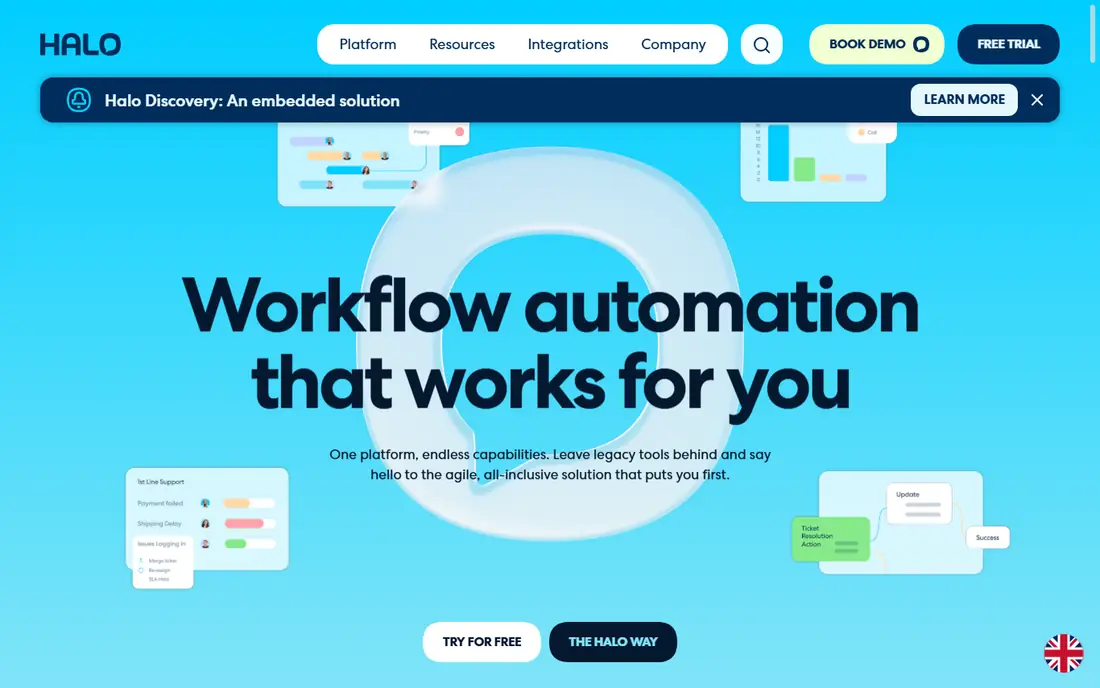
HaloPSA is a professional services automation platform for MSPs, covering ticketing, billing, projects, contracts, and customer portals. Its interface is modern compared with older PSAs, and integrations cover RMM tools, accounting, and remote access. Teams can manage service delivery and billing from one system.
HaloPSA is a PSA, not an RMM, so monitoring and patching need a separate tool or integration. For an MSP that wants a modern PSA to replace ConnectWise Manage, HaloPSA is a leading choice.
- Ticketing, billing, and projects in one PSA
- Modern interface
- Strong integrations
- RMM needs a separate tool or integration
- Pricing is per agent
Atera
Ideal for: All-in-one RMM
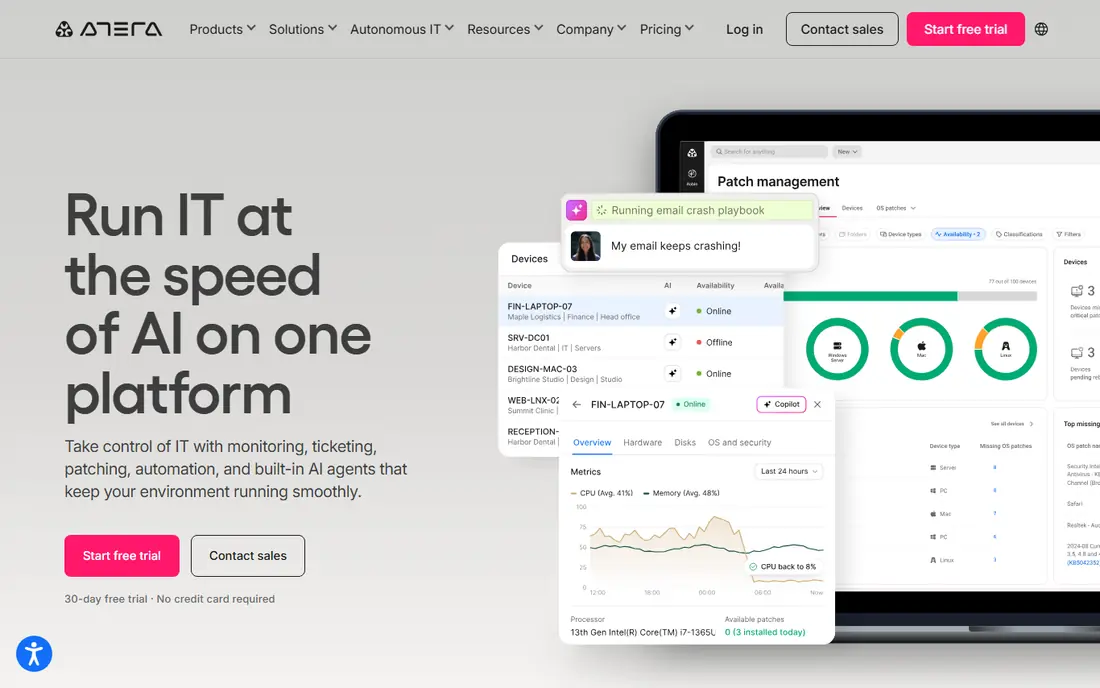
Atera combines remote monitoring and management with PSA features, including ticketing, billing, and reporting, in one platform. Pricing is per technician rather than per device, which suits MSPs with many endpoints. AI features help with ticket triage and scripting.
The PSA side is lighter than a dedicated PSA such as HaloPSA, so larger MSPs may want a deeper tool. For a small to midsize MSP that wants RMM and PSA together at a clear price, Atera is a strong fit.
- RMM plus PSA in one platform
- Per-technician pricing
- AI features included
- PSA depth is lighter than HaloPSA
- Larger MSPs may need more
NinjaOne
Ideal for: Endpoint management
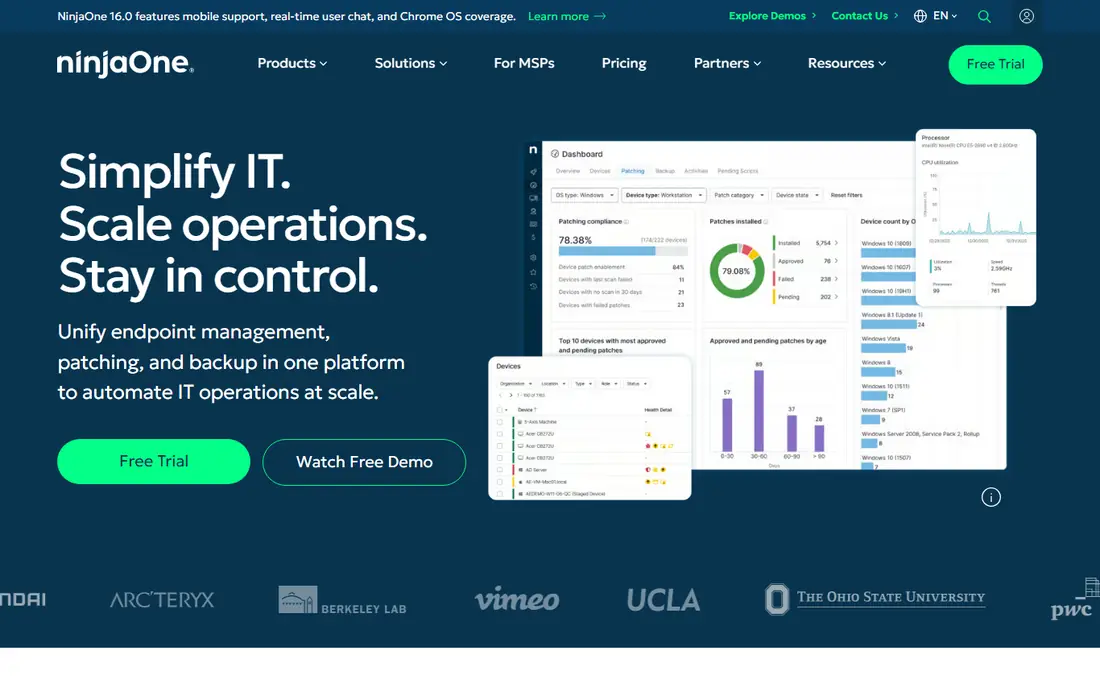
NinjaOne is an endpoint management platform covering monitoring, patching, software deployment, remote access, and automation for Windows, Mac, and Linux devices. Its interface is fast and clean, and automation policies handle routine work across fleets. It integrates with ticketing and PSA tools for service workflows.
NinjaOne is not a full PSA, so billing and project management need another tool. For an MSP or IT team that prioritizes endpoint management, NinjaOne's speed and reliability stand out.
- Fast endpoint management
- Patching and automation
- Clean interface
- PSA features are limited
- Pricing is quote-based
Syncro
Ideal for: MSP RMM plus PSA
Syncro combines RMM, PSA, and billing in one platform for MSPs, with per-technician pricing and integrated remote access through Splashtop. It covers monitoring, patching, scripting, ticketing, invoicing, and customer portals, which suits small to midsize MSPs that want one system.
Syncro's scale is smaller than the largest MSP platforms, and some features feel less polished. For a growing MSP that wants RMM, PSA, and billing together without enterprise complexity, Syncro is a good value choice.
- RMM plus PSA and billing
- Per-technician pricing
- Integrated remote access
- Smaller scale than Kaseya or ConnectWise
- Some features need polish
SuperOps
Ideal for: Modern MSP platform
SuperOps is a modern MSP platform combining RMM and PSA, with monitoring, patching, ticketing, billing, and client portals in one system. Its interface is clean, AI features assist with tickets and documentation, and pricing tiers are clear for small and growing MSPs.
As a newer platform, its integration ecosystem is still growing compared with ConnectWise or Kaseya. For an MSP that wants a modern, unified platform and is willing to grow with it, SuperOps is an appealing choice.
- Modern RMM plus PSA
- AI features
- Clear pricing tiers
- Newer platform than rivals
- Ecosystem is still growing
Kaseya BMS
Ideal for: MSP billing and service
Kaseya BMS is a business management solution for MSPs, covering service desk, billing, projects, and CRM within the Kaseya ecosystem. It integrates with Kaseya VSA for remote management and other Kaseya tools, giving MSPs a unified stack for service and billing.
BMS works best inside the Kaseya ecosystem, so teams outside it may prefer a standalone PSA. For an MSP already on Kaseya VSA or moving to the full Kaseya stack, BMS is the natural PSA choice.
- PSA plus billing in the Kaseya ecosystem
- Service desk and projects
- Integrations
- Works best inside Kaseya
- Pricing is quote-based
ManageEngine ServiceDesk Plus
Ideal for: IT service management
ManageEngine ServiceDesk Plus is an IT service management platform covering incident, problem, change, asset, and service catalog management. It offers both cloud and on-premise deployment, which suits IT departments with data control needs. Integrations cover Active Directory, monitoring tools, and other ManageEngine products.
The interface can feel busy, and large deployments need planning. For an IT department that needs full ITSM with an on-premise option, ServiceDesk Plus is a strong, cost-effective choice.
- Full ITSM with incident, problem, and change
- On-premise option
- Asset management
- Interface can feel busy
- Setup needs planning for large teams
Freshservice
Ideal for: IT service desk
Freshservice, from Freshworks, is a cloud ITSM platform with ticketing, incident, problem, change, and asset management, plus automation and AI features. Its interface is clean and easy for agents and end users, and it integrates with monitoring, chat, and other Freshworks products.
MSP billing and contract features are thinner than in a dedicated PSA, so MSPs may need an add-on. For an internal IT team that wants a modern service desk, Freshservice is easy to deploy and use.
- Clean ITSM interface
- Automation and AI
- Asset management included
- MSP billing features are thinner than PSA tools
- Pricing grows with agents
How we picked these
We compared official feature pages, pricing pages, and app-store listings for PSA, RMM, and ITSM tools available in October 2026. We favored tools with current products, MSP or IT service features, and a range of deployment options. We also weighed billing accuracy, agent compatibility, and integration depth, since an MSP tool must handle real client devices and invoices from day one. We did not include our own product in this list.
How to choose a ConnectWise alternative
Start with which ConnectWise product you replace. A PSA replacement points to HaloPSA or Kaseya BMS, while an RMM replacement points to Atera, NinjaOne, or Syncro. A combined replacement points to Atera, Syncro, or SuperOps, while an internal IT team may prefer Freshservice or ServiceDesk Plus.
Then test ticketing, billing, and remote access with a real client or department. Check integrations with your accounting, remote access, and documentation tools, since a weak link there costs time daily. The best alternative is the one your technicians actually open first each morning.
For an MSP, switching PSA or RMM tools touches billing, ticketing, and client trust at once, so plan the move in stages. Start with ticketing and time tracking for one team, then add billing, then migrate remaining clients, rather than switching everything on a single weekend. Check contract and billing details closely: recurring invoices, agreements, and time entries must transfer accurately, or clients will dispute the first invoice from the new system. Also test remote access and monitoring on your actual client devices, including older machines and Macs, since agent compatibility varies. Integrations matter daily: accounting, documentation, and backup tools must connect cleanly, or technicians will waste time on manual work. Finally, train technicians before go-live and keep the old system readable for a month, so open tickets and history stay reachable during the transition.
Frequently asked questions
What is the best ConnectWise alternative?
HaloPSA suits MSPs that want a modern PSA, while Atera and Syncro suit MSPs that want RMM plus PSA together. NinjaOne suits endpoint management, and Freshservice suits internal IT service desks.
What is the difference between PSA and RMM?
PSA, professional services automation, covers ticketing, billing, projects, and contracts. RMM, remote monitoring and management, covers device monitoring, patching, and remote access. Many MSPs use both, either as separate tools or in a combined platform.
Is Atera better than NinjaOne?
Atera combines RMM with PSA and per-technician pricing, which suits smaller MSPs that want one platform. NinjaOne focuses on endpoint management with a fast interface, which suits teams that prioritize device management and use a separate PSA.
Can I migrate from ConnectWise to HaloPSA?
Yes. HaloPSA offers migration support from ConnectWise Manage, including tickets, clients, and billing data. Plan the migration with a trial, map your workflows, and test billing before switching.
Does Freshservice work for MSPs?
Freshservice works for internal IT teams and for MSPs with lighter billing needs, but dedicated PSAs such as HaloPSA offer deeper MSP billing and contract features. MSPs should check billing needs before choosing Freshservice.
Should an MSP use one combined platform or separate PSA and RMM tools?
It depends on size and needs. A combined platform such as Atera, Syncro, or SuperOps suits small to midsize MSPs that want one system and one bill, with less integration work. Larger MSPs often prefer a dedicated PSA such as HaloPSA plus a dedicated RMM such as NinjaOne, since each tool is deeper in its own area. The trade-off is integration effort versus depth. If your team struggles with integrations, a combined platform usually wins; if you need advanced features in either area, separate best-of-breed tools fit better.