Custom AI Agent Tools Best Practices in 2026: 7 Tools Compared

- LangChain suits full agent lifecycles, with build, test, deploy, monitor, iterate and govern stages, plus more than 350 million monthly open source downloads.
- CrewAI suits enterprise multi-agent work, with a build and runtime platform used by 65% of the Fortune 500, plus governance with tracing, audit and human approval.
- LlamaIndex suits document-grounded agents, with LlamaParse agentic OCR, a free plan with 10,000 credits per month, and paid plans from $50 per month.
- n8n suits workflow agents, with on-prem options, SSO, audit logs, human-in-the-loop guardrails and evaluations.
- Haystack suits production RAG agents, with standardized tool calling, branching and looping pipelines, and multimodal support.
- Microsoft Agent Framework suits .NET and Python production agents, with graph workflows, checkpointing, human-in-the-loop control and OpenTelemetry observability.
- Flowise suits visual agent building, with a free plan at $0 per month, multi-agent workflows, human review, execution traces and 100-plus LLMs and vector databases.
- Best practices across all tools: define the agent's job narrowly, limit tool permissions, sandbox code execution, require human approval for sensitive actions, evaluate before shipping, and monitor cost, latency and errors in production.
Quick comparison
| Product | Ideal for | Price from | Free version | |
|---|---|---|---|---|
 LangChain | Full agent lifecycle | See website | Yes, open source | Visit |
 CrewAI | Enterprise multi-agent | See website | See website | Visit |
 LlamaIndex | Document agents | Free, 10,000 credits | Yes | Visit |
 n8n | Workflow agents | See website | Yes, self-hosted | Visit |
 Haystack | Production RAG agents | Free | Yes, open source | Visit |
 Microsoft Agent Framework | .NET and Python agents | Free | Yes, open source | Visit |
 Flowise | Visual agent building | $0/month | Yes | Visit |
The best custom AI agent tools
Custom AI agents are programs that use a language model to plan, call tools, read data and act toward a goal. The tools below help teams build, test, deploy and govern those agents, and the best practices woven through this article come from the tools' own guidance: narrow scope, least-privilege tools, sandboxing, evals, human approval and monitoring. We checked each tool's official homepage before listing it.
LangChain
Ideal for: Full agent lifecycle
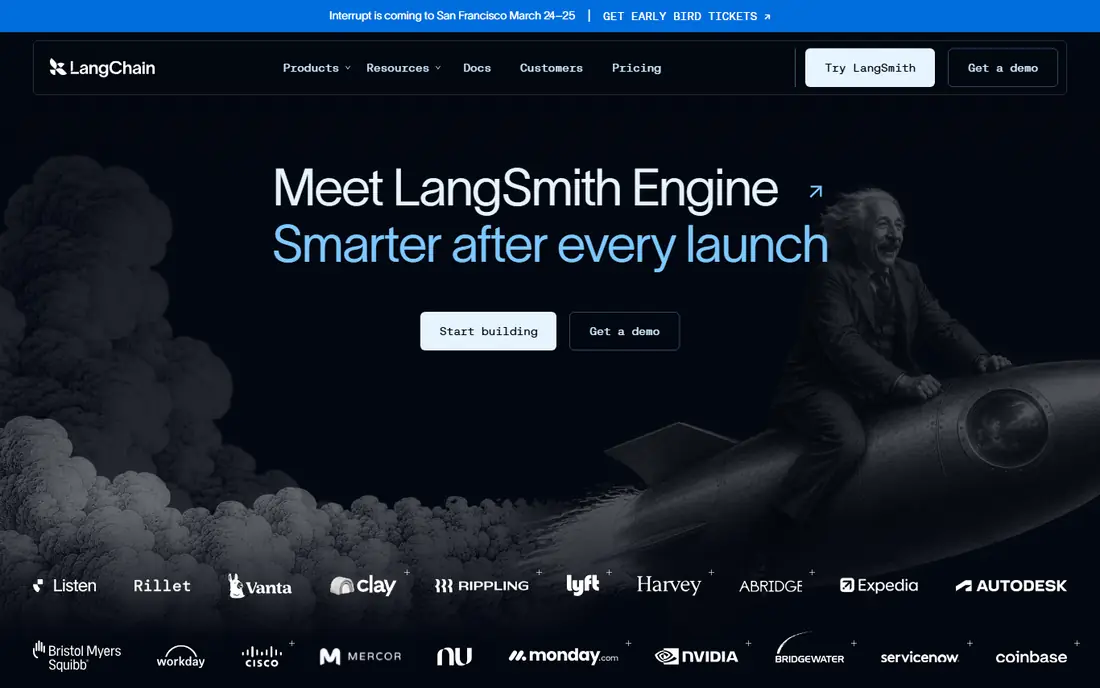
LangChain presents itself as the open agent platform to own your intelligence, covering build, test, deploy, monitor, iterate and govern. Its homepage highlights building with proven agent patterns, owning the harness, context, memory and model choice, debugging with step-by-step tracing, shipping on infrastructure for long-running tasks with isolated sandboxes for agent-generated code, and governing with cost limits, sensitive-data detection and human approval for sensitive actions. It notes more than 350 million monthly open source downloads and 7,000-plus LangSmith customers, including five of the Fortune 10.
LangChain suits teams that want one platform across the agent lifecycle, from prototype to governed production. Its lifecycle framing matches best practice directly: test before shipping, monitor in production, and require approval for sensitive actions. For visual-only building, Flowise is simpler, but for full lifecycle control LangChain leads.
- Open agent platform to own your intelligence
- Build agents fast with or without code and any model provider
- Test with step-by-step tracing and evals from traces
- Deploy on infra for long-running tasks, persistent state and secure execution
- Monitor with online evals, dashboards and alerts
- Iterate through a feedback loop
- Govern with cost limits, sensitive-data detection and human approval for sensitive actions
- More than 350 million monthly open source downloads
- 7,000-plus LangSmith customers
- Platform breadth needs learning
- Production setup takes planning across build, test and govern stages
CrewAI
Ideal for: Enterprise multi-agent
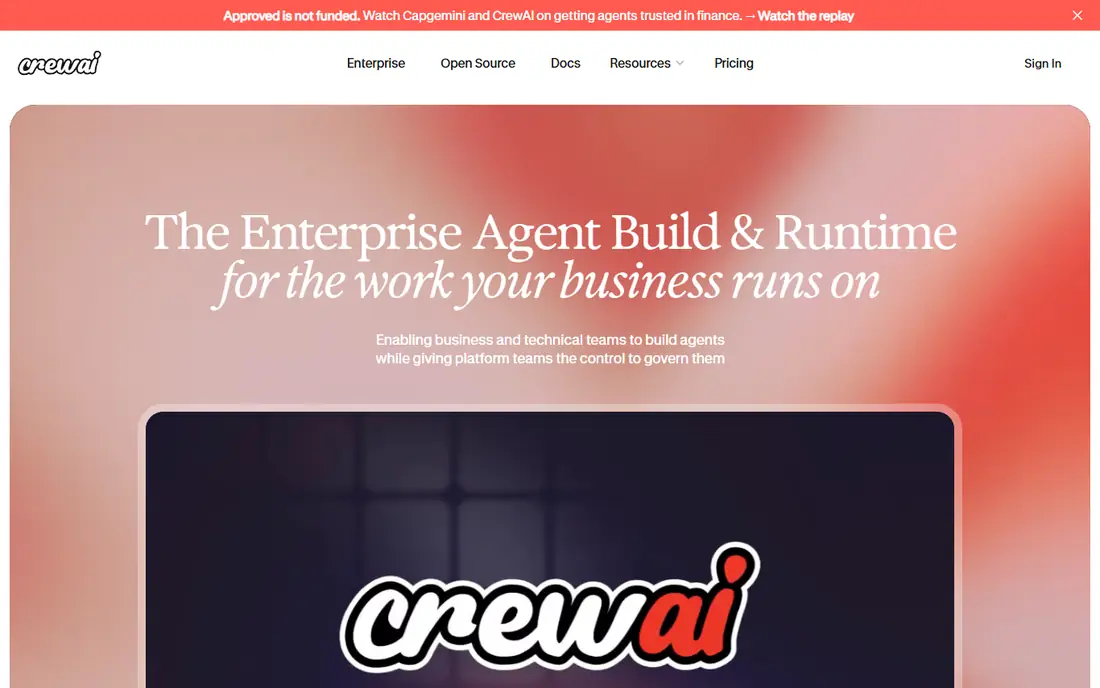
CrewAI is the enterprise agent build and runtime for the work businesses run on, giving business and technical teams a unified build platform with central governance. Its homepage highlights discovery that matches patterns from billions of agent runs against tickets, chats, apps and workflows, a multi-agent builder guided by 700,000 agent workflow patterns, and a control plane in the execution path of every workflow ensuring every interaction is observable, compliant and reversible. Governance includes real-time tracing of every LLM call, tool call and memory read with cost accounting, RBAC and audit, human approval gates, and runtime hooks for PII redaction and policy checks.
CrewAI suits enterprises building multi-agent systems for operations, where governance, audit and reversibility matter as much as capability. Its discovery feature helps teams pick the right automation before building, which is itself a best practice. For open-source single-agent work, LangChain or Haystack may be lighter, but for governed enterprise agents CrewAI is a strong pick.
- Enterprise agent build and runtime for business and technical teams
- Used by 65% of the Fortune 500
- Discovery ranks automation opportunities by effort, value and readiness
- Multi-agent builder with no-code visual editor exportable to Python and code-first API
- Role-based agents with deterministic workflows
- Control plane with real-time tracing, RBAC, audit trails, human-in-the-loop approval gates and PII redaction
- Optimization with multi-LLM testing and evals
- Enterprise focus and pricing need a sales conversation
- Smaller teams may not need its governance depth
LlamaIndex
Ideal for: Document agents
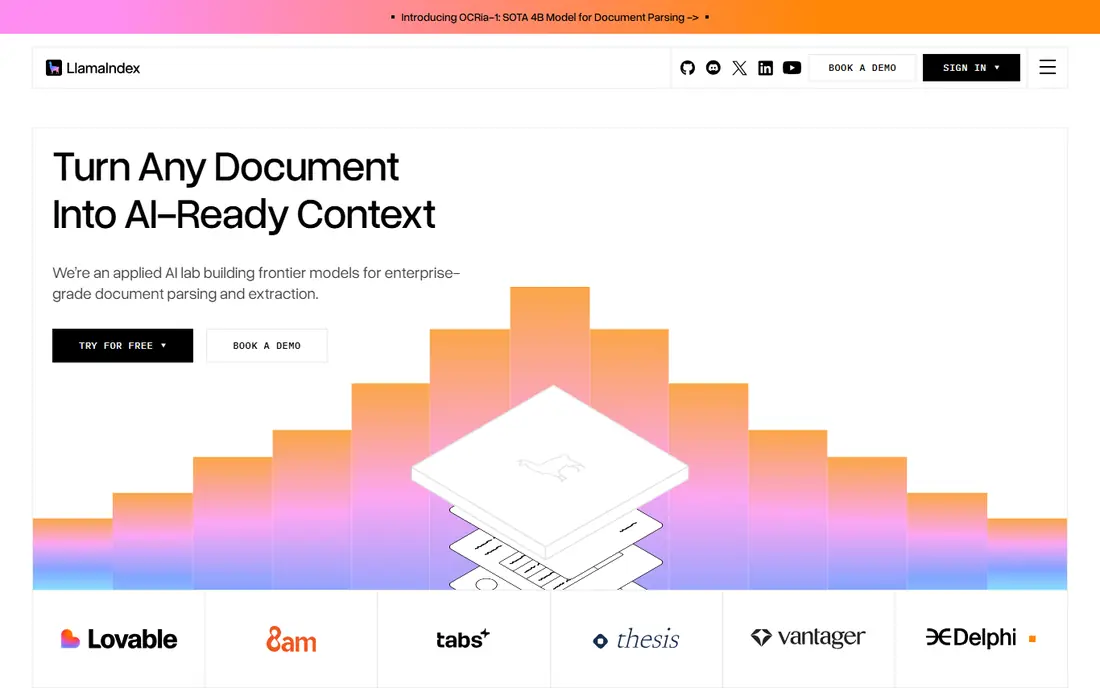
LlamaIndex is an applied AI lab building frontier models for document parsing and extraction, with LlamaParse for enterprise-grade document automation. Its homepage highlights agentic OCR for layout-aware parsing, structured extraction of defined schemas, and building and deploying end-to-end document agents, with a free plan including 10,000 credits per month. It notes more than 1 billion documents processed, 25 million package downloads per month and 300,000-plus LlamaParse users, with enterprise security including granular access controls, encryption and HIPAA, GDPR and SOC2 compliance.
LlamaIndex suits custom agents that must read messy documents accurately, such as finance, insurance and healthcare workflows. Its parsing quality reduces the retrieval errors that cause agent hallucinations, which is a core best practice: ground agents in clean, structured data. For general multi-tool agents, LangChain fits better, but for document-grounded agents LlamaIndex leads.
- AI agents for document OCR and workflows
- LlamaParse agentic OCR for layout-aware parsing of 50-plus file types
- Free plan with 10,000 credits per month, about 1,000 pages
- Paid plans from $50 per month
- Structured extraction with defined schemas
- Multi-step document agents
- More than 1 billion documents processed
- 25 million package downloads per month
- 99.9% uptime
- HIPAA, GDPR and SOC2 compliant out of the box
- Cloud or VPC deployment
- Document-centric, so general tool orchestration needs another framework
- Paid parsing costs scale with volume
n8n
Ideal for: Workflow agents
n8n is the AI workflow automation platform for agents and workflows you can follow, where users open any step, see what it does and explain it to anyone who runs it. Its homepage highlights security and control with on-prem deployment, SSO, encrypted secrets and RBAC, observability with audit logs, workflow history and real-time alerts, developer experience with Git-based control and isolated environments, and AI governance with human-in-the-loop, guardrails and evaluations. Case studies note Huel saving 1,000 hours with an AI-first culture and Vodafone delivering a 2.2 million pound security operations win.
n8n suits teams that want agents as inspectable workflows, where each step, tool call and approval is visible and auditable. Its human-in-the-loop and guardrail features match best practice for sensitive workflows. For code-first agent frameworks, LangChain or Microsoft Agent Framework fit better, but for transparent workflow agents n8n is excellent.
- Platform for agents and workflows you can follow, with every step inspectable
- Fully on-prem option with SSO, SAML, LDAP, encrypted secret stores, version control and RBAC
- Audit logs and log streaming to SIEM, workflow history, real-time alerts and usage dashboards
- Git-based control and isolated environments
- AI governance with human-in-the-loop, guardrails and evaluations
- Trusted by Fortune 500 companies
- Case results including Huel saving 1,000 hours and Vodafone's 2.2 million pound security operations win
- Workflow model suits structured processes more than open-ended agents
- Self-hosting needs operations effort
Haystack
Ideal for: Production RAG agents
Haystack is an open-source AI framework for production-grade agents, built around advanced retrieval-augmented generation, AI agents, multimodal AI and conversational AI. Its homepage highlights highly performant RAG pipelines with hybrid retrieval and self-correction loops, production-ready agents with standardized tool calling and scalable context engineering, and branching and looping pipelines that give full control over complex, multi-step decision flows. Its prompt flows use Jinja-2 templates for content generation engines matched to exact workflows.
Haystack suits developers building production RAG agents where retrieval quality and pipeline control matter most. Its self-correction loops and standardized tool calling embody best practice: verify retrieved context before acting, and keep tool interfaces consistent. For a managed platform, LangChain or CrewAI may be easier, but for open-source RAG agents Haystack is a strong choice.
- Open-source AI framework for production-grade agents
- Advanced RAG with hybrid retrieval and self-correction loops
- Production-ready agents with standardized tool calling and scalable context engineering
- Branching and looping pipelines for full control over multi-step decision flows
- Multimodal support for image processing and audio transcription
- Conversational AI with standardized generator interfaces
- Flexible prompt flows with Jinja-2 templates
- Developer framework, so it needs coding skill
- Production deployment needs your own infrastructure
Microsoft Agent Framework
Ideal for: .NET and Python agents
Microsoft Agent Framework is an open, multi-language framework for building production-grade AI agents and multi-agent workflows in .NET and Python, with Go support as well. Its project page highlights orchestration beyond a single prompt, graph-based patterns including sequential, concurrent, handoff and group collaboration, durability, restartability, observability, governance and human-in-the-loop control, plus provider flexibility so architecture can evolve without major rewrites. Features include middleware, declarative YAML agents, agent skills, DevUI for testing and debugging, and built-in OpenTelemetry tracing.
Microsoft Agent Framework suits teams taking agents from prototype to production in .NET or Python, especially those already using Azure or Microsoft Foundry. Its checkpointing and human-in-the-loop controls match best practice for long-running, sensitive agents. Note that AutoGen, its predecessor, is now archived and no longer maintained, so new projects should start with Microsoft Agent Framework instead.
- Open, multi-language framework for production-grade agents and multi-agent workflows in .NET, Python and Go
- Enterprise-ready successor to AutoGen with long-term support
- Graph workflows with sequential, concurrent, handoff and group collaboration patterns
- Checkpointing, streaming, human-in-the-loop and time-travel
- Built-in OpenTelemetry observability
- Middleware for request and response processing
- Declarative agents in YAML
- Foundry hosted agents with two extra lines of code
- MIT licence
- 14,317 stars on its project page
- Newer framework, so community resources are still growing
- Azure and Foundry integration is strongest for Microsoft-stack teams
Flowise
Ideal for: Visual agent building
Flowise is an open-source platform to build AI agents visually, with modular building blocks for any agentic system, from simple compositional workflows to autonomous agents. Its homepage highlights Agentflow for multi-agent systems, Chatflow for single-agent systems with tool calling and RAG, human-in-the-loop review, full execution traces with Prometheus and OpenTelemetry, and APIs, SDKs and embedded chat for integration. Pricing starts with a free plan at $0 per month with 2 flows and 100 predictions, then Starter at $35 per month and Pro at $65 per month, with enterprise deployment on cloud or on-premises.
Flowise suits teams that want to prototype custom agents visually, especially for RAG chatbots and multi-agent workflows, without writing framework code first. Its execution traces and human review support best practice from the start. For code-first production agents, LangChain or Microsoft Agent Framework offer more control, but for visual agent building Flowise is the most accessible pick here.
- Open source agentic systems development platform with visual building
- Multi-agent systems with workflow orchestration across coordinated agents
- Single-agent chat assistants with tool calling and RAG
- Human-in-the-loop review of agent tasks
- Full execution traces with Prometheus and OpenTelemetry support
- APIs, SDKs and embedded chat
- 100-plus LLMs, embeddings and vector databases
- Cloud and on-prem deployment
- Free plan with 2 flows, 100 predictions per month and evaluations
- Starter at $35 per month and Pro at $65 per month
- Visual building suits many agents but complex logic may still need code
- Free plan limits flows and predictions
How we picked these
We compared official homepages, agent building models, evaluation and governance features, deployment options and price, favoring tools that actively support custom agents in 2026. We covered code frameworks, enterprise platforms, document agents, workflow agents and visual builders, because the best tool depends on your team's skills and governance needs. We checked each tool's own site before listing it. We excluded AutoGen for new projects because Microsoft has archived it and directs new users to Microsoft Agent Framework.
Best practices for custom AI agent tools
Start narrow. Define one job for the agent, list its allowed tools, and set clear success criteria before building. LangChain's proven patterns, CrewAI's discovery ranking and Microsoft Agent Framework's workflow patterns all help here: pick the smallest agent that solves the job, then expand only after evals pass. Avoid giving an agent broad permissions, such as full database write access, when it only needs to read one table or call one API.
Next, build safety into the agent. Limit tool permissions to least privilege, run agent-generated code in isolated sandboxes, as LangChain recommends, and require human approval for sensitive actions, such as sending money, deleting data or contacting customers. Add PII redaction and policy checks, as CrewAI's control plane does, and keep audit logs and traces, as n8n and Flowise provide, so every action can be reviewed. Test with evals before shipping: turn real traces into datasets, measure accuracy, cost, latency and errors, and fix failures before users see them.
Finally, govern agents in production. Monitor cost, latency, errors and tool behavior with dashboards and alerts, as LangChain's monitor stage does, and track regressions before users do. Version prompts, tools and models together so rollbacks work, and review agent behavior regularly with human feedback. Ground agents in clean data, using LlamaIndex parsing for documents and Haystack retrieval for RAG, so answers rest on verified sources rather than model guesses. These practices matter more than any single tool choice.
Frequently asked questions
What are custom AI agent tools?
Custom AI agent tools are frameworks and platforms for building agents that plan, call tools, read data and act toward a goal, such as LangChain, CrewAI, Haystack and Microsoft Agent Framework. They differ from chatbots by taking actions through tools, not just answering questions.
Which tool is best for building a custom AI agent?
LangChain suits most teams for full lifecycle coverage, CrewAI suits enterprise multi-agent governance, and Microsoft Agent Framework suits .NET and Python production agents. For document agents choose LlamaIndex, for workflow agents choose n8n, and for visual building choose Flowise.
Should I still use AutoGen for new agents?
No, Microsoft has archived AutoGen and no longer maintains it, directing new users to Microsoft Agent Framework, its enterprise-ready successor with long-term support. Existing AutoGen users should plan migration using Microsoft's migration guide.
How do I keep AI agents safe?
Limit tool permissions, sandbox code execution, require human approval for sensitive actions, redact sensitive data, log every action, and evaluate before shipping. These practices appear across LangChain, CrewAI, n8n and Microsoft Agent Framework for good reason.
How do I evaluate an AI agent before launch?
Turn real traces into test datasets, measure accuracy, cost, latency and errors, and check tool calls and outputs against expected results. LangChain's test stage, CrewAI's optimization with evals, and n8n's evaluations all support this workflow.
Can I build AI agents without coding?
Yes, Flowise offers visual building with multi-agent workflows and RAG chatbots, CrewAI offers a no-code visual editor exportable to Python, and LangChain supports building with or without code. Visual tools suit prototypes, while code frameworks suit complex production agents.