Best Daydream AEO Alternatives in 2026: 8 Answer Engine Tools Compared

- 1
 ProfoundAI visibility trackingVisit
- 2
 Peec AIBrand mentions in AI answersVisit
- 3
 Scrunch AIPrompt monitoringVisit
- 4
 Otterly AISimple AI visibility reportsVisit
- 5
 EvertuneAI visibility across modelsVisit
- Profound and Peec AI suit teams that want dedicated tracking of brand mentions across AI answers.
- Scrunch AI and Otterly AI suit smaller teams that want prompt monitoring without enterprise complexity.
- Evertune suits brands that want statistically grounded visibility scores across many AI models.
- Writesonic suits content teams that want answer optimization bundled with AI writing tools.
- Semrush and Ahrefs suit teams that want answer engine data alongside traditional SEO toolkits.
Quick comparison
| Product | Ideal for | Price from | Free version | |
|---|---|---|---|---|
| Profound | AI visibility tracking | See website | See website | Visit |
| Peec AI | Brand mentions in AI answers | See website | See website | Visit |
| Scrunch AI | Prompt monitoring | See website | See website | Visit |
| Otterly AI | Simple AI visibility reports | See website | See website | Visit |
| Evertune | AI visibility across models | See website | See website | Visit |
 Writesonic | Writing plus answer optimization | See website | See website | Visit |
 Semrush | SEO plus AI visibility | See website | Free trial | Visit |
 Ahrefs | SEO plus brand monitoring | See website | See website | Visit |
The best Daydream AEO alternatives
Daydream AEO helps brands track how they appear in AI-generated answers, and answer engine optimization, often shortened to AEO, is the practice of shaping content so AI assistants cite and recommend it. The tools below cover similar ground: they monitor prompts, track brand mentions and citations, and show where a brand appears in AI answers. They differ in depth, platform coverage, and price, so the right pick depends on how central AI search is to your marketing.
Profound
Ideal for: AI visibility tracking

Profound is built specifically for the AI search era, tracking how a brand shows up in answers from major AI assistants. It monitors prompts, surfaces the sources those answers cite, and shows how visibility changes over time. That focus suits marketing teams that need to report AI visibility to leadership in concrete terms.
The trade-off is scope: Profound does not replace a traditional SEO toolkit, so teams still need other tools for rankings, backlinks, and technical audits. Pricing is not fully published. For teams whose main question is how AI answers treat their brand, Profound is a strong dedicated pick.
- Dedicated AI answer tracking
- Prompt-level reporting
- Conversation and citation views
- Narrower than full SEO suites
- Pricing is quote-based for larger teams
Peec AI
Ideal for: Brand mentions in AI answers
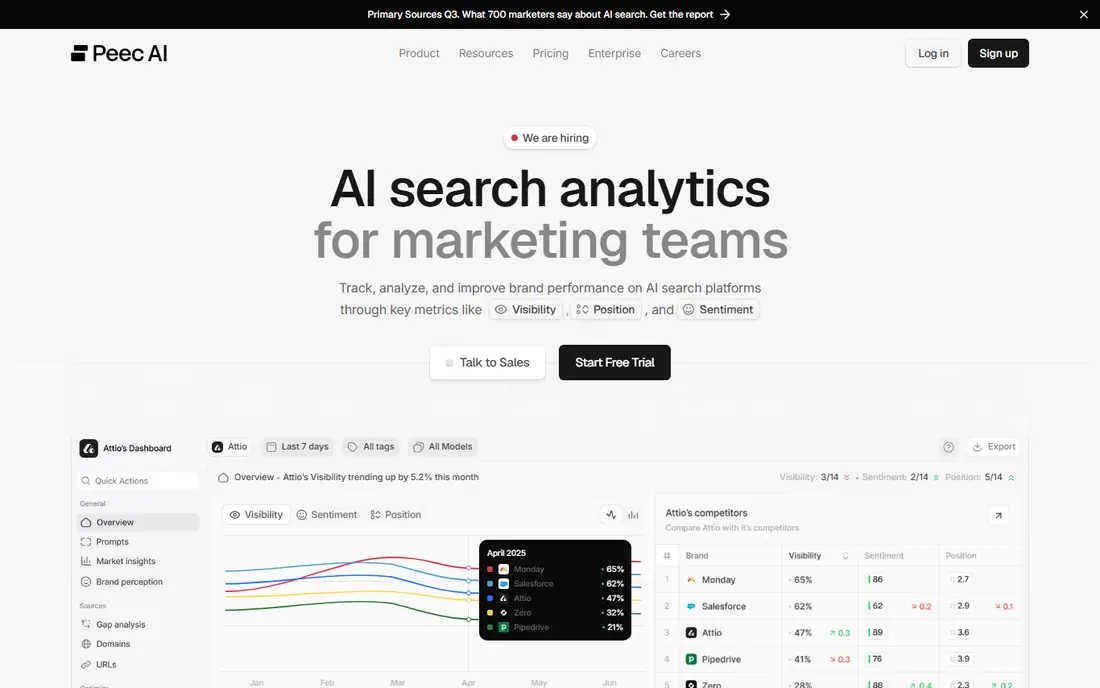
Peec AI tracks how often and how favorably AI assistants mention a brand, with sentiment views that show whether mentions are positive, neutral, or negative. Competitor comparisons put your visibility next to rivals on the same prompts, which helps teams see where they trail. Prompt libraries make it easier to start without writing hundreds of test questions.
As a newer vendor, Peec AI has fewer third-party integrations than Semrush or Ahrefs. For teams that want a focused, readable view of brand presence in AI answers, it is a practical choice.
- Clear mention and sentiment tracking
- Competitor comparisons
- Prompt libraries
- Newer vendor
- Fewer integrations than established suites
Scrunch AI
Ideal for: Prompt monitoring
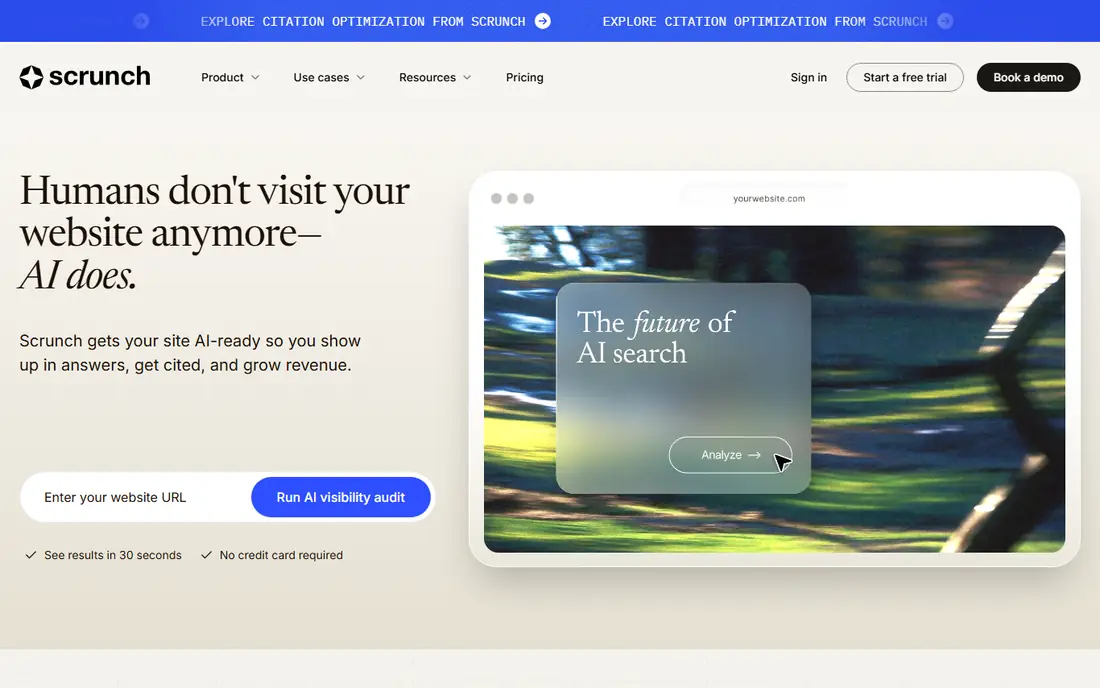
Scrunch AI monitors the prompts customers actually ask and shows how a brand performs on them, including which personas and questions drive mentions. Content gap findings point to topics where competitors appear and you do not, which gives content teams a clear next step. Setup is straightforward compared with enterprise platforms.
The feature set is smaller than the biggest AEO platforms, and reporting depth varies by plan. For small and mid-size teams that want prompt monitoring without a long implementation, Scrunch AI is a good fit.
- Prompt and persona monitoring
- Content gap findings
- Straightforward setup
- Smaller feature set than enterprise platforms
- Reporting depth varies
Otterly AI
Ideal for: Simple AI visibility reports
Otterly AI keeps AI visibility reporting simple, with dashboards that show brand mentions, competitor positions, and the links AI answers cite. That simplicity suits teams that want a weekly check on AI presence without learning a complex platform. Citation views help content teams see which pages actually get referenced.
It offers less guidance on how to improve content than tools with built-in optimization workflows. For teams that want clear, readable AI visibility reports, Otterly AI is an easy starting point.
- Simple dashboards
- Brand and competitor tracking
- Link and citation views
- Less depth on content optimization
- Newer product
Evertune
Ideal for: AI visibility across models
Evertune tracks brand visibility across major AI models, sampling prompts repeatedly to produce scores that hold up statistically rather than shifting with a single answer. That approach suits brands that need reliable comparisons across ChatGPT, Gemini, Claude, Perplexity, and other models. Prompt strategy draws on real user questions, so tracking follows what buyers actually ask.
Beyond tracking, Evertune connects visibility gaps to content work and advertising inside AI conversations, which helps teams act on the data. The platform leans enterprise, and pricing is quote-based. For brands that want rigorous, multi-model AI visibility, Evertune is a strong pick.
- Tracks many AI models
- Statistically grounded scores
- Content and ad actions from visibility data
- Enterprise focus
- Pricing is quote-based
Writesonic
Ideal for: Writing plus answer optimization
Writesonic combines AI writing tools with answer engine features, so content teams can draft, optimize, and check AI visibility in one workflow. Templates cover blog posts, ads, and product pages, and optimization guidance helps shape content for citation. That bundle suits teams that produce a lot of content and want AEO inside the writing process.
AEO depth varies by plan, and dedicated trackers offer deeper prompt reporting. For content teams that want writing and answer optimization together, Writesonic is a convenient pick.
- AI writing plus AEO features
- Content optimization guidance
- Many templates
- AEO features are part of a broader suite
- Depth varies by plan
Semrush
Ideal for: SEO plus AI visibility
Semrush is a full SEO platform that has added AI visibility tracking alongside its keyword, ranking, and competitor tools. Teams that already use Semrush for search can add AI answer monitoring without adopting a separate product, and the large keyword database helps build prompt lists from real search demand. Competitor research remains a strength.
Costs grow as seats and add-ons pile up, and the platform takes time to learn. For teams that want AEO data inside a proven SEO toolkit, Semrush is the safest broad choice.
- Full SEO toolkit plus AI tracking
- Large keyword data
- Competitor research
- Cost grows with seats and add-ons
- Learning curve for new users
Ahrefs
Ideal for: SEO plus brand monitoring
Ahrefs is known for backlink and content data, and it has added brand monitoring and AI visibility features to that base. Teams can pair citation tracking with the content and link data that often decides which pages AI answers cite. Reports are clear, and the interface is fast.
Its AI features are newer than its SEO core, so dedicated AEO tools may offer deeper prompt analysis. For teams already invested in Ahrefs for search, adding its AI visibility views is a natural step.
- Strong backlink and content data
- Brand mention tracking
- Clear reports
- AI features are newer than its SEO core
- Pricing is subscription only
How we picked these
We compared official feature pages, pricing, and public reviews for each tool, and we checked that each product is actively offered in October 2026. We favored tools that track real AI answers across major assistants, and we kept a mix of dedicated AEO platforms and broader suites with AEO features. We left out generic rank trackers with no AI answer data and tools that have shut down.
How to choose an AEO tool
AI answers change often, so pick a tool that fits how your team will actually use the data week to week.
Start with your prompt list
Write down the questions customers ask before buying, including comparisons, pricing questions, and problem-based queries. A tool is only useful if it tracks those prompts well, so test your real list during a trial rather than trusting a demo. Include competitor names in the list, since share of voice only means something against rivals.
Check citation quality, not just mentions
A mention without a citation sends no traffic, so look at which pages AI answers actually link to and whether your best pages appear. Tools that show citation sources help content teams fix the right pages. Also check sentiment, since a mention in a negative context is not a win.
Plan for fast change
AI platforms update models and answer formats regularly, which shifts results even when your content stays the same. Favor tools that update tracking often and explain changes in plain terms. Revisit your prompt list each quarter, since customer questions shift as products and markets change.
Answer engine tracking only helps if the prompts you watch match real buyer questions. Start with the questions your sales and support teams already hear, then add brand comparisons and category questions that buyers ask before they know your name. Run the same prompt set on a fixed schedule so changes over time mean something, and record citations separately from mentions, since a mention without a citation rarely sends traffic. Pair visibility data with search console clicks and demo requests to see which answers turn into pipeline. Review prompt lists each quarter, since product lines and buyer language shift.
Frequently asked questions
What is Daydream AEO?
Daydream AEO is an answer engine optimization tool that helps brands track and improve how they appear in AI-generated answers. The tools here offer similar tracking of brand mentions, citations, and prompt performance across AI assistants.
What is answer engine optimization?
Answer engine optimization means shaping content so AI assistants cite and recommend it in their answers. It covers clear factual pages, structured content, and strong source authority, and it differs from traditional SEO because the goal is citation inside an answer rather than a blue link ranking.
Which AEO tool is best for small teams?
Scrunch AI and Otterly AI suit smaller teams, since they focus on prompt monitoring and readable reports without enterprise complexity. Writesonic also fits small content teams that want writing and optimization in one tool.
Do AEO tools replace SEO tools?
No. AI answers draw on the same web content that search engines rank, so rankings, links, and technical health still matter. Most teams pair a dedicated AEO tracker with a traditional SEO toolkit such as Semrush or Ahrefs.
How do I measure AEO success?
Track brand mention rate, citation rate, share of voice against competitors, and sentiment across your core prompt list. Traffic from AI referrals is harder to measure, so pair tool data with analytics on referral sources and branded search volume.