Best Intercom Alternatives in 2026: 8 Tools Compared

- Zendesk suits larger support teams that need tickets, while Crisp and Tawk.to suit smaller teams on a budget.
- HubSpot Service Hub is our pick for teams already using HubSpot CRM and marketing tools.
- Drift and Freshchat suit different needs, with Drift for sales conversations and Freshchat for support chat.
- Live chat pricing usually depends on seats, contacts and features, so get a quote for your team size.
- Free plans work for small teams, but automation, integrations and reporting usually need a paid plan.
Quick comparison
| Product | Ideal for | Price from | Free version | |
|---|---|---|---|---|
 Zendesk | Larger support teams | See website | Free trial | Visit |
 Crisp | Small teams on budget | Free | Yes | Visit |
 Tawk.to | Free live chat | Free | Yes | Visit |
 HubSpot Service Hub | HubSpot users | Free | Yes | Visit |
 Freshchat | Support chat | Free | Yes | Visit |
 Drift | Sales conversations | See website | No | Visit |
 LiveChat | Simple live chat | See website | Free trial | Visit |
 Help Scout | Shared inbox support | See website | Free trial | Visit |
The best Intercom alternatives
Intercom is a powerful customer messaging platform, but its pricing and complexity push many teams to look elsewhere. Alternatives range from free live chat to full support suites with tickets, automation and CRM integration. We compared official feature pages, pricing, app listings and public reviews to find tools that still serve teams well in October 2026.
Zendesk
Ideal for: Larger support teams
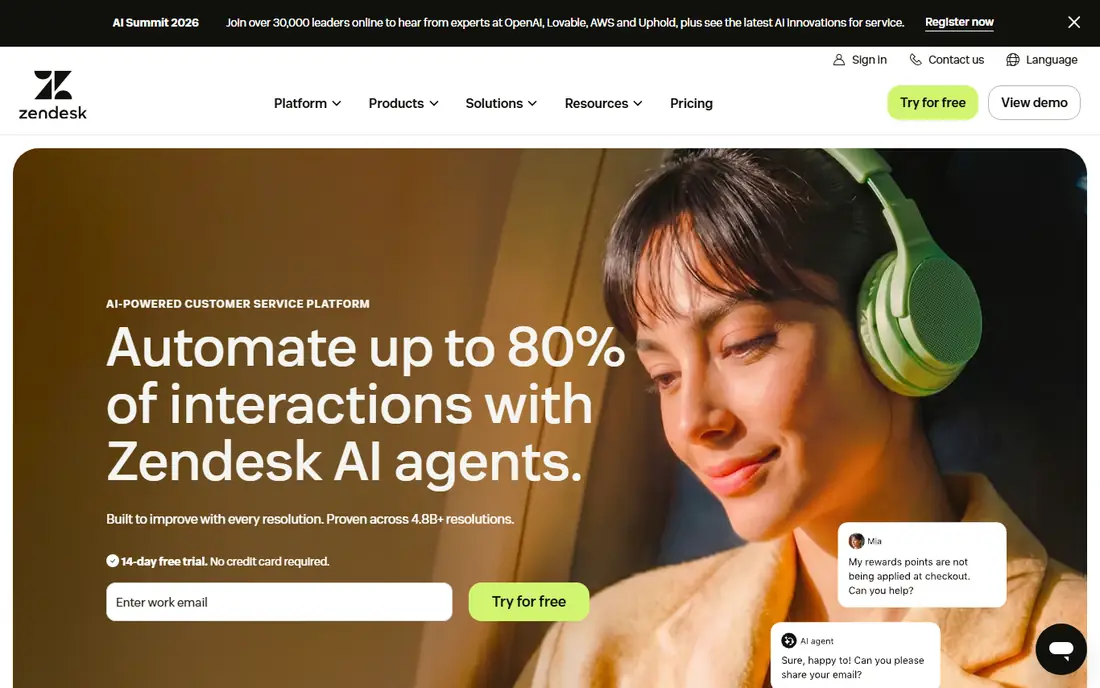
Zendesk is the most complete support alternative to Intercom for larger teams. It combines live chat, email tickets, phone, help centre and AI automation in one system, with reporting that shows volume, response times and agent performance. That breadth suits companies with high support volume and a need for structured ticket workflows.
Complexity and price are the trade-offs. Zendesk takes longer to set up than a simple chat tool, and pricing per agent can add up for large teams. If your support is mainly tickets and you need deep reporting, Zendesk is a strong choice, but small teams may prefer Crisp or Tawk.to.
- Full ticketing and support suite
- Strong reporting
- Large integration library
- Higher price and complexity
- Setup takes time
- Messaging less conversational than Intercom
Crisp
Ideal for: Small teams on budget

Crisp is a popular Intercom alternative for startups and small businesses because its free plan covers live chat, shared inbox and basic automation for small teams. Paid plans add more seats, automation and integrations at prices lower than Intercom or Zendesk. The interface is clean and easy to set up, which helps teams that want chat running the same day.
Advanced automation and reporting are thinner than enterprise tools, so large support teams may outgrow Crisp. For a small team that needs live chat, email and a shared inbox without a large budget, Crisp offers excellent value.
- Free plan for small teams
- Shared inbox and chat
- Good value on paid plans
- Advanced automation limited
- Smaller integration library
- Reporting thinner than Zendesk
Tawk.to
Ideal for: Free live chat

Tawk.to is the only tool on this list that offers live chat completely free, with unlimited agents, monitoring, ticketing and a knowledge base included. That makes it ideal for small businesses, nonprofits and startups with no budget for support software. You can add it to a website in minutes and start chatting with visitors the same day.
Paid add ons remove Tawk.to branding and add video chat and other features, while the interface feels dated beside Crisp or HubSpot. Support is mainly community led, so teams that need a dedicated helpdesk may prefer a paid tool, but for free live chat, Tawk.to is unmatched.
- Completely free live chat
- Unlimited agents
- Monitoring and ticketing included
- Paid add ons for branding removal and video
- Interface feels dated
- Support is community led
HubSpot Service Hub
Ideal for: HubSpot users
HubSpot Service Hub is the best Intercom alternative for teams already using HubSpot CRM, marketing or sales tools. The free tier includes live chat, shared inbox, tickets and a knowledge base, all connected to the CRM, so support conversations link to customer records automatically. That integration saves time and gives support agents full context.
Advanced automation, reporting and feedback tools need paid tiers, and teams not already on HubSpot may find the ecosystem heavy. If you already use HubSpot, Service Hub is a natural choice, since it avoids a separate messaging platform and keeps customer data in one place.
- Free CRM and live chat
- Integrates with HubSpot marketing and sales
- Tickets and knowledge base
- Advanced features need paid tiers
- HubSpot ecosystem lock in
- Reporting limited on free plan
Freshchat
Ideal for: Support chat
Freshchat, from Freshworks, offers modern messaging for support teams, with live chat, in app messaging and bots that can answer common questions. The free plan covers small teams, while paid plans add AI, automation and integrations with Freshdesk for ticketing. That combination suits teams that want chat plus a full support desk without Intercom pricing.
Advanced AI and automation need higher tiers, and the ecosystem is smaller than Zendesk's, so some niche integrations may be missing. For support teams that want a modern chat experience at a lower price than Intercom, Freshchat is a solid choice.
- Free plan for small teams
- Modern messaging
- Integrates with Freshdesk
- Advanced AI features need paid plans
- Smaller ecosystem than Zendesk
- Pricing rises with users
Drift
Ideal for: Sales conversations
Drift is built for sales conversations, not general support, with chatbots and playbooks that qualify leads, book meetings and route high intent visitors to sales reps. That focus makes it powerful for B2B companies that want website chat to generate pipeline, rather than just answer support questions. CRM integrations keep lead data in sync with sales tools.
Price is high, and support only teams will find Drift overkill, since its strength is sales, not ticketing. If your website chat goal is lead generation and sales meetings, Drift is worth evaluating, but if you need support tickets, choose Zendesk or Help Scout instead.
- Strong for sales and lead qualification
- Chatbots and playbooks
- Integrates with CRM
- Expensive for support only use
- Sales focus, not general support
- Pricing quoted
LiveChat
Ideal for: Simple live chat
LiveChat is a straightforward live chat tool that focuses on doing chat well, with customisable widgets, canned responses, chat routing and reporting. It integrates with many CRMs, helpdesks and e-commerce platforms, which makes it easy to add to an existing stack. Setup is quick, and agents can learn it in a day.
There is no permanent free plan, only a trial, and support features like ticketing are thinner than Zendesk's. For businesses that mainly need website chat, not a full support suite, LiveChat is a reliable and well supported choice, with pricing per agent.
- Easy setup
- Good chat widgets
- Reporting and integrations
- No permanent free plan
- Support features thinner than Zendesk
- Pricing per agent
Help Scout
Ideal for: Shared inbox support
Help Scout suits teams whose support is mainly email, with a clean shared inbox, collision detection, saved replies and a knowledge base. It feels more personal than a ticket system, since conversations look like email rather than ticket numbers, which customers often prefer. Live chat is available through an add on, and integrations cover common CRMs and tools.
Live chat is not the core product, so chat heavy teams should check the add on carefully, and pricing per user can add up for large teams. For email heavy support teams that want a human, organised inbox, Help Scout is an excellent Intercom alternative.
- Clean shared inbox
- Knowledge base
- Good for email heavy support teams
- Live chat is an add on
- Pricing per user
- Less automation than Intercom
How we picked these
We compared official feature pages, pricing pages and public reviews, and we only included tools that still offer live chat or customer messaging in October 2026. We favoured tools with clear free or trial options, distinct strengths for different team sizes, and a range of prices from free to enterprise, so readers can shortlist by budget and use case.
How to choose an Intercom alternative
Start with your main job: support tickets, live chat, sales conversations or all three. Ticket heavy teams should shortlist Zendesk and Help Scout, chat heavy teams should look at Crisp, Tawk.to and LiveChat, and sales focused teams should evaluate Drift. If you already use HubSpot or Freshworks, their service tools will integrate more smoothly than a standalone chat app.
Check pricing for your actual team size and contact volume, since many tools charge per agent, per contact or per conversation. Test the chat widget on your own website, since speed, mobile experience and customisation matter to visitors, and ask about automation, integrations and reporting before you commit, since those features often sit on higher tiers.
Frequently asked questions
What is the best free Intercom alternative?
Tawk.to offers completely free live chat with unlimited agents, while Crisp, HubSpot Service Hub and Freshchat offer free plans for small teams. Choose Tawk.to for pure free chat, and Crisp or HubSpot for a broader free tier.
Is Zendesk better than Intercom?
Zendesk is better for ticket based support and reporting, while Intercom is stronger for conversational messaging and product tours. Choose Zendesk for high volume support, and Intercom or Drift for sales and product messaging.
Which Intercom alternative is best for small businesses?
Crisp is best for small businesses that want a clean, affordable chat and inbox, while Tawk.to is best if budget is zero. HubSpot Service Hub is best if you already use HubSpot CRM.
Can I migrate from Intercom to another tool?
Yes, most tools offer import tools or APIs for conversations, contacts and help centre articles, though migration effort varies. Ask the new vendor for migration help and test with a small batch before moving everything.
Do I need live chat if I already have email support?
Live chat helps visitors who want an immediate answer and can increase conversions, especially for sales and onboarding questions. Email suits complex issues that need investigation, so many teams offer both.