Best Invoca Alternatives in 2026: 8 Products Compared

- 1
 CallRailCall tracking for agenciesVisit
- 2
 CallTrackingMetricsMulti-channel attributionVisit
- 3
 WhatConvertsLead tracking for agenciesVisit
- 4
 MarchexEnterprise call analyticsVisit
- 5
 RetreaverPay-per-call trackingVisit
- CallRail is our pick for most people, thanks to its balance of features, documentation, and price.
- CallTrackingMetrics is a strong second choice if you want a different strength, especially for multi-channel attribution.
- If cost is the main concern, check the free options first, including WhatConverts and any free tier listed in the table below.
- For larger teams or stricter requirements, Marchex and Retreaver are worth a closer look, since they cover scale and control in more depth.
- Always confirm current pricing on the vendor site before you buy, since plans and free tiers change during the year.
Quick comparison
| Product | Ideal for | Price from | Free version | |
|---|---|---|---|---|
| CallRail | Call tracking for agencies | See website | Free trial | Visit |
| CallTrackingMetrics | Multi-channel attribution | See website | Free trial | Visit |
| WhatConverts | Lead tracking for agencies | See website | Free trial | Visit |
| Marchex | Enterprise call analytics | See website | No | Visit |
| Retreaver | Pay-per-call tracking | See website | No | Visit |
 Phonexa | Lead and call platforms | See website | No | Visit |
 CallPage | Website callback widgets | See website | Free trial | Visit |
 Infinity | Call intelligence for marketers | See website | Free trial | Visit |
The best invoca alternatives
We compared official feature pages, pricing pages, app store listings, privacy policies, and public reviews to build this list. The options below cover the well-known leaders and smaller tools that earned a place on merit, and each one works in October 2026. Read the short notes, then use the buying guide at the end to narrow the list to one or two finalists for a trial.
CallRail
Ideal for: Call tracking for agencies
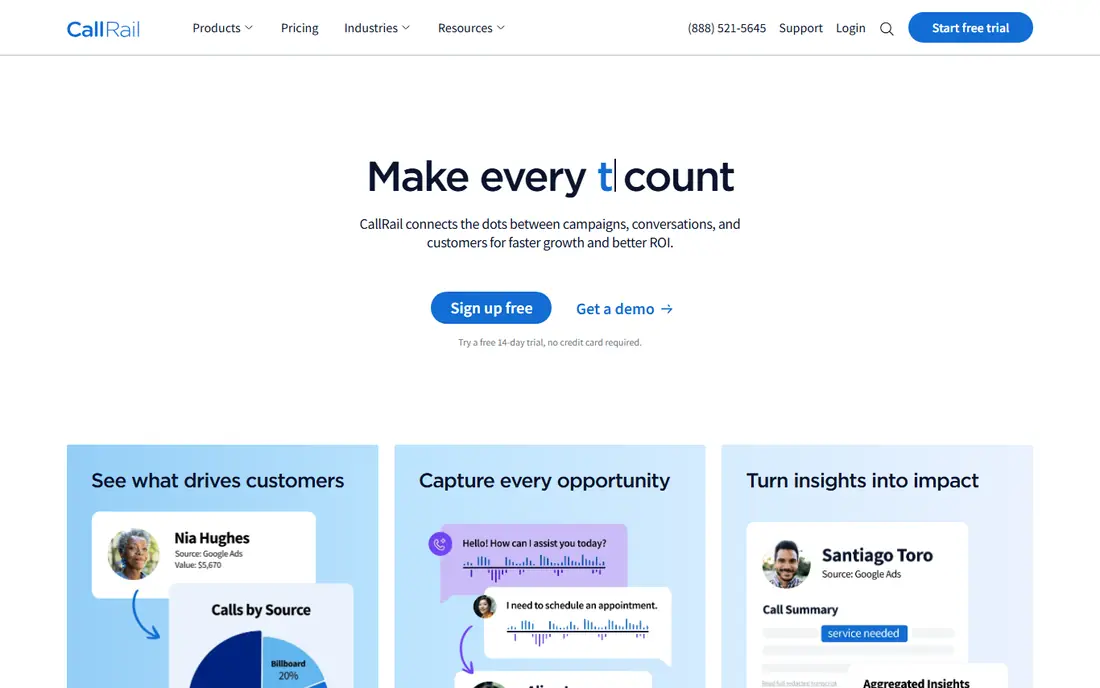
CallRail is the go-to for agencies and local businesses that need to tie phone calls to campaigns. It offers tracking numbers, recording, and integrations with ad platforms and CRMs, plus agency features like multi-account management. Reporting connects calls to keywords and ads, which is the core need here.
Costs rise with extra numbers and minutes, so high-volume teams should model their usage before signing. Setup also takes care to route numbers correctly, though support docs are thorough.
- Call tracking and recording
- Strong integrations
- Agency tools
- Costs grow with numbers and minutes
- Setup takes care
CallTrackingMetrics
Ideal for: Multi-channel attribution
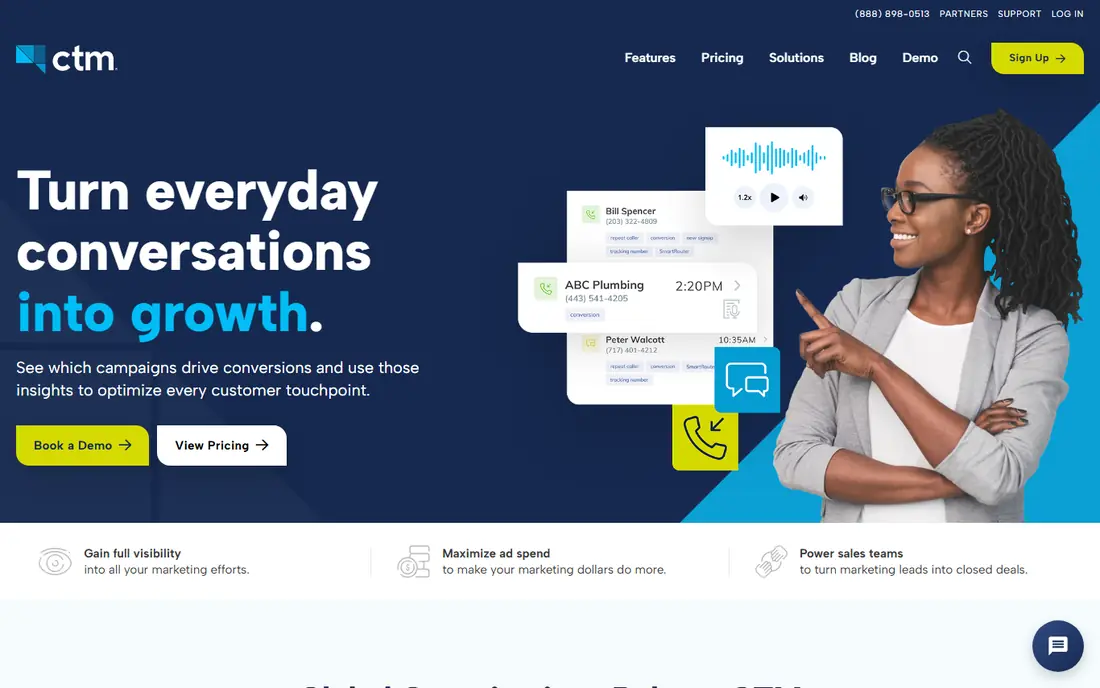
CallTrackingMetrics covers calls, texts, and chats with attribution across channels, plus AI scoring to sort real leads from spam. It suits companies that get leads from many places and want one view of them. Integrations with ad platforms and CRMs are broad.
The tier structure can be confusing, and small teams may pay for features they never use. Start with the core tracking plan and add AI scoring only if call volume justifies it.
- Call and text tracking
- AI scoring
- Broad integrations
- Pricing tiers can confuse
- Smaller teams may overbuy
WhatConverts
Ideal for: Lead tracking for agencies
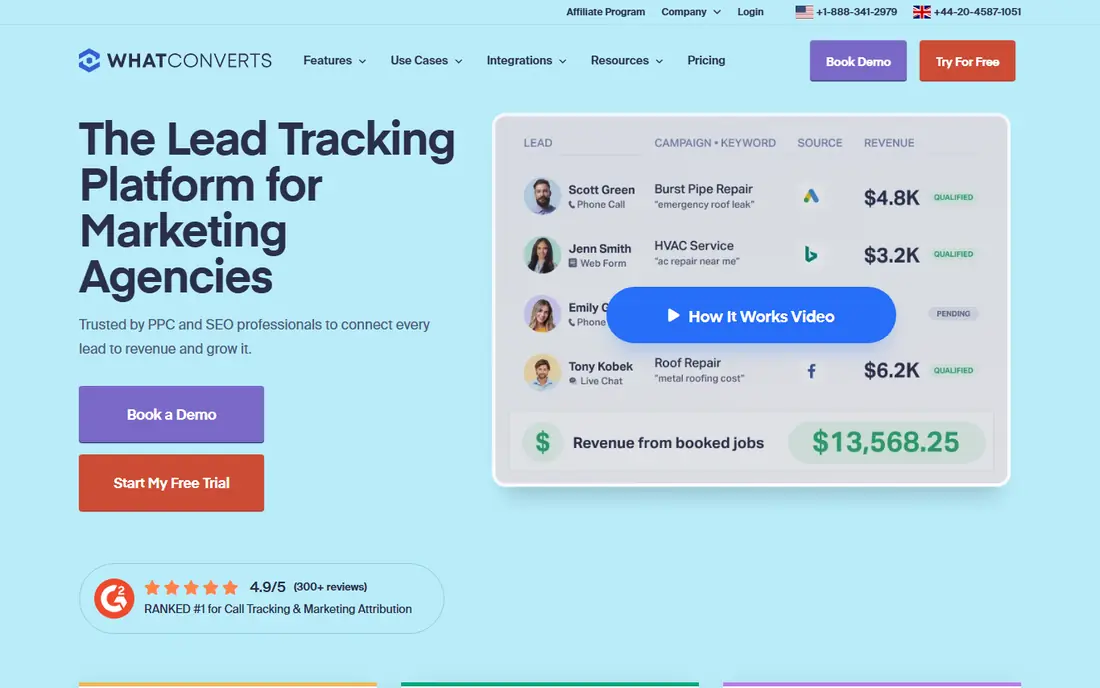
WhatConverts tracks calls, forms, chats, and texts in one lead manager, with white-label reporting for agencies. It is built for proving marketing results to clients, and its lead view makes follow-up easier than a call log alone. Agencies that report monthly will appreciate the client dashboards.
The interface is functional rather than polished, and new users need time to learn the lead workflow. It is a work tool first, and its design reflects that.
- Lead manager
- Call and form tracking
- White-label options
- Interface is functional, not flashy
- Learning curve
Marchex
Ideal for: Enterprise call analytics
Marchex focuses on enterprise call analytics, using AI to surface conversation insights from large call volumes. Big companies use it to understand why customers call and which campaigns drive valuable conversations. Its scale and analytics depth suit operations with thousands of calls a month.
It is enterprise priced and sales-led, so small businesses will find it heavy. Expect a guided sales process and confirm the plan fits your call volume before engaging.
- AI conversation insights
- Enterprise scale
- Call analytics
- Enterprise pricing
- Sales-led signup
Retreaver
Ideal for: Pay-per-call tracking
Retreaver is built for pay-per-call businesses, with real-time routing, buyer management, and call controls that general trackers lack. If your revenue depends on routing calls to buyers, its specialized features matter more than generic analytics. It handles the commercial side of calls, not just the counting.
Its niche focus means a smaller community and fewer general marketing integrations. Teams that only need basic call tracking will find simpler tools a better fit.
- Real-time call routing
- Pay-per-call support
- Buyer tools
- Niche focus
- Smaller community
Phonexa
Ideal for: Lead and call platforms
Phonexa bundles call tracking, lead distribution, and email tools into one platform for lead-driven businesses. That breadth suits companies that buy, route, and sell leads across channels. Its reporting ties calls to lead outcomes, which is useful for performance marketing.
The suite is broad, so teams that want only call tracking may find it more than they need. Pricing is by quote, so get a clear scope before committing.
- All-in-one lead suite
- Call tracking
- Distribution tools
- Broad suite can overwhelm
- Pricing by quote
CallPage
Ideal for: Website callback widgets
CallPage adds callback widgets to websites so visitors can request a call in seconds. It is simple to install, it captures leads at the moment of interest, and it suits small businesses that want more calls without a full tracking stack. The widget approach converts browsing visitors directly.
Its analytics are narrower than full call tracking platforms, with less depth on campaign attribution. Use it for capture, and pair it with a tracker if attribution matters.
- Fast callback widgets
- Lead capture
- Simple setup
- Narrower analytics
- Less attribution depth
Infinity
Ideal for: Call intelligence for marketers
Infinity provides call tracking and analytics with AI insights for marketers who need to connect calls to campaigns. Its platform suits companies where phone calls are a major conversion path. Integrations with ad platforms and CRMs tie calls to revenue.
Pricing is by quote, and its US presence is smaller than some rivals, since it is UK based. American buyers should confirm support hours and number coverage first.
- Call tracking and analytics
- AI insights
- Integrations
- Pricing by quote
- Smaller US presence
How we picked these
We started from the products that genuinely fit this topic and removed any that were discontinued, that did not serve US users, or that failed to match the core job. For each survivor, we checked the vendor official site for features and pricing, read app store listings where they exist, and looked at privacy policies and public reviews for known problems. We did not claim hands-on testing we did not do, and we left prices as See website wherever the vendor does not publish a clear figure.
Finally, we checked for known problems in public reviews and privacy policies, and we noted them where they matter, rather than hiding them. A product with a past privacy issue or a confusing renewal price still appears here if it is otherwise strong, but the write-up says so plainly, so you can weigh that risk yourself before you sign up.
We also weighed fit over fame. A famous product that only partly covers this topic lost out to a smaller tool that covers it well. That is why the list mixes leaders with strong smaller options, and why each write-up names one honest weakness alongside its strengths.
How to choose the right option for you
Start with the job, not the brand
Write down the one task you need done every week, then check which products do that task well without extra tools. CallRail covers the common case for most buyers, while Phonexa suits a narrower need. If a product needs three add-ons to do your core job, it is probably the wrong pick, however popular it is.
Check the true cost
Compare the plan you will actually use, not the headline price. Count seats, usage, and any add-ons, and check renewal pricing as well as the first-year price. Free tiers help for testing, but they often cap the exact feature you will need later, so read the limits before you commit a team to one.
Run a short trial with real work
Pick two finalists and run each on a real task for a week, not a demo script. Watch setup time, support replies, and how it handles your edge cases. CallTrackingMetrics and WhatConverts are good trial candidates for many buyers, since they show their strengths quickly. The product your team actually uses beats the one with the longest feature list.
Match the tool to your team size
A tool built for a thousand users can slow a team of five with setup, approvals, and training, while a tool built for solo users can break when a whole department adopts it. Check seat limits, permission controls, and admin features against your real headcount, not your hoped-for headcount. If you plan to grow, ask whether the next tier up keeps your data and settings intact, or forces a migration. The cheapest plan that fits today is often the right start, as long as the upgrade path is clear.
Check support, privacy, and exit options
Read the privacy policy for how your data is used, especially for tools that handle customer data, health data, or financial data. Check support hours and response channels too, since a cheap tool with slow support costs more in lost time than a pricier one with fast help. Finally, confirm you can export your data in a usable format. A tool that locks your work inside its own format makes switching painful later, and that exit cost should count in your decision just like the monthly price.
Frequently asked questions
What are invoca alternatives?
Invoca Alternatives are tools and services that do the same core job as the original, with different prices, features, and trade-offs. The list above covers the strongest options we found that work in October 2026, from well-known leaders to smaller tools worth a look.
Which of these invoca alternatives is best for most people?
For most buyers, CallRail is the safest starting point, thanks to its balance of features and price. If your main need is multi-channel attribution, start with CallTrackingMetrics instead, and run a trial before you commit.
Are there free invoca alternatives?
Yes, several options on this list offer a free tier or a free and open version, and the comparison table shows which ones. Free tiers usually cap usage or features, so check the limits against your real workload before you rely on one.
How much do invoca alternatives cost?
Prices range from free to enterprise quotes, and the table lists the starting price we could verify for each product. Where a vendor does not publish a clear price, we wrote See website, and you should ask for a quote based on your seats and usage.
What should I check before I pay for one of these invoca alternatives?
Check the plan limits, the renewal price, and the cancellation terms on the vendor site, and confirm the features you need are in the plan you will buy, not a higher tier. Read the privacy policy if the tool will hold customer or personal data, and test support with a real question during the trial. A short trial answers more than any sales page.
How hard is it to switch to a new option?
Switching effort depends on how much data and workflow you have built up. Export your data first, run the new tool alongside the old one for a short period, and move one team or project at a time. Most vendors on this list offer import tools or migration help.