Best Liveblocks Alternatives in 2026: 7 Collaboration Tools Compared

- Yjs suits developers who want an open source CRDT for real-time editing.
- Ably and Pusher suit teams that need reliable real-time messaging and presence.
- PartyKit suits developers who want programmable real-time servers.
- Convex and Supabase Realtime suit teams that want a backend plus real-time sync.
- Firebase Realtime Database suits teams already inside Google infrastructure.
Quick comparison
| Product | Ideal for | Price from | Free version | |
|---|---|---|---|---|
 Yjs | Open source real-time editing | Free | Yes | Visit |
 Ably | Real-time messaging | See website | Yes | Visit |
 Pusher | Real-time channels | See website | Yes | Visit |
 PartyKit | Programmable real-time servers | See website | Free trial | Visit |
 Convex | Backend with real-time sync | See website | Yes | Visit |
 Supabase Realtime | Postgres real-time sync | See website | Yes | Visit |
 Firebase Realtime Database | Google real-time backend | See website | Yes | Visit |
The best Liveblocks alternatives
Liveblocks provides ready-made collaboration features such as presence, comments, and storage for web apps. The tools below cover similar ground, from open source sync libraries to hosted real-time platforms. We compared official documentation, pricing pages, and public developer guides.
Yjs
Ideal for: Open source real-time editing
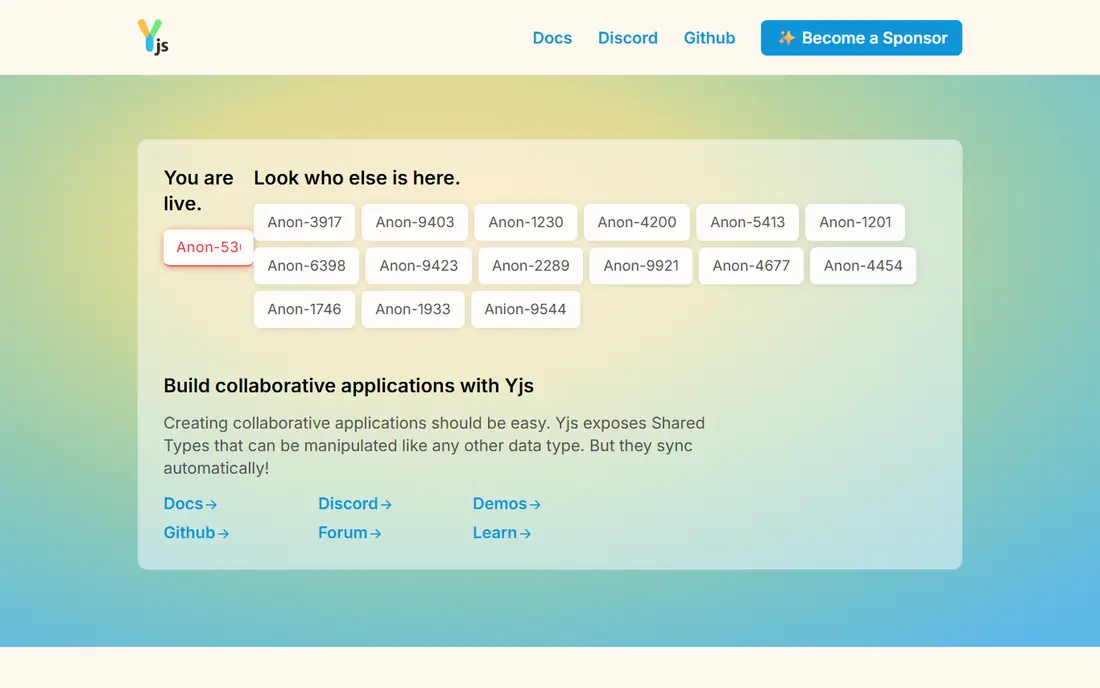
Yjs is an open source framework for shared editing, built on conflict-free replicated data types that let users edit offline and sync later without conflicts. It binds to popular editors and frameworks, which makes it a solid base for collaborative documents, whiteboards, and code editors. Because it is open source, teams control their data and hosting.
Production use needs a sync server, whether self-hosted or via a provider, and that adds engineering work. For teams that want full control and no vendor lock-in, Yjs is our pick for the sync layer. Pair it with your own presence and storage design.
- Open source CRDT with strong offline and sync support
- Many editor bindings
- No vendor lock-in
- Needs your own server or hosting for production
- More developer work than a hosted API
Ably
Ideal for: Real-time messaging

Ably provides real-time messaging infrastructure with channels, presence, and history, used for live updates, chat, and collaborative features. Its global network and fallback handling suit apps where message delivery must be reliable. SDKs cover major web and mobile platforms, which speeds integration.
Unlike Liveblocks, Ably does not ship ready-made comment threads or document storage, so teams build those layers. For developers who want a dependable real-time backbone, Ably is a strong pick. Its free tier suits prototypes and small apps.
- Reliable pub-sub messaging with presence
- Global edge network
- Strong SDK coverage
- Higher-level collaboration features need building yourself
- Pricing scales with messages
Pusher
Ideal for: Real-time channels
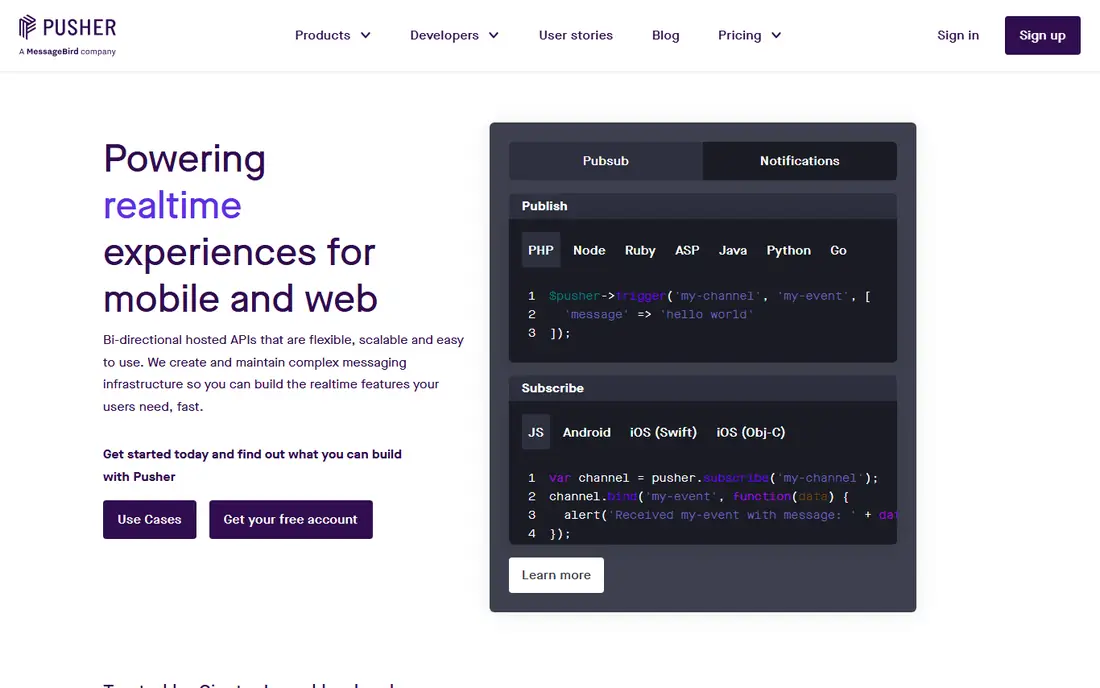
Pusher Channels gives apps simple real-time event delivery, with presence channels that show who is online. It suits live notifications, dashboards, chat, and simple collaboration features where full document sync is not needed. Setup is quick, and its docs are friendly to new developers.
For complex shared editing, Yjs or a backend sync tool fits better. For straightforward live updates and presence, Pusher is a fast, proven choice. Its free tier covers development and small production apps.
- Simple channels API for live updates
- Presence channels for online users
- Easy setup for small apps
- Less suited to complex document sync
- Message limits on lower tiers
PartyKit
Ideal for: Programmable real-time servers
PartyKit lets developers run small real-time servers, called parties, that hold room state and broadcast updates to connected clients. That model suits multiplayer apps, collaborative tools, and live rooms where custom server logic matters. Its developer experience is modern, with quick deploys and TypeScript support.
It is newer than Ably or Pusher, so ecosystem depth is smaller, and scaling costs need modeling. For developers who want custom real-time logic without managing servers, PartyKit is an appealing pick. Test it with a prototype before committing a large app.
- Programmable real-time servers close to your users
- Room-based state for collaboration
- Modern developer experience
- Newer platform with a smaller ecosystem
- Pricing model needs careful reading for scale
Convex
Ideal for: Backend with real-time sync
Convex is a backend platform where database queries react live: when data changes, subscribed clients update automatically. That reactive model suits collaborative apps, dashboards, and multiplayer features without a separate sync layer. TypeScript functions, auth, and file storage round out the platform.
Its data model differs from Postgres or Firebase, so migration needs planning. For new apps that want backend plus real-time sync in one system, Convex is a strong modern pick. Its free tier supports development and small launches.
- Backend with reactive queries that update clients live
- TypeScript-first functions
- Built-in auth and storage options
- Newer backend with a distinct data model
- Migration from other backends takes work
Supabase Realtime
Ideal for: Postgres real-time sync
Supabase Realtime broadcasts Postgres changes to subscribed clients, letting apps show live updates from a familiar relational database. Combined with Supabase auth, storage, and edge functions, it forms a full backend for collaborative apps. Open source and self-hosting options appeal to teams that want control.
Building full document collaboration still needs app-level logic for conflicts and presence. For teams that know Postgres and want real-time features on a standard database, Supabase Realtime is a strong pick. Its free tier covers prototypes well.
- Real-time sync on top of Postgres
- Open source with self-hosting
- Auth, storage, and database in one platform
- Realtime setup needs Postgres knowledge
- Complex collaboration logic still needs app code
Firebase Realtime Database
Ideal for: Google real-time backend
Firebase Realtime Database stores data as JSON and syncs it live to connected clients, with offline support for mobile apps. It integrates with Firebase auth, hosting, and Cloud Functions, which suits teams already on Google Cloud. Docs and community support are extensive.
Complex queries and relational data fit Postgres better, so large collaborative apps may prefer Supabase or Convex. For mobile-first apps and prototypes on Google infrastructure, Firebase Realtime Database remains a reliable pick. Its free tier, under the Spark plan, suits early development.
- Real-time JSON database with offline sync
- Deep Google Cloud integration
- Large docs and community
- Data model suits simpler apps
- Complex queries are harder than in Postgres
How we picked these
We compared official documentation, pricing pages, and public developer guides, looking for real-time sync, presence, messaging, or backend features that match Liveblocks. We favored tools that are actively maintained and work in October 2026, and we mixed open source libraries with hosted platforms. We did not claim hands-on testing, and we note that pricing often scales with usage, so model costs for your expected traffic.
We also weighed practical details that matter after signup. That included how easy each product is to set up, whether support answers promptly, and whether pricing stays clear as usage grows. We read user complaints as well as praise, since repeated complaints about billing, onboarding, or missing features often signal a real weakness. Where a product had a known limitation, we said so in its write-up rather than smoothing it over. Our goal was a shortlist that a reader can trust for liveblocks alternatives, not a list of every vendor in the market. Readers with unusual needs should still test their top two choices, since fit depends on budget, team size, and the features used every day.
What to check before you choose
Start with your collaboration model. Shared document editing needs a CRDT such as Yjs, while live dashboards and notifications need only messaging from Ably or Pusher. Presence and comments can be built on either, but ready-made features save time if your deadline is tight.
Next, test latency and offline behavior with real users in your target regions. Check auth and permission models too, since collaborative apps must prevent one room seeing another room data. A prototype with two or three simultaneous editors will reveal sync problems early, before they reach production.
Testing your shortlist before you commit
A short trial answers questions that no comparison table can settle. Sign up for your top two choices, run a real task from your own work, and watch how long it takes and where you get stuck. For liveblocks alternatives, that real task might be a weekly workflow you repeat, a report you need every month, or a setup step your team must repeat for new members. If a tool slows that task down, it will cost time every week, no matter how good its feature list looks.
Pay attention to support during the trial as well. Send a question through the normal support channel and note how long a useful answer takes. Check billing clarity too: confirm what the trial includes, when it ends, and what the first paid invoice will actually show. A tool that is hard to cancel, or that hides fees until checkout, deserves caution.
Finally, ask who else on your team must use the tool. A product that only one person likes will stall, while a product the whole team adopts will pay for itself. Gather quick feedback from the people who will use it daily, compare their notes with your own, and then choose. That small amount of trial discipline prevents most bad purchases, and it costs far less than switching tools again in six months.
Budgeting the full cost, not just the headline price
Headline prices rarely tell the full story. Add up per-user fees, add-on charges, implementation help, and any training your team needs, then compare that total across your shortlist. A cheaper plan that needs three paid add-ons can end up costing more than a fuller plan from a rival. Check renewal terms as well, since introductory discounts often expire after the first term and the second year price is the one you will actually live with.
Think about exit costs too. Before you commit, confirm how your data exports, whether your content or history moves cleanly, and what happens if you pause or cancel. A tool with clean exports gives you freedom later, while a tool that locks data in makes switching painful. Choosing with the full cost and the exit path in mind keeps your liveblocks alternatives decision sound for the long term, not just for the first month.
Frequently asked questions
What does Liveblocks do?
Liveblocks provides hosted collaboration building blocks such as presence, comments, notifications, and storage for web apps. Developers add these to their own product without building sync infrastructure from scratch.
Is Yjs a direct Liveblocks replacement?
Yjs covers the sync layer, but not hosted presence, comments, or storage out of the box. Teams pair Yjs with their own server or a hosted provider to match Liveblocks breadth.
Which alternative is best for a small prototype?
Pusher, Ably, Supabase, and Convex all offer free tiers that suit prototypes. Pick based on whether you need messaging, a database, or a full backend.
Do these tools handle offline editing?
Yjs and Firebase handle offline sync well, while messaging-only tools need extra app logic for offline work. Test offline behavior if your users edit on mobile or poor connections.
How do costs scale for real-time tools?
Most charge by messages, connections, or database usage, so costs rise with active users. Model peak concurrent users and message volume before committing to a paid plan.