Best Mqtt Alternatives in 2026: 8 Options Compared

- HiveMQ, EMQX and Mosquitto are the closest MQTT options, covering managed cloud, enterprise and open source needs.
- RabbitMQ and Kafka suit teams that need message queuing and event streaming beyond simple device messaging.
- NATS is a lightweight pick for fast, simple messaging between services and devices.
- Ably and PubNub suit teams that want real-time messaging as a hosted service without running brokers.
Quick comparison
| Product | Ideal for | Price from | Free version | |
|---|---|---|---|---|
 HiveMQ | managed MQTT platform | See website | Free trial | Visit |
 EMQX | scalable MQTT broker | See website | Yes | Visit |
 Mosquitto | free open source MQTT broker | Free | Yes | Visit |
 RabbitMQ | general message queuing | See website | Yes | Visit |
 Apache Kafka | event streaming at scale | Free | Yes | Visit |
 NATS | lightweight fast messaging | Free | Yes | Visit |
 Ably | hosted real-time messaging | See website | Yes | Visit |
 PubNub | real-time app messaging | See website | Free trial | Visit |
The best Mqtt Alternatives
Here are our picks for the best mqtt alternatives, covering a mix of well-known leaders and strong smaller options. We compared official feature pages, pricing pages, app-store listings, privacy policies and public reviews to build this list.
HiveMQ
Ideal for: managed MQTT platform
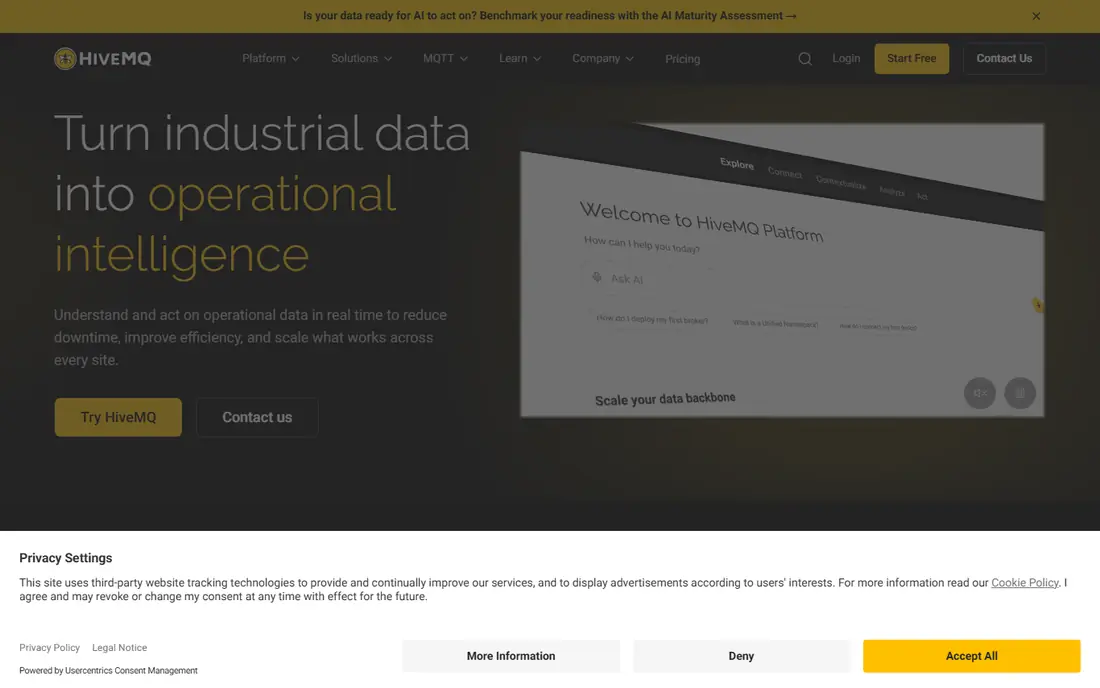
HiveMQ is a leading MQTT platform for enterprise IoT, with a broker that handles large device fleets, clustering and reliability features. A managed cloud option removes the operations burden, while self-hosted editions suit teams that need full control. Its MQTT expertise shows in the feature set.
Pricing is quoted for larger deployments, and the platform assumes MQTT knowledge. For serious IoT deployments that need MQTT done properly, HiveMQ is a top choice.
Bottom line: HiveMQ suits managed MQTT platform best. Its strongest point is enterprise MQTT features, while the main drawback to weigh is pricing is quoted for larger use. Check the current pricing page before deciding, since plans and limits change.
- Enterprise MQTT features
- Managed cloud option
- Strong reliability
- Pricing is quoted for larger use
- Setup needs MQTT knowledge
EMQX
Ideal for: scalable MQTT broker
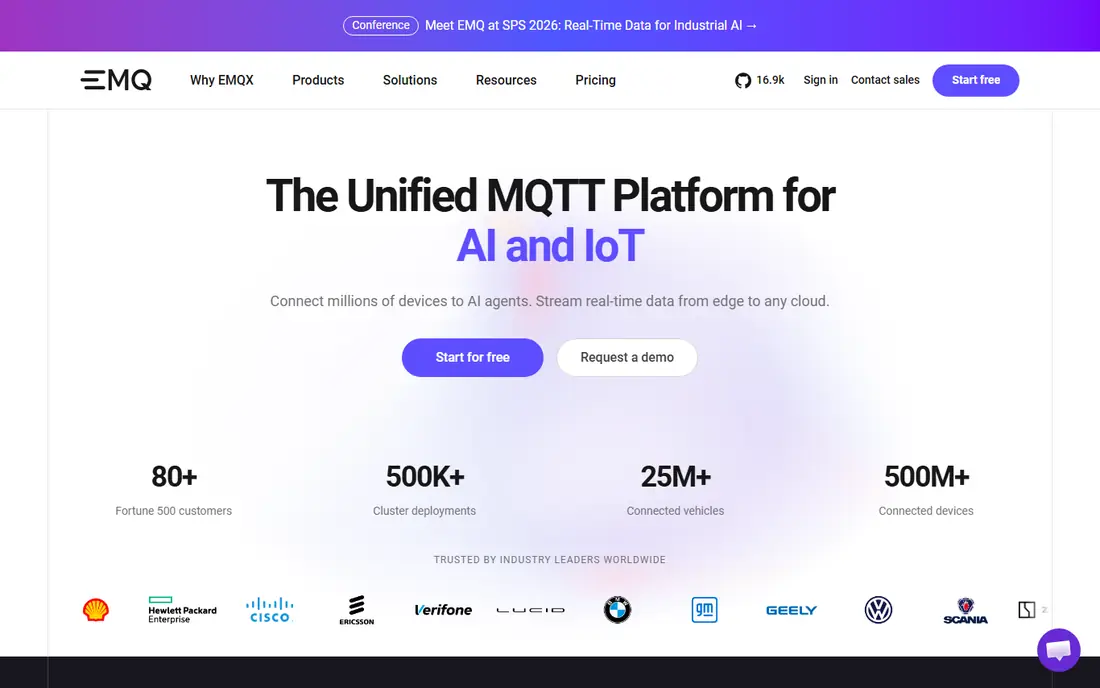
EMQX is an MQTT broker built for scale, with an open source core and a managed cloud service. It handles large numbers of concurrent connections, supports MQTT 5 features, and offers clustering for reliability. Teams building large IoT platforms value its performance.
Advanced features sit on paid plans, and the interface takes time to learn. For a scalable MQTT broker with an open source starting point, EMQX is a strong pick.
Bottom line: EMQX suits scalable MQTT broker best. Its strongest point is high scalability, while the main drawback to weigh is advanced features need paid plans. Check the current pricing page before deciding, since plans and limits change.
- High scalability
- Open source core
- Managed cloud option
- Advanced features need paid plans
- Interface takes learning
Mosquitto
Ideal for: free open source MQTT broker

Mosquitto, part of the Eclipse Foundation, is the classic open source MQTT broker, and it remains the simplest way to run MQTT. It is lightweight, easy to install and supported by almost every MQTT client library. For small projects and prototypes, it is often all you need.
It has no built-in clustering or management interface, and support comes from the community. Larger fleets usually need HiveMQ or EMQX. For a free, simple MQTT broker, Mosquitto is the default choice.
Bottom line: Mosquitto suits free open source MQTT broker best. Its strongest point is free and lightweight, while the main drawback to weigh is no built-in clustering or management UI. Check the current pricing page before deciding, since plans and limits change.
- Free and lightweight
- Simple to run
- Widely supported
- No built-in clustering or management UI
- Community support only
RabbitMQ
Ideal for: general message queuing
RabbitMQ is a general message broker that supports queues, routing and publish-subscribe patterns across many protocols, including MQTT through a plugin. It suits teams that need reliable task queues and flexible routing alongside device messaging. The community and documentation are extensive.
It is heavier than a pure MQTT broker for constrained devices, and clustering setup needs care. For teams that need queuing plus messaging in one system, RabbitMQ is a versatile option.
Bottom line: RabbitMQ suits general message queuing best. Its strongest point is flexible routing and queues, while the main drawback to weigh is heavier than MQTT for constrained devices. Check the current pricing page before deciding, since plans and limits change.
- Flexible routing and queues
- Large community
- Many client libraries
- Heavier than MQTT for constrained devices
- Setup needs care
Apache Kafka
Ideal for: event streaming at scale
Apache Kafka is an event streaming platform built for high-throughput data pipelines, where events are stored as logs that can be replayed. It suits teams processing large volumes of IoT or application data, with an ecosystem of connectors and stream processing tools.
Running Kafka well is complex, and it is overkill for simple device messaging. Managed Kafka services reduce that burden at a cost. For large-scale event data, Kafka is the industry standard.
Bottom line: Apache Kafka suits event streaming at scale best. Its strongest point is high-throughput event streaming, while the main drawback to weigh is complex to run. Check the current pricing page before deciding, since plans and limits change.
- High-throughput event streaming
- Replayable logs
- Huge ecosystem
- Complex to run
- Overkill for simple device messaging
NATS
Ideal for: lightweight fast messaging
NATS is a lightweight messaging system built for speed and simplicity, connecting services and devices with minimal overhead. It uses few resources, starts quickly and suits microservices and edge deployments where simplicity matters. JetStream adds persistence and streaming when needed.
Enterprise features are thinner than Kafka, and persistence requires JetStream configuration. For fast, simple messaging without heavy infrastructure, NATS is an excellent pick.
Bottom line: NATS suits lightweight fast messaging best. Its strongest point is very fast and simple, while the main drawback to weigh is fewer enterprise features than Kafka. Check the current pricing page before deciding, since plans and limits change.
- Very fast and simple
- Low resource use
- Good for microservices
- Fewer enterprise features than Kafka
- Persistence needs JetStream
Ably
Ideal for: hosted real-time messaging
Ably is a hosted real-time messaging service for web, mobile and IoT apps, with global infrastructure and SDKs for major platforms. It handles pub-sub, presence and history as a managed service, so teams do not run brokers themselves. That convenience appeals to app developers.
Usage-based pricing needs monitoring for high-volume apps, and it is less focused on raw device fleets than HiveMQ. For real-time app messaging without broker operations, Ably is a strong choice.
Bottom line: Ably suits hosted real-time messaging best. Its strongest point is managed real-time service, while the main drawback to weigh is usage-based pricing needs watching. Check the current pricing page before deciding, since plans and limits change.
- Managed real-time service
- Global infrastructure
- Good SDKs
- Usage-based pricing needs watching
- Less suited to raw IoT fleets
PubNub
Ideal for: real-time app messaging
PubNub provides real-time messaging as a managed platform, with presence, history and access control built in. It suits chat, live updates, multiplayer and IoT dashboards, with SDKs for web and mobile. Teams that want real-time features without infrastructure work benefit most.
Pricing is usage based, and raw IoT fleet management is secondary to app messaging. For real-time features in apps, PubNub is a reliable, well-documented option.
Bottom line: PubNub suits real-time app messaging best. Its strongest point is managed real-time platform, while the main drawback to weigh is pricing is usage based. Check the current pricing page before deciding, since plans and limits change.
- Managed real-time platform
- Presence and history
- Broad SDK support
- Pricing is usage based
- IoT device focus is secondary
How we picked these
We started from the original product and what people use it for, then compared official feature pages, pricing pages, app-store listings, privacy policies and public reviews for each candidate. We kept only products that exist, work in October 2026 and genuinely fit the topic, and we left out products that were discontinued, unrelated or too thin to recommend.
We weighed fit for the topic first, then price and free options, ease of setup and the honest downsides that show up in reviews and documentation. Prices are given as listed on the vendor's own site where we could verify them, and we wrote See website where a price was quoted, unclear or likely to change by plan.
We also left out products that no longer exist, that have been folded into a different product, or that only partly fit the topic. A longer list would have been easier to write, but a list padded with poor fits helps nobody choose, so we kept the list to products we can genuinely recommend for this use.
How to choose a messaging system
Start with the pattern you need. Publish and subscribe suits device telemetry, while queues suit task processing and event logs suit replaying history. A system built for one pattern can often do the others, but it will not do them equally well.
Next, check scale and reliability needs. A home project with ten devices has different requirements from a fleet of a million sensors, and delivery guarantees, persistence and clustering all matter more at scale. Test with realistic message rates before committing.
Finally, weigh managed versus self-hosted. A managed service costs more per month but removes operations work, while a self-hosted broker costs less in fees but needs someone to run it. Pick the balance your team can maintain.
Check the renewal price, not just the first bill. Introductory discounts, per-user charges and usage limits can change the cost sharply in year two, so ask for the standard price and model it at your expected team size. A tool that stays affordable as you grow is worth more than a cheap first month.
Read the fine print on limits. Free tiers and entry plans often cap users, projects, storage or monthly usage, and those caps decide whether a plan works in practice. Confirm the limits that matter to you in writing before you commit to a paid plan.
Frequently asked questions
What is MQTT used for?
MQTT is a lightweight messaging protocol used for IoT devices, sensors and real-time applications. Devices publish messages to topics, and other systems subscribe to those topics, which keeps bandwidth low and works well on unreliable networks.
What is the best MQTT alternative?
HiveMQ and EMQX are strong managed and enterprise MQTT options, while Mosquitto is the classic open source broker. If you need more than MQTT, RabbitMQ, Kafka or NATS may be a better fit.
Can I use MQTT for free?
Yes. Mosquitto is free and open source, and HiveMQ, EMQX, Ably and PubNub offer free tiers or trials with limits. Self-hosting Mosquitto costs nothing in licence fees, though you need a server.
Is Kafka a replacement for MQTT?
Kafka can handle IoT data, but it is heavier than MQTT and built for event streaming rather than constrained devices. Many teams use MQTT at the edge and Kafka behind it for processing and storage.
Do these systems work for web apps?
Yes. Ably and PubNub are built for real-time web and mobile apps, while MQTT over WebSockets also works for browsers. RabbitMQ, Kafka and NATS suit server-side messaging between services.
Can I try these options before paying?
Yes, in most cases. Nearly every option on this list offers a free tier or a free trial, and we note that in the comparison table and in each product block. Use the trial for real work rather than a quick look, and check the renewal price before the trial ends so there are no surprises.