Best MuleSoft Alternatives: 8 Options Compared

- Boomi and Workato suit teams that want low-code integration without MuleSoft's complexity, while Informatica suits heavy data workloads.
- API-led design is MuleSoft's strength, so rivals that reuse APIs and governance best are the closest replacements.
- Pricing is mostly quoted or usage-based, so ask for a quote on your real connector and volume counts.
- Small teams should trial one live workflow end to end before signing, since setup effort varies widely.
Quick comparison
| Product | Ideal for | Price from | Free version | |
|---|---|---|---|---|
 Boomi | Enterprise integration without heavy code | See website | Free trial | Visit |
 Workato | Business-led SaaS automation | See website | Free trial | Visit |
 Informatica | Large enterprise data integration | See website | Free trial | Visit |
 SnapLogic | Data and app integration at scale | See website | Free trial | Visit |
 Jitterbit | Mid-market integration and automation | See website | Free trial | Visit |
 Tray.io | Flexible automation for operations teams | See website | Free trial | Visit |
 Microsoft Azure Logic Apps | Azure-centered integration | See website | Free trial | Visit |
 Zapier | Simple app-to-app automation | Free | Yes | Visit |
The best MuleSoft alternatives
MuleSoft is powerful, but its cost and complexity push many teams to look elsewhere. We compared eight integration platforms that cover API management, data integration, and workflow automation for businesses of different sizes.
Boomi
Ideal for: Enterprise integration without heavy code
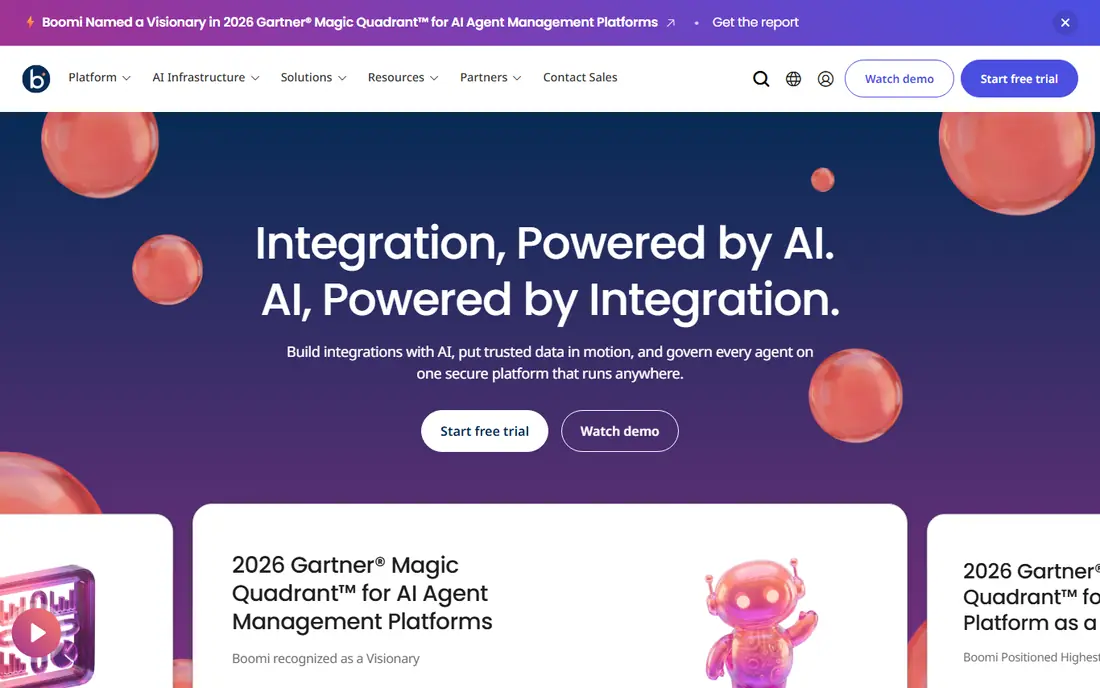
Our pick for Enterprise integration without heavy code is Boomi, and it stands out for a low-code builder with a large connector library. Readers who want enterprise integration without heavy code will find its approach direct and practical. The trade-off is that pricing is opaque and advanced use needs training, so weigh that before you commit.
Pricing is listed as See website below, and the free plan status is Free trial. We checked the official site and the app store listing for current plan details, and we suggest confirming the plan that fits your usage before checkout. Compared with the rest of this list, Boomi works best when enterprise integration without heavy code is your main priority.
- Low-code builder
- Large connector library
- Cloud and hybrid support
- Pricing is opaque
- Advanced use needs training
Workato
Ideal for: Business-led SaaS automation

If business-led SaaS automation matters most to you, Workato deserves a close look. It is known for low-code recipes that business teams can build, which gives it a clear edge in this list. On the other hand, per-recipe pricing can grow fast at scale, so it is not the right fit for everyone.
Before you choose, compare Workato with one or two others in this list on price, limits, and support. Its free plan status is Free trial and its starting price is shown as See website. In our view, it is a sensible shortlist pick for readers who value business-led SaaS automation above extra features.
- Recipes business teams can build
- Broad app connectors
- Solid automation
- Per-recipe pricing can grow fast
- Enterprise features cost more
Informatica
Ideal for: Large enterprise data integration

Informatica earns its place here for large enterprise data integration. Its main strength is deep governance and broad connectivity, and that makes day to day use feel focused rather than scattered. The catch is that deployment is complex and costly, which may matter more to some readers than others.
We would shortlist Informatica when large enterprise data integration is the deciding factor. The starting price is See website and the free plan status is Free trial, so the cost picture is clear from the official pricing page. Try the free option or trial first if one is offered, and test it on a real task.
- Deep governance
- Broad connectivity
- Strong data quality tools
- Complex and costly to deploy
- Steep learning curve
SnapLogic
Ideal for: Data and app integration at scale
For readers focused on data and app integration at scale, SnapLogic is a strong contender. It offers a visual pipeline builder with strong data handling, and we found that combination easy to recommend for its target audience. Still, enterprise pricing is quoted on request, so check that detail against your own needs.
The honest summary is this: SnapLogic is strong on data and app integration at scale and weaker where enterprise pricing is quoted on request. With a starting price of See website and a free plan status of Free trial, it is easy to compare against the other options here. Pick it if its strength matches the job you need done most often.
- Visual pipeline builder
- Many connectors
- Strong data handling
- Enterprise pricing is quoted
- Learning curve for complex flows
Jitterbit
Ideal for: Mid-market integration and automation
Jitterbit suits readers who need mid-market integration and automation without extra fuss. The headline strength is app and data integration in one platform, which covers the core job well. The downside is that pricing is quoted and the community is smaller, so a short trial is worth it before you pay.
Pricing is listed as See website below, and the free plan status is Free trial. We checked the official site and the app store listing for current plan details, and we suggest confirming the plan that fits your usage before checkout. Compared with the rest of this list, Jitterbit works best when mid-market integration and automation is your main priority.
- App and data integration in one platform
- Good Salesforce ties
- Usable builder
- Pricing is quoted
- Smaller community than larger rivals
Tray.io
Ideal for: Flexible automation for operations teams
Our pick for Flexible automation for operations teams is Tray.io, and it stands out for a flexible builder with strong API support. Readers who want flexible automation for operations teams will find its approach direct and practical. The trade-off is that pricing scales with usage, so weigh that before you commit.
Before you choose, compare Tray.io with one or two others in this list on price, limits, and support. Its free plan status is Free trial and its starting price is shown as See website. In our view, it is a sensible shortlist pick for readers who value flexible automation for operations teams above extra features.
- Flexible workflow builder
- Strong API support
- Good for ops teams
- Pricing scales with usage
- Complex flows need care
Microsoft Azure Logic Apps
Ideal for: Azure-centered integration
If azure-centered integration matters most to you, Microsoft Azure Logic Apps deserves a close look. It is known for native Azure integration with pay-as-you-go pricing, which gives it a clear edge in this list. On the other hand, it works best inside Azure, so it is not the right fit for everyone.
We would shortlist Microsoft Azure Logic Apps when azure-centered integration is the deciding factor. The starting price is See website and the free plan status is Free trial, so the cost picture is clear from the official pricing page. Try the free option or trial first if one is offered, and test it on a real task.
- Native Azure integration
- Pay-as-you-go pricing
- Many connectors
- Best inside Azure
- Multi-cloud setups take more work
Zapier
Ideal for: Simple app-to-app automation
Zapier earns its place here for simple app-to-app automation. Its main strength is the easiest start with a huge app library, and that makes day to day use feel focused rather than scattered. The catch is that it is not a full enterprise platform, which may matter more to some readers than others.
The honest summary is this: Zapier is strong on simple app-to-app automation and weaker where it is not a full enterprise platform. With a starting price of Free and a free plan status of Yes, it is easy to compare against the other options here. Pick it if its strength matches the job you need done most often.
- Easiest start for small automations
- Huge app library
- Free tier
- Not a full enterprise integration platform
- Costs rise with tasks
How we picked these
We compared official feature pages, pricing pages, app store listings, privacy policies, and public reviews for each option in this list. We kept only products that exist and work in October 2026 and that truly fit the topic, and we dropped anything whose official homepage did not load or did not match the product. Where we could not verify a current price from the vendor, we wrote See website rather than guessing a figure.
We also weighed who each product is really for, not just how many features it lists. A strong pick for a large team can be a poor pick for one person, and the reverse is true too. That is why each write-up names a best fit and an honest weakness, so you can match the product to your own situation instead of chasing the longest feature list.
Finally, we checked renewal and trial terms where the vendor publishes them, since first-year prices and trial limits can change the real cost. When a vendor did not publish a clear price, we left the field as See website and said so plainly, rather than filling the gap with an estimate. That approach keeps every price claim in this list traceable to the vendor's own pages.
How to choose an integration platform
Start by naming the job: connecting SaaS apps, building reusable APIs, or moving large data volumes. Low-code tools shine for SaaS workflows, while data platforms handle volume and governance better. A tool that does everything may do your main job worse than a focused rival.
Check connectors for your core systems first, then test error handling, monitoring, and security features. Integration work fails quietly when retries and alerts are weak, so a trial on a real workflow matters more than a demo. Also confirm pricing units, since per-connector, per-task, and per-volume models bill very differently.
Plan for who will maintain the integrations. Developer-heavy platforms need skilled staff, while low-code tools let operations teams build and fix flows. Factor training and support into the total cost, not just the subscription price.
Before you pay, run a short checklist against your top two picks: confirm the plan limits, test the feature you will use most, check support hours, and confirm cancellation terms. A product that passes that checklist on a real task is usually the right choice, even if a rival lists more features on paper. Keep notes from your trial so the decision stays based on evidence, not marketing.
Frequently asked questions
What is the closest alternative to MuleSoft?
Boomi is often the closest match for enterprise integration with a low-code builder and a large connector library. Workato is closer for business-led automation across SaaS apps. Informatica fits better when data integration and governance matter most.
Are MuleSoft alternatives cheaper?
Many are cheaper for mid-sized use, but enterprise pricing is usually quoted and depends on connectors, volume, and users. Model your real workload and ask each vendor for a comparable quote before deciding on cost alone.
Can non-developers build integrations on these tools?
Workato, Zapier-style flows, and Boomi let business users build many integrations without code. Complex API design, transformations, and governance still benefit from developer input, even on low-code platforms.
Do these tools replace API management?
Some include API design and management, while others focus on app-to-app workflows. If you publish APIs to partners, check gateway, versioning, and security features rather than assuming every integration tool covers them.
How long does it take to switch from MuleSoft?
A simple set of workflows can move in weeks, while a large API estate can take months. Start with one non-critical workflow, document mappings and error handling, and run old and new flows in parallel during the switch.