Node.js and Go Alternatives for Pandas and NumPy in 2026: 7 Tools Compared

- 1
 ArqueroJavaScript dataframesVisit
- 2
 math.jsJavaScript math and matricesVisit
- 3
 stdlibJavaScript statisticsVisit
- 4
 TensorFlow.jsJavaScript machine learningVisit
- 5
 Apache ArrowColumnar data in JavaScript and GoVisit
- Arquero suits JavaScript dataframes, with a fluent API for filter, aggregation, window, join and reshaping over million-row tables.
- math.js suits JavaScript math, with matrices, complex numbers, fractions, units and symbolic computation in Node.js and browsers.
- stdlib suits JavaScript statistics, with more than 3,000 built-in functions for mathematics, statistics, machine learning, streams and plotting.
- TensorFlow.js suits JavaScript machine learning, running models in the browser or Node.js and converting Python TensorFlow models.
- Apache Arrow suits columnar data in both JavaScript and Go, with a language-independent format and zero-copy reads.
- Gonum suits Go numerics, with matrices, linear algebra, statistics, probability, optimization and network analysis.
- Gota suits Go dataframes, with DataFrames, Series, filtering, GroupBy, aggregation and joins, though its repository is archived.
- No single JS or Go tool matches pandas plus NumPy alone: most teams combine a dataframe tool with a numerics tool.
Quick comparison
| Product | Ideal for | Price from | Free version | |
|---|---|---|---|---|
| Arquero | JavaScript dataframes | Free | Yes | Visit |
| math.js | JavaScript math and matrices | Free | Yes | Visit |
| stdlib | JavaScript statistics | Free | Yes | Visit |
| TensorFlow.js | JavaScript machine learning | Free | Yes | Visit |
| Apache Arrow | Columnar data in JavaScript and Go | Free | Yes | Visit |
 Gonum | Go numerics | Free | Yes | Visit |
 Gota | Go dataframes | Free | Yes | Visit |
The best node.js and go alternatives for pandas and numpy
Pandas gives Python dataframes for cleaning, filtering, grouping and joining tabular data, while NumPy gives fast arrays and linear algebra. JavaScript and Go teams can get similar power without Python, but the ecosystem is split: one tool usually covers dataframes, another covers arrays and stats. We checked each tool's official homepage or repository before listing it, and we note where a project is archived or limited.
Arquero
Ideal for: JavaScript dataframes
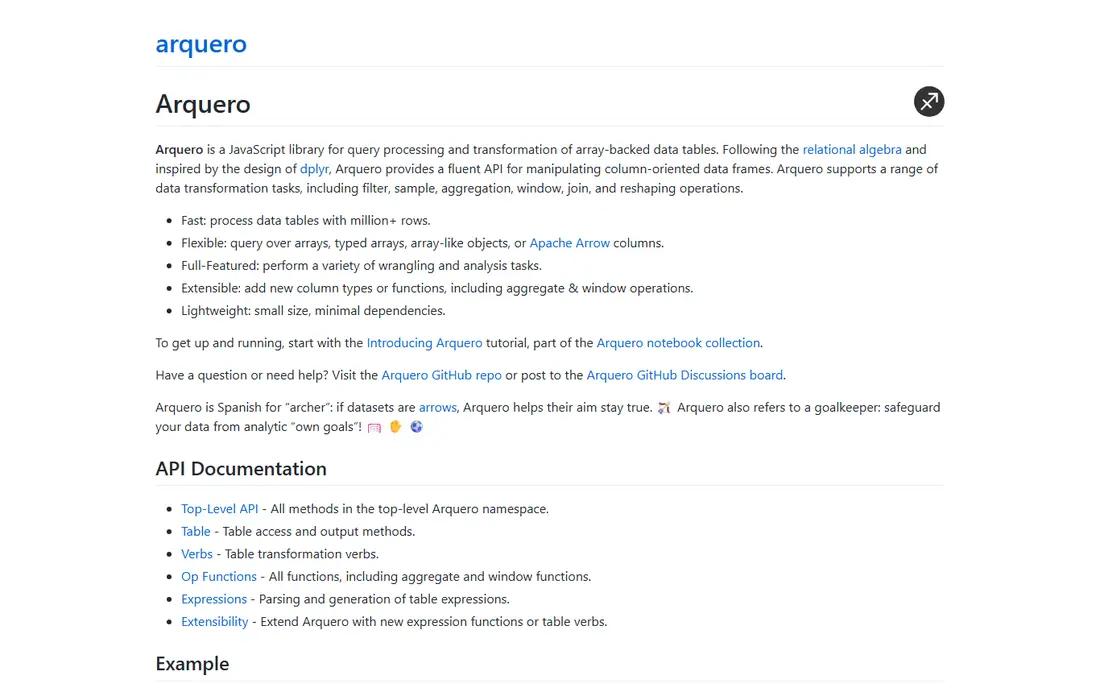
Arquero models each column as an array of values and transforms tables through verbs that return new tables, allowing method chaining for multi-step transformations. Its example builds a table of monthly sunshine hours for Seattle, Chicago and San Francisco, derives differences, sorts them, computes correlations with op.corr, and reshapes data with fold and groupby rollups for min, max, average, median and skew. It runs in browsers from a CDN and in Node.js or application bundles via ES module imports, with a tutorial collection on Observable.
Arquero suits JavaScript teams that need pandas-style dataframe wrangling in Node.js or the browser, especially for dashboards, data apps and analysis notebooks. Its column-oriented design and Arrow compatibility make it fast for large tables. For arrays and linear algebra, pair Arquero with math.js or stdlib, but for dataframe work alone Arquero is the closest JavaScript equivalent to pandas here.
- JavaScript library for query processing and transformation of array-backed data tables
- Fluent API inspired by dplyr for column-oriented data frames
- Filter, sample, aggregation, window, join and reshaping operations
- Fast processing of million-plus-row tables
- Works over arrays, typed arrays, array-like objects or Apache Arrow columns
- Lightweight with minimal dependencies
- Requires Node 18 or higher
- JavaScript-only, so Go teams need a different tool
- Smaller ecosystem than pandas for plotting and machine learning
math.js
Ideal for: JavaScript math and matrices
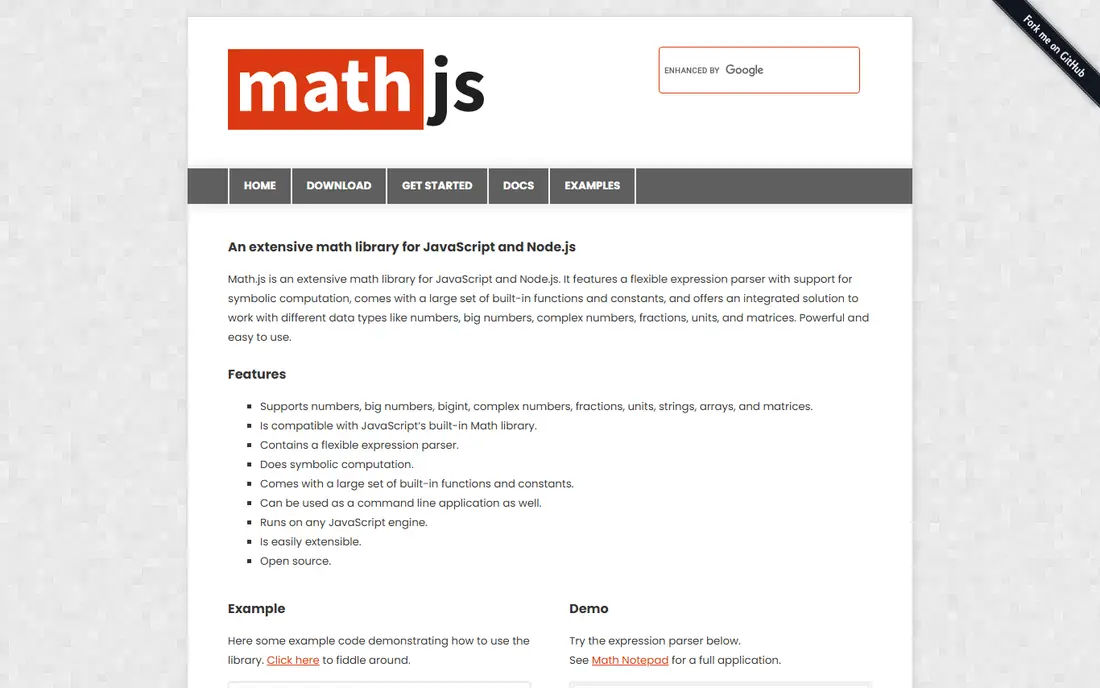
math.js offers an integrated solution for working with different data types, from plain numbers to big numbers, complex numbers, fractions, units and matrices. Its examples show rounding, trigonometry, logarithms, square roots of negative numbers giving imaginary results, derivatives such as derivative of x squared plus x giving 2x plus 1, matrix powers, unit conversion from centimeters to inches, and chaining operations such as 3 plus 4 times 2 giving 14. Its expression parser lets users evaluate strings such as sin of 45 degrees squared, and its Math Notepad demo provides a full application for interactive math.
math.js suits JavaScript developers who need NumPy-style matrix math, units and symbolic computation in Node.js or the browser. Its type system handles cases plain JavaScript numbers cannot, such as exact fractions and complex results. For dataframe operations, combine math.js with Arquero, but for math and matrices math.js is a strong NumPy alternative in JavaScript.
- Extensive math library for JavaScript and Node.js
- Flexible expression parser with symbolic computation
- Large set of built-in functions and constants
- Supports numbers, big numbers, bigint, complex numbers, fractions, units, strings, arrays and matrices
- Compatible with JavaScript's built-in Math library
- Runs on any JavaScript engine
- Open source
- Usable as a command-line application
- Not a dataframe library, so table wrangling needs Arquero or stdlib
- Expression parsing adds overhead for tight numeric loops
stdlib
Ideal for: JavaScript statistics
stdlib describes itself as a standard library for JavaScript and Node.js, covering mathematics, data visualization, utilities and documentation. Its mathematics section promises high-performance, rigorous and reliable functions to build statistical models and machine learning libraries, while its plotting section supports exploratory data analysis, and its utilities cover grouping, filtering, mapping and transforming data in browsers and on servers. Its REPL lets developers interactively manipulate data and prototype with more than 3,000 built-in functions.
stdlib suits JavaScript teams that need NumPy-style statistics and math plus data utilities in one library, especially for building custom analysis or machine learning code. Its rigor and testing suit production use where correctness matters. For dataframe-style chaining, Arquero is more ergonomic, but for statistical depth stdlib is the most complete JavaScript alternative to NumPy and parts of pandas here.
- Standard library for JavaScript and Node.js
- High-performance, rigorous mathematical and statistical functions
- Data visualization and plotting for exploratory analysis
- Utilities to assert, group, filter, map, pluck and transform data
- Consistent documentation, examples, tests and benchmarks
- REPL with more than 3,000 built-in functions for mathematics, statistics, machine learning, streams and plotting
- Apache-licensed open source
- Large modular library, so learning the package layout takes time
- Less dataframe ergonomics than Arquero
TensorFlow.js
Ideal for: JavaScript machine learning
TensorFlow.js brings machine learning to JavaScript developers, with tutorials for end-to-end examples, pre-trained models for common use cases and live demos that run in the browser. Its three main paths cover running existing models, retraining existing models on your own data, and developing ML directly in JavaScript. Converting Python TensorFlow models lets teams reuse Python-trained models in web apps without a Python server.
TensorFlow.js suits teams that need NumPy-style tensor operations plus model training and inference in JavaScript, especially for browser apps where data stays on the device. Its tensor API covers many NumPy-like operations, though it is optimized for ML rather than general data wrangling. For dataframe work, pair it with Arquero, but for JavaScript ML TensorFlow.js is the natural choice.
- Develop ML models in JavaScript and use ML directly in the browser or Node.js
- Run off-the-shelf JavaScript models or convert Python TensorFlow models
- Retrain pre-existing models on your own data
- Build and train models directly in JavaScript with flexible APIs
- Pre-trained models for common use cases
- Live demos run in the browser
- Machine learning focus, not general dataframe or array work
- Browser performance depends on device and WebGL support
Apache Arrow
Ideal for: Columnar data in JavaScript and Go
Apache Arrow defines a columnar memory format that lets analytic tools share data without copying or serializing it, speeding up data access for large datasets. Its libraries implement the format and provide building blocks for high-performance analytics, with Go and JavaScript both supported alongside Python, R, Rust and others. Its ecosystem is community-driven, with committers from many organizations, and its documentation covers installation and getting started for each language.
Apache Arrow suits JavaScript and Go teams that move large tabular datasets between tools, languages or services, since its format avoids conversion overhead. It pairs naturally with Arquero in JavaScript, which queries Arrow columns directly, and with Gonum or Gota in Go for numeric work. For a single-language dataframe API, Arquero or Gota are simpler, but for cross-language performance Arrow is foundational.
- Language-independent columnar memory format for flat and nested data, organized for efficient analytic operations on modern CPUs and GPUs
- Zero-copy reads for fast data access without serialization overhead
- Libraries for C, C++, .NET, Go, Java, JavaScript, Julia, MATLAB, Python, R, Ruby, Rust and Swift
- Used by many popular projects as the basis for analytic engines
- Format and building blocks, not a full dataframe API, so analysis logic needs Arquero, Gonum or another layer
- Learning curve for the columnar model
Gonum
Ideal for: Go numerics
Gonum is a set of Go packages designed to make writing numerical and scientific algorithms productive, performant and scalable. Its homepage lists matrices and linear algebra, statistics, probability distributions and sampling, function differentiation, integration and optimization, and network creation and analysis. It appeals to developers tired of sluggish performance and fighting C and vectorization, struggling to manage growing programs, or wanting easy parallel computing and fully transparent source code they can read.
Gonum suits Go teams that need NumPy-style arrays, linear algebra and statistics in production services, where Go's speed, concurrency and single-binary deployment beat Python. Its composable packages let you build exactly the numeric stack you need without a monolithic framework. For dataframe operations, add Gota or Arrow, but for Go numerics Gonum is the standard choice.
- Set of packages for numerical and scientific algorithms that are productive, performant and scalable
- Libraries for matrices and linear algebra, statistics, probability distributions and sampling
- Tools for function differentiation, integration and optimization
- Network creation and analysis
- Consistent, composable and comprehensible scientific code
- Parallel computing support
- Compiler catches mistakes early
- Numerics focus, not a dataframe library, so table wrangling needs Gota or Arrow
- Go learning curve for Python data scientists
Gota
Ideal for: Go dataframes
Gota implements DataFrames, Series and data wrangling methods for Go, modeled on tabular datasets like Excel sheets, CSV files or SQL tables, where columns are features and rows are measurements. Its readme shows loading from records, structs, maps, CSV and JSON, subsetting rows, selecting columns, updating values, filtering with comparison operators, GroupBy with aggregation, arranging by columns, mutating columns, inner, left, right and cross joins, and applying functions to rows or columns with Capply and Rapply. Operations chain together, with errors captured in the DataFrame Err field, and Gota interfaces with Gonum for numeric work.
Gota suits Go teams that want pandas-style dataframe wrangling and accept an archived project, for example for internal tools or learning. Its API covers the core pandas verbs well. The archive status is a real risk for production use: no new fixes or features will arrive, so new projects should weigh Gota against building on Arrow plus Gonum, or using a maintained dataframe library. For a direct pandas parallel in Go, though, Gota remains the clearest match.
- DataFrames, Series and data wrangling for Go
- Loading from records, structs, maps, CSV and JSON
- Subsetting, column selection, filtering, GroupBy and aggregation, arranging, mutating, joins and function application
- Chaining operations with error handling
- Interfacing with Gonum
- Column type integrity with NaN support
- Repository is archived, so no active maintenance
- API was still in flux, with use at your own risk noted in its readme
- Smaller community than Gonum
How we picked these
We compared official homepages and repositories, language coverage, dataframe features, array and statistics depth, machine learning support and maintenance status, favoring tools that are actively usable in 2026 for JavaScript or Go data work. We covered JavaScript dataframes, math, statistics and machine learning, plus a cross-language columnar format and Go numerics and dataframes, because pandas plus NumPy spans all of these. We checked each tool's own site before listing it.
How to choose a Node.js or Go alternative
Start with your language and task. For JavaScript dataframes, choose Arquero. For JavaScript math and matrices, choose math.js. For JavaScript statistics, choose stdlib. For JavaScript machine learning, choose TensorFlow.js. For Go numerics, choose Gonum. For Go dataframes, choose Gota with awareness of its archived status, or build on Arrow plus Gonum for a maintained path. For sharing data across languages, choose Apache Arrow as the format layer.
Next, test performance and ergonomics on your real data. Load a representative CSV, filter, group, join and aggregate it, then run a numeric operation such as a matrix multiply or a statistical summary, and measure time and memory. JavaScript tools run well in browsers and Node.js but may trail NumPy for very large numeric arrays, while Go tools offer strong performance and concurrency for services. Check whether your workflow needs plotting, since pandas pairs with matplotlib while JS and Go need separate visualization libraries.
Finally, consider maintenance and team skills. Archived projects such as Gota carry risk for production systems, so prefer maintained tools for long-lived services and keep archived tools for internal or short-term use. If your team already knows Python, weigh whether staying with pandas and NumPy through a Python service is simpler than rewriting in JS or Go: the best alternative is the one your team can maintain, not the one with the most features.
Frequently asked questions
Can JavaScript fully replace pandas and NumPy?
For many web and dashboard tasks, yes, by combining Arquero for dataframes with math.js or stdlib for math and statistics, plus TensorFlow.js for machine learning. For very large scientific computing, Python's ecosystem remains deeper, so test performance on your data before committing.
Can Go fully replace pandas and NumPy?
For services and production pipelines, Go with Gonum for numerics and Gota or Arrow for tables covers much of pandas and NumPy, with better concurrency and deployment. Gota's archived status is a drawback, so maintained Go projects often build on Arrow plus Gonum instead.
What is the closest JavaScript equivalent to pandas?
Arquero is the closest JavaScript equivalent to pandas for dataframe wrangling, with a fluent API for filter, aggregation, window, join and reshaping over column-oriented tables, including support for Apache Arrow columns.
What is the closest Go equivalent to NumPy?
Gonum is the closest Go equivalent to NumPy, with matrices, linear algebra, statistics, probability, optimization and network analysis in composable packages designed for performance and scalability.
Is Gota still maintained?
No, the Gota repository is archived, which means it receives no active maintenance. It remains usable and its dataframe API is complete for core tasks, but new production projects should consider that risk and evaluate Arrow plus Gonum as a maintained alternative.
How do I move data between JavaScript, Go and Python?
Use Apache Arrow as a shared columnar format, which supports JavaScript, Go, Python and many other languages with zero-copy reads. Export from pandas to Arrow, then read the same data in Arquero or Go tools without costly serialization.