Pardot Alternatives in 2026: 8 Tools Compared

- 1
 HubSpot Marketing HubAll-in-one marketingVisit
- 2
 Marketo EngageEnterprise automationVisit
- 3
 ActiveCampaignSmall team automationVisit
- 4
 MailchimpEmail-first marketingVisit
- 5
 KeapSmall business CRM plus marketingVisit
- HubSpot Marketing Hub is the most complete alternative for teams that want CRM plus marketing in one platform.
- Marketo Engage suits enterprises already on Adobe or Salesforce ecosystems.
- ActiveCampaign, Mailchimp, and Keap suit smaller teams with lower budgets and simpler setups.
- SharpSpring, Act-On, and Ortto cover agencies and mid-market teams with automation at lower cost.
Quick comparison
| Product | Ideal for | Price from | Free version | |
|---|---|---|---|---|
| HubSpot Marketing Hub | All-in-one marketing | See website | Yes | Visit |
| Marketo Engage | Enterprise automation | See website | No | Visit |
| ActiveCampaign | Small team automation | See website | Free trial | Visit |
| Mailchimp | Email-first marketing | See website | Yes | Visit |
| Keap | Small business CRM plus marketing | See website | Free trial | Visit |
 SharpSpring | Agency automation | See website | Free trial | Visit |
 Act-On | Mid-market automation | See website | Free trial | Visit |
 Ortto | Data-driven automation | See website | Free trial | Visit |
The best Pardot alternatives
We compared official feature pages, pricing pages, and app-store listings for marketing automation tools available in October 2026. Pardot is now known as Account Engagement in Salesforce, and the tools below cover the same B2B marketing automation needs.
HubSpot Marketing Hub
Ideal for: All-in-one marketing

HubSpot Marketing Hub combines email, landing pages, forms, social, ads, and automation with a built-in CRM. Teams can build workflows, score leads, and report on campaigns without stitching several tools together. A free tier covers basic marketing tools, while paid hubs add automation, A/B testing, and deeper reporting.
Costs grow with marketing contacts and hub tiers, so large databases need careful plan choice. For a B2B team that wants CRM and marketing in one place with a clear upgrade path, HubSpot is the most complete Pardot alternative.
- CRM plus marketing in one platform
- Strong reporting
- Free tools to start
- Costs grow with contacts and hubs
- Advanced features need higher tiers
Marketo Engage
Ideal for: Enterprise automation
Marketo Engage, part of Adobe Experience Cloud, is an enterprise marketing automation platform for B2B teams. It offers lead management, scoring, nurturing, account-based marketing, and cross-channel campaigns, with deep reporting and integrations across Adobe and Salesforce systems.
Pricing is quote-based and setup needs expertise, so it suits larger teams. For an enterprise already on Adobe or Salesforce, Marketo's depth and ecosystem make it the natural Pardot alternative.
- Deep B2B automation and lead management
- Adobe ecosystem
- Strong reporting
- Pricing is quote-based
- Setup needs expertise
ActiveCampaign
Ideal for: Small team automation
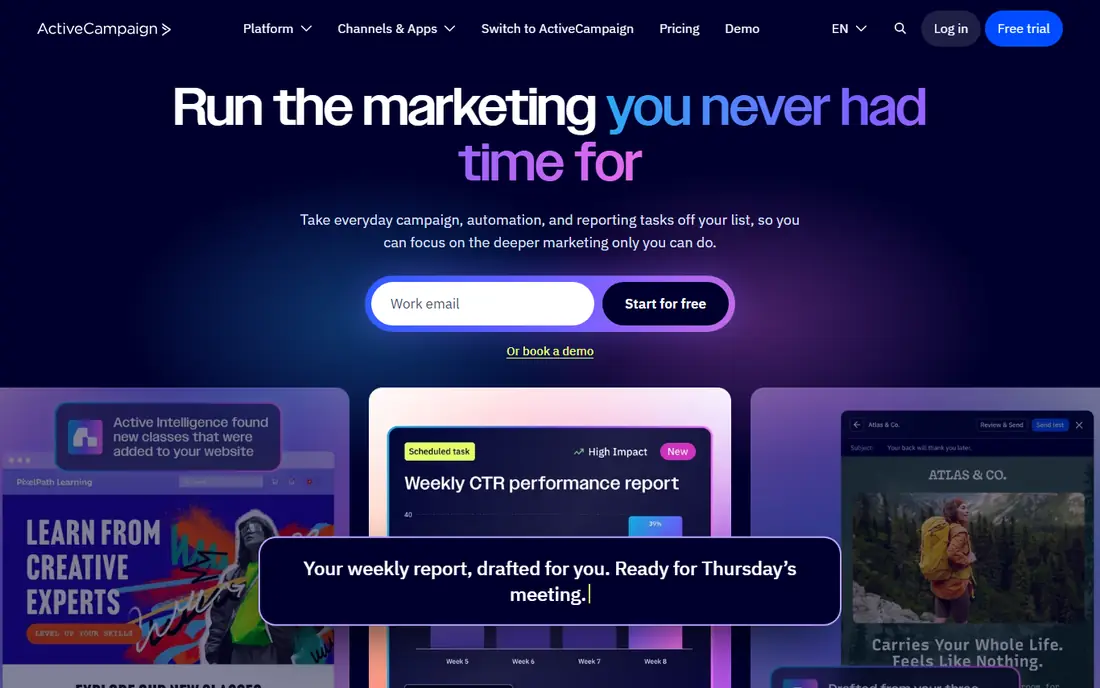
ActiveCampaign combines email marketing, automation, and a built-in CRM at a price that suits small and midsize teams. Its visual automation builder supports conditions, goals, and site tracking, and it integrates with many e-commerce and CRM tools. Plans scale by contacts, with trials available.
The interface can feel busy for beginners, and reporting is simpler than HubSpot's. For a small team that wants real automation without enterprise cost, ActiveCampaign is a strong value pick.
- Strong automation builder
- CRM included
- Good value for small teams
- Interface can feel busy
- Reporting is simpler than HubSpot
Mailchimp
Ideal for: Email-first marketing
Mailchimp started as an email platform and now covers email, automation, landing pages, and basic CRM features. Its editor and templates make attractive emails easy, and a free tier covers small audiences. Paid plans add automation journeys, A/B testing, and predictive insights.
Automation depth is simpler than HubSpot or Marketo, so complex B2B nurture programs may outgrow it. For a small team that mainly needs email plus light automation, Mailchimp's ease and free tier are hard to beat.
- Easy to start
- Free tier
- Strong email design and audience tools
- Automation is simpler than dedicated platforms
- Pricing grows with contacts
Keap
Ideal for: Small business CRM plus marketing
Keap, formerly Infusionsoft, combines CRM, email marketing, automation, and invoicing for small businesses. It suits service businesses that need to capture leads, follow up automatically, and get paid from the same system. Setup is simpler than enterprise platforms, with onboarding help available.
Enterprise features such as account-based marketing are thinner here. For a small business that wants CRM, marketing, and payments together, Keap is a practical all-in-one choice.
- CRM plus automation in one tool
- Invoicing and payments
- Easy setup for small teams
- Fewer enterprise features
- Pricing scales with contacts
SharpSpring
Ideal for: Agency automation
SharpSpring, now part of Constant Contact, offers marketing automation plus a built-in CRM, with features for agencies such as client management and white-label options. It covers email, landing pages, forms, automation, and reporting at a price that undercuts many enterprise platforms.
The integration ecosystem is smaller than HubSpot's, and parts of the interface feel dated. For an agency or mid-market team that wants full automation at a lower cost, SharpSpring is worth a look.
- Full automation plus CRM
- Agency features
- Competitive pricing
- Smaller ecosystem than HubSpot
- Interface feels dated in places
Act-On
Ideal for: Mid-market automation
Act-On is a marketing automation platform for mid-market B2B teams, covering email, landing pages, forms, lead scoring, and reporting. It integrates with Salesforce, Microsoft Dynamics, SugarCRM, and other systems, so teams can keep their existing CRM. Support and onboarding help suit teams without a dedicated marketing ops hire.
The interface feels dated compared with HubSpot, and some pricing is quote-based. For a mid-market team that wants solid automation with CRM flexibility, Act-On remains a reliable choice.
- Email, automation, and lead scoring
- Integrations with major CRMs
- Good support
- Interface feels dated
- Pricing is quote-based for some plans
Ortto
Ideal for: Data-driven automation
Ortto combines a customer data platform with marketing automation, letting teams build audiences from product, billing, and CRM data and run visual customer journeys. It covers email, SMS, and push, with analytics that show journey performance. A free trial covers basic use.
Ortto is a smaller brand than HubSpot or Marketo, so its integration list is shorter. For a data-driven team that wants audiences and journeys from unified customer data, Ortto's approach is distinctive.
- Customer data platform plus automation
- Visual journey builder
- Good analytics
- Smaller brand than HubSpot
- Pricing scales with contacts
How we picked these
We compared official feature pages, pricing pages, and app-store listings for marketing automation tools available in October 2026. We favored tools with current products, B2B automation features, and a range of prices, from free tiers to enterprise platforms. We also checked CRM sync quality, contact-based pricing, and migration support, since those factors decide the true cost of switching platforms. We did not include our own product in this list.
How to choose a Pardot alternative
Start with your CRM. If you use Salesforce, check how each tool syncs leads, campaigns, and scores, since a weak sync wastes the automation. If you want CRM and marketing together, HubSpot, ActiveCampaign, or Keap may suit better than a standalone automation tool.
Then test a real nurture journey. Build a form, a workflow, and a scored lead path, and check reporting end to end. Also compare contact-based pricing, since costs grow with database size in most tools. The best alternative is the one your team can run without a full-time marketing ops hire.
Marketing automation buys often fail on data, not software. Before switching, audit your contact database: duplicates, bad emails, and missing fields will break scoring and personalization in any new tool. Plan the migration for lists, forms, landing pages, workflows, and lead scoring, and test each piece with a small segment before a full move. Also check email deliverability basics, including domain authentication and sender reputation, since a new platform sends from new infrastructure. Pricing needs a careful read: most tools charge by contacts, and a database full of unengaged contacts can push you into a higher tier for no benefit. Clean the list first, then compare plans on engaged contacts. Finally, assign an owner for the platform. Automation tools drift without someone watching workflows, scores, and reports, and a named owner keeps the system useful after launch.
Deliverability is another factor that deserves a test before you commit. Set up domain authentication on a trial account, send test campaigns to major email providers, and check spam placement, since a new platform starts with no sender reputation. Warm up sending gradually rather than blasting your full list on day one, especially if your domain is new to the platform. Also check how the tool handles bounces, unsubscribes, and spam complaints, since poor list hygiene damages deliverability for every future campaign. A short pilot with a small, engaged segment will reveal deliverability problems early, when they are still easy to fix.
Frequently asked questions
What is Pardot now called?
Pardot is now called Account Engagement in Salesforce, after a rebrand. Many buyers still search for Pardot alternatives, and the tools on this list cover the same B2B marketing automation needs.
What is the best Pardot alternative?
HubSpot Marketing Hub suits most teams, with CRM plus marketing in one platform. Marketo Engage suits enterprises on Adobe or Salesforce, while ActiveCampaign and Mailchimp suit smaller teams with lower budgets.
Can I migrate from Pardot to HubSpot?
Yes. HubSpot offers migration tools and services for Salesforce and Pardot data, including lists, forms, and workflows. Plan the migration carefully, especially lead scoring and campaign history, and test before switching.
Is Mailchimp enough for B2B marketing automation?
Mailchimp covers email, light automation, and landing pages well for small teams. For complex B2B nurture, scoring, and account-based programs, HubSpot, Marketo, or ActiveCampaign offer deeper automation.
How much does marketing automation cost?
Costs vary by contacts and features, from free tiers for small audiences to quote-based enterprise plans. Compare contact limits, automation depth, and CRM needs before choosing, since the cheapest plan may not cover your database.
How long does it take to migrate marketing automation platforms?
A small team with simple workflows can migrate in a few weeks, while an enterprise with many workflows, integrations, and scoring models may need two to three months. The slowest parts are usually data cleanup, workflow rebuilding, and testing, not the tool setup itself. Run the old and new systems in parallel for at least one campaign cycle, so you can compare results and catch missing pieces. Budget time for team training too, since a new interface slows everyone down at first.