Protonmail alternatives in 2026: 7 Options Compared

- Our pick for most readers is Tuta, because it covers privacy first mail with encryption with a clear setup path and a free or trial start.
- Mailbox.org is the strongest second choice for privacy focused mail with office tools, especially when the first pick does not fit your budget or workflow.
- Free plans are real but limited: Fastmail and other free tiers suit small teams and simple jobs, while larger or complex work usually needs a paid plan.
- Check the full cost before you commit, including per user fees, add-ons, and any payment or processing charges, since headline prices rarely tell the whole story.
- Test with a real project or workflow before paying, because the best protonmail alternatives for you is the one your team actually keeps using after the trial ends.
Quick comparison
| Product | Ideal for | Price from | Free version | |
|---|---|---|---|---|
 Tuta | privacy first mail with encryption | Free | Yes | Visit |
 Mailbox.org | privacy focused mail with office tools | See website | Free trial | Visit |
 Fastmail | fast reliable mail without ads | See website | Free trial | Visit |
 Zoho Mail | mail inside a business suite | Free | Yes | Visit |
 StartMail | private mail with disposable aliases | See website | Free trial | Visit |
 Posteo | low cost green hosted mail | See website | No | Visit |
 Hushmail | encrypted mail for professional use | See website | Free trial | Visit |
The best protonmail alternatives
We compared official feature pages, pricing pages, app store listings and public reviews for this list, and we focused on products that exist and work today. The options below cover different budgets and needs, so read the best for line first and shortlist two or three that match your situation. Prices change, so confirm the current price on the vendor site before you buy, and use a free plan or trial wherever one is offered.
Tuta
Ideal for: privacy first mail with encryption
For teams that need privacy first mail with encryption, Tuta is a natural first look. On the vendor site, the strengths that stand out are end to end encrypted mail and calendar, and the broader package also covers open source clients in a way that fits daily use. The honest catch is search inside encrypted mail is limited, and a second point to weigh is import tools are basic. Those limits do not rule Tuta out, but they do change who should pick it. If your workflow hits that limit every week, a different option on this list will serve you better, while a reader who rarely hits it may never notice the gap. Our take: Tuta is worth a trial when privacy first mail with encryption is your main need, and the vendor site shows it starts free with a free plan is available. Shortlist it beside one cheaper option and one more powerful option, test the same real task in each, and pick the one that feels clearest after a week of actual use, not after a demo.
- End to end encrypted mail and calendar
- Open source clients
- Affordable paid plans
- Search inside encrypted mail is limited
- Import tools are basic
- Some features lag larger providers
Mailbox.org
Ideal for: privacy focused mail with office tools
Mailbox.org stands out for privacy focused mail with office tools, and that focus shapes everything else it does. On the vendor site, the strengths that stand out are german hosted mail with calendar and drive, and the broader package also covers good privacy stance in a way that fits daily use. The honest catch is interface feels dated, and a second point to weigh is setup needs care for custom domains. Those limits do not rule Mailbox.org out, but they do change who should pick it. If your workflow hits that limit every week, a different option on this list will serve you better, while a reader who rarely hits it may never notice the gap. Our take: Mailbox.org is worth a trial when privacy focused mail with office tools is your main need, and the vendor site shows it pricing is listed on the vendor site with a free trial is offered. Shortlist it beside one cheaper option and one more powerful option, test the same real task in each, and pick the one that feels clearest after a week of actual use, not after a demo.
- German hosted mail with calendar and drive
- Good privacy stance
- Custom domains supported
- Interface feels dated
- Setup needs care for custom domains
- Mobile apps are basic
Fastmail
Ideal for: fast reliable mail without ads
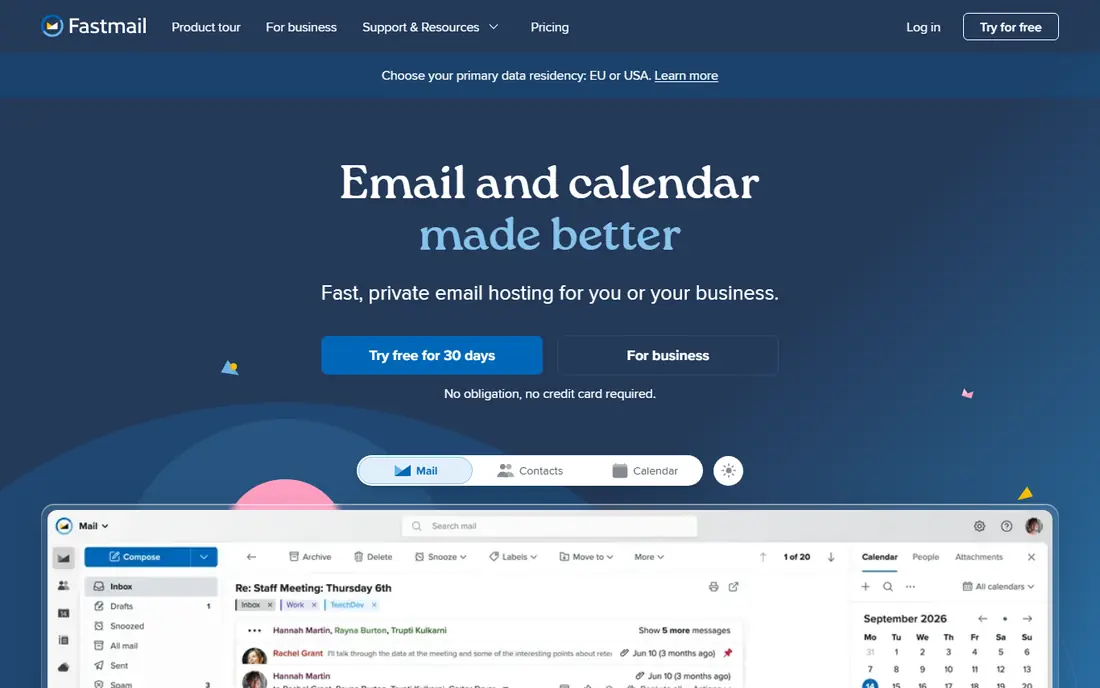
If fast reliable mail without ads is your main need, Fastmail deserves a close look. On the vendor site, the strengths that stand out are fast and reliable, and the broader package also covers strong filtering and aliases in a way that fits daily use. The honest catch is no free plan, and a second point to weigh is encryption is not end to end by default. Those limits do not rule Fastmail out, but they do change who should pick it. If your workflow hits that limit every week, a different option on this list will serve you better, while a reader who rarely hits it may never notice the gap. Our take: Fastmail is worth a trial when fast reliable mail without ads is your main need, and the vendor site shows it pricing is listed on the vendor site with a free trial is offered. Shortlist it beside one cheaper option and one more powerful option, test the same real task in each, and pick the one that feels clearest after a week of actual use, not after a demo.
- Fast and reliable
- Strong filtering and aliases
- Good calendar and contacts
- No free plan
- Encryption is not end to end by default
- Price is per user
Zoho Mail
Ideal for: mail inside a business suite
Zoho Mail fits mail inside a business suite well, with a feature set built around that job. On the vendor site, the strengths that stand out are free tier for small teams, and the broader package also covers integrates with zoho apps in a way that fits daily use. The honest catch is privacy stance is weaker than tuta or proton, and a second point to weigh is free tier limits apply. Those limits do not rule Zoho Mail out, but they do change who should pick it. If your workflow hits that limit every week, a different option on this list will serve you better, while a reader who rarely hits it may never notice the gap. Our take: Zoho Mail is worth a trial when mail inside a business suite is your main need, and the vendor site shows it starts free with a free plan is available. Shortlist it beside one cheaper option and one more powerful option, test the same real task in each, and pick the one that feels clearest after a week of actual use, not after a demo.
- Free tier for small teams
- Integrates with Zoho apps
- Custom domains on paid plans
- Privacy stance is weaker than Tuta or Proton
- Free tier limits apply
- Interface can feel busy
StartMail
Ideal for: private mail with disposable aliases
Teams focused on private mail with disposable aliases will find StartMail a practical option. On the vendor site, the strengths that stand out are strong privacy focus, and the broader package also covers unlimited aliases in a way that fits daily use. The honest catch is no free plan, and a second point to weigh is calendar and drive are limited. Those limits do not rule StartMail out, but they do change who should pick it. If your workflow hits that limit every week, a different option on this list will serve you better, while a reader who rarely hits it may never notice the gap. Our take: StartMail is worth a trial when private mail with disposable aliases is your main need, and the vendor site shows it pricing is listed on the vendor site with a free trial is offered. Shortlist it beside one cheaper option and one more powerful option, test the same real task in each, and pick the one that feels clearest after a week of actual use, not after a demo.
- Strong privacy focus
- Unlimited aliases
- No ads or tracking
- No free plan
- Calendar and drive are limited
- Mobile experience is simpler
Posteo
Ideal for: low cost green hosted mail
Posteo is best understood as a tool for low cost green hosted mail, rather than an all purpose system. On the vendor site, the strengths that stand out are low monthly cost, and the broader package also covers strong privacy and security stance in a way that fits daily use. The honest catch is account setup is manual in places, and a second point to weigh is no custom domain on basic plans. Those limits do not rule Posteo out, but they do change who should pick it. If your workflow hits that limit every week, a different option on this list will serve you better, while a reader who rarely hits it may never notice the gap. Our take: Posteo is worth a trial when low cost green hosted mail is your main need, and the vendor site shows it pricing is listed on the vendor site with no free plan is listed, so budget for a paid plan. Shortlist it beside one cheaper option and one more powerful option, test the same real task in each, and pick the one that feels clearest after a week of actual use, not after a demo.
- Low monthly cost
- Strong privacy and security stance
- No ads
- Account setup is manual in places
- No custom domain on basic plans
- English support is limited
Hushmail
Ideal for: encrypted mail for professional use
When encrypted mail for professional use matters most, Hushmail is one of the stronger names to test. On the vendor site, the strengths that stand out are encrypted mail with business plans, and the broader package also covers long history in a way that fits daily use. The honest catch is interface feels dated, and a second point to weigh is free tier is very limited. Those limits do not rule Hushmail out, but they do change who should pick it. If your workflow hits that limit every week, a different option on this list will serve you better, while a reader who rarely hits it may never notice the gap. Our take: Hushmail is worth a trial when encrypted mail for professional use is your main need, and the vendor site shows it pricing is listed on the vendor site with a free trial is offered. Shortlist it beside one cheaper option and one more powerful option, test the same real task in each, and pick the one that feels clearest after a week of actual use, not after a demo.
- Encrypted mail with business plans
- Long history
- Custom domains
- Interface feels dated
- Free tier is very limited
- Feature set lags modern providers
How we picked these
We started from the main keyword and the related searches readers use, then checked official feature pages, pricing pages, app store listings, privacy pages and public reviews for each candidate. We kept only products that exist and work today, that truly fit protonmail alternatives, and whose official homepage loads. We mixed well known leaders with smaller options, and we favoured products with clear pricing, a trial or free plan, and honest limits we could state plainly. We did not claim hands-on testing that did not happen. Instead, we compared what vendors publish, what reviewers report, and where each product fits best, so readers can see both strengths and catches before they spend money or time on a trial.
How to choose a ProtonMail alternative
Decide what privacy means for your use, because end to end encryption, jurisdiction, and business features are different things. Tuta and StartMail suit users who prioritise encryption, Fastmail suits users who prioritise speed and reliability, and Zoho Mail suits teams already using Zoho tools. Check custom domain support, import tools, calendar and contacts, mobile apps, and how recovery works if you lose access. Test with a secondary address first, move mail in stages, and keep your old account active until forwarding and logins are confirmed. Start with a shortlist of three, not ten, and give each one the same test task. Note where you get stuck, how long setup takes, and whether support answers clearly, because those small frictions grow with daily use. Keep notes from each trial in one place, so the final choice rests on evidence from your own workflow, not on a feature list alone.
Frequently asked questions
What are the best ProtonMail alternatives?
Tuta is the closest privacy focused alternative, Fastmail is best for speed and reliability, and Mailbox.org suits users wanting European hosting. The best pick depends on whether encryption, speed or suite tools matter most.
Is Tuta as private as ProtonMail?
Tuta offers end to end encryption for mail and calendar and an open source approach, which makes it a strong privacy alternative. Check current encryption scope, recovery options and jurisdiction before switching sensitive mail.
Is there a free ProtonMail alternative?
Tuta, Zoho Mail and Fastmail trials offer low cost or free starts, though full features usually need a paid plan. Free tiers often limit storage, domains or support.
Can I use my own domain with these services?
Most paid plans support custom domains, including Tuta, Mailbox.org, Fastmail, Zoho Mail and Hushmail, though setup steps vary. Confirm domain and alias limits on the plan you intend to buy.
How do I switch email providers safely?
Set up the new account, import old mail, update logins and forwarding, then keep the old account for a transition period. Test sending and receiving with contacts before closing the old mailbox.