7 Best Secureframe Alternatives for 2026

- The list opens with Hyperproof, aimed at enterprise GRC programs.
- A permanent free plan is missing from all 7 tools, Hyperproof and Thoropass included; plan for a trial or a premium start.
- Check the limits for Apptega before you commit: automation depth trails Vanta and Drata for large cloud estates.
- Every tool from Hyperproof to Thoropass works by quote, with no list price shown.
- Thoropass suits software plus audit in one vendor.
Direct answer
This list puts Hyperproof first for enterprise GRC programs. Alternatives: Scrut for AI-assisted compliance and risk, and Apptega for service providers and in-house teams. All 7 tools are compared below on price, free plan and limits.
Quick comparison
| Product | Ideal for | Price from | Free version | |
|---|---|---|---|---|
 Hyperproof | Enterprise GRC programs | See website | No | Visit |
 Scrut | AI-assisted compliance and risk | See website | No | Visit |
 Apptega | Service providers and in-house teams | See website | No | Visit |
 Vanta | Widest recognition and integrations | See website | No | Visit |
 Scytale | Guided compliance with experts | See website | No | Visit |
 Strike Graph | Adaptable AI-native compliance | See website | No | Visit |
 Thoropass | Software plus audit in one vendor | See website | No | Visit |
The best Secureframe
If you are comparing Secureframe, this page covers 7 tools in one place: what each is best for, what it costs to start, whether it has a free plan, and the main limit to know about.
Hyperproof
Ideal for: Enterprise GRC programs
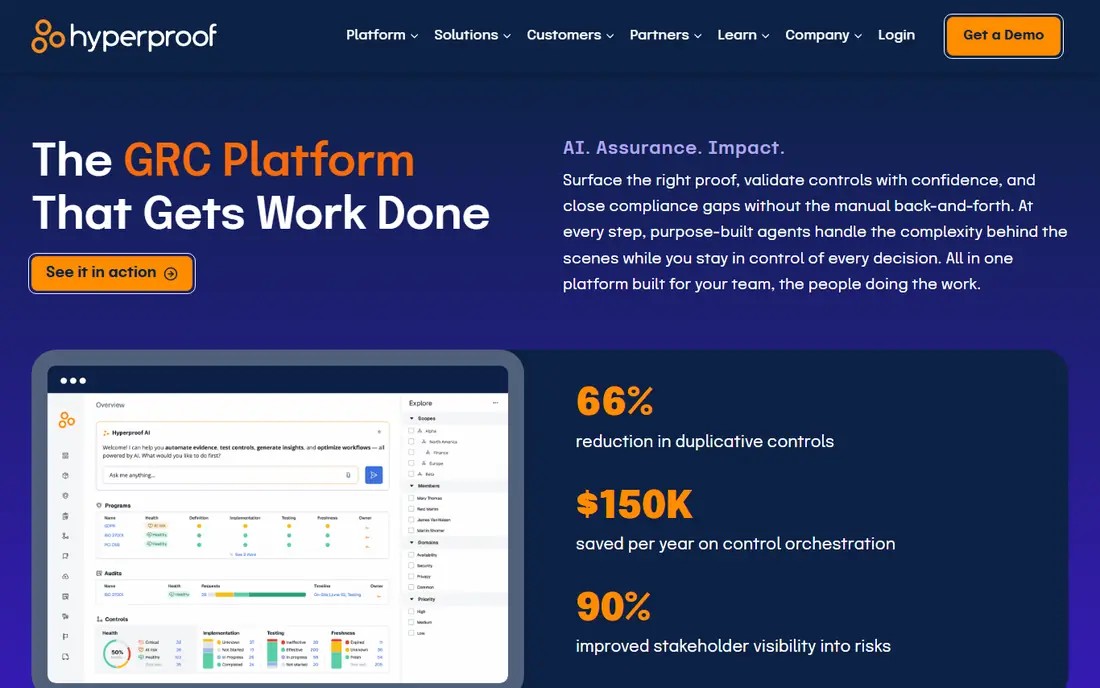
Where Hyperproof fits: enterprise GRC programs. Hyperproof is a governance, risk, and compliance system that handles compliance, risk, audit, and trust together.
Downsides: Smaller teams may find it heavier than needed.
Its typical control approach maps one control to numerous frameworks, which cuts duplicate work for businesses that run SOC 2, ISO 27001, and internal audit programs at once. Worth adding: pricing is quote-based, and implementation takes more planning than a startup-focused tool. Hyperproof shows no starting price here, so confirm the cost on the vendor site. No free plan comes with Hyperproof.
- Typical control set across programs
- Audit collaboration and risk management
- Enterprise focus and pricing
Scrut
Ideal for: AI-assisted compliance and risk

Pick Scrut if this describes you: AI-assisted compliance and risk. Its risk register links cloud, access, policy, and vendor signals. So a failed control presents up as a prioritized risk instead of an isolated alert.
Downsides: Newer AI features need review before relying on outputs.
AI output still needs human review, notably for policy language and questionnaire answers that customers depend on. From a buyer's view, integrations handle typical cloud, identity, and development tools, and the trust center keeps customer-facing proof current. On top of that, for teams that want compliance and risk management together, with AI help on routine work, Scrut is a good fit. No starting price is listed for Scrut here; confirm pricing on the vendor site. Scrut has no permanent free option.
- Risk register and vendor risk in one place
- Wide integrations
- Pricing is quote-based
Apptega
Ideal for: Service providers and in-house teams

Apptega serves service providers and in-house teams. Apptega serves managed security providers and in-house teams that run compliance programs for multiple clients or business units.
It supports plenty of frameworks, maps controls across them, and tracks assessments, risks, and remediation in one place. Pricing for Apptega is not stated here, so ask the vendor for current figures. Apptega has no free plan.
The main drawbacks: Automation depth trails Vanta and Drata for large cloud estates.
- Framework cross-mapping
- Multi-client program management
- Best known for provider use
Vanta
Ideal for: Widest recognition and integrations
Vanta is a good fit for widest recognition and integrations. Its name is widely recognized in security reviews, and its integration library spans cloud, identity, HR, ticketing, and code tools that auditors expect to see connected. As for the details, teams should request a full quote that lists every module they need.
Downsides: Pricing is quote-based and total cost grows with extras.
For businesses selling to large enterprises, Vanta's recognition frequently justifies that total. Beyond that, the primary drawback is cost structure. In practice, continuous monitoring flags control gaps as they appear, and the trust center lets prospects check your posture without repeated document requests. From a buyer's view, the system price is only part of the bill, since trust center features, questionnaire automation, and additional frameworks can add up, and the SOC 2 audit itself is a separate engagement with an outside firm. Check the vendor site for Vanta pricing; none is listed in this comparison. There is no free plan with Vanta.
- Capable trust center and questionnaire automation
- Very large integration library
- Audit fee is separate
Scytale
Ideal for: Guided compliance with experts
Scytale is designed for guided compliance with experts. That guidance helps firms that lack a compliance lead, since experts help scope controls, prepare evidence, and respond to auditor questions. On top of that, the system supports plenty of security, privacy, and AI frameworks, with control mapping that cuts duplicate work when adding a standard.
Downsides: Audit and penetration testing may be extras.
Teams that want software only may find Scytale more practical than needed, whereas teams that want a guide will value the expert layer. It is a decent middle ground between a self-serve system and a full consulting engagement. Scytale shows no starting price here, so confirm the cost on the vendor site. No free plan comes with Scytale.
- Wide framework support
- Dedicated compliance experts
- Pricing is quote-based
Strike Graph
Ideal for: Adaptable AI-native compliance
Strike Graph is a good fit for adaptable AI-native compliance. Strike Graph lets teams design a security program around their actual business instead of forcing a fixed template. Beyond that, for teams that value adaptability, Strike Graph is a practical Secureframe alternative.
Worth adding: controls, evidence, and frameworks can be tailored, which helps businesses with unusual products or regulatory mixes. As for the details, AI-assisted setup links systems and collects evidence, and live tracking shows readiness across frameworks. Check the vendor site for Strike Graph pricing; none is listed in this comparison. Strike Graph does not include a free plan.
Trade-offs to know: Pricing is quote-based.
- Clear audit readiness tracking
- AI-assisted evidence collection
- Smaller brand recognition than Vanta or Drata
Thoropass
Ideal for: Software plus audit in one vendor
Thoropass is built with software plus audit in one vendor in mind. Thoropass differs from most tools here since it pairs software with its own audit and assurance team. In daily use, the trade-off is auditor independence and choice.
Limits to weigh: Pricing is quote-based.
From a buyer's view, pricing is also quote-based, so compare its combined software-plus-audit price against a system quote plus a separate audit quote. In practice, Thoropass also handles HIPAA, HITRUST, ISO 27001, PCI, and GDPR, which matters for healthcare and fintech businesses. Some firms prefer to pick their own auditor, and Thoropass's bundled model does not suit that preference. Thoropass shows no starting price here, so confirm the cost on the vendor site. There is no free plan with Thoropass.
- In-house auditors in the same product
- Task-based audit workflow
- Using its audit firm limits auditor choice
How we built this list
Ainotely used vendor pricing pages and product documentation as the base, then compared plans, free access and documented limits for 7 tools. Prices and plan limits come from vendor pages and can change, so confirm them on the vendor site before you buy. Tools are placed by general fit for Secureframe, with price clarity and free access as tie-breakers. A different team can reasonably rank them differently.
A buyer's checklist
- Request quotes from Hyperproof, Thoropass and the others; the list shows no fixed prices.
- Before choosing Hyperproof, weigh its main limit: enterprise focus and pricing.
- Check the support hours and onboarding help Vanta offers; smaller vendors vary a lot here.
- Ask Scytale about contract length, onboarding fees and user minimums before you sign.
- Ask whether Thoropass integrates with your current software, and whether that comes standard or as an add-on.
Frequently asked questions
Can I migrate from Secureframe to another tool?
Yes, in most cases. You can export policies, controls, and evidence from Secureframe and rebuild them in the new product. Control mapping and integration setup still take time.
How long does SOC 2 take with these tools?
Type 2 brings an observation period, generally multiple months, during which controls must operate. Tools accelerate evidence work, but they cannot shorten the observation period an auditor needs.
Do these tools publish their prices?
No. None of the tools, from Hyperproof to Thoropass, shows a fixed starting price here, so budget time for quotes.
How are the tools for Secureframe ordered?
The order follows typical fit for Secureframe, with Hyperproof first and Thoropass last, then price clarity and free access. It is editorial judgement, not a score, so another team could rank the tools differently.
Is Hyperproof the right pick for everyone comparing Secureframe?
No single tool suits every team. Hyperproof comes first because it fits enterprise GRC programs, while Scrut suits AI-assisted compliance and risk and Apptega suits service providers and in-house teams. Match the tool to your own size, budget and workflow before deciding.
Do these tools cover HIPAA and ISO 27001 too?
Framework coverage still varies, so confirm your exact standards, including GDPR, PCI DSS, or HITRUST, before signing. Control mapping across frameworks is where these tools save the most time.