Best Skybox Security Alternatives in 2026: 8 Options Compared

- Tufin, FireMon and AlgoSec are the closest replacements for firewall policy and network security management.
- Tenable, Qualys and Wiz suit teams that want a broader view of vulnerabilities and cloud exposure alongside network data.
- RedSeal adds network modelling that helps teams see how an attack could move through their estate.
- Brinqa fits teams that want to combine risk data from many tools into one prioritised view.
Quick comparison
| Product | Ideal for | Price from | Free version | |
|---|---|---|---|---|
 Tufin | firewall policy management | See website | Free trial | Visit |
 FireMon | network security policy management | See website | Free trial | Visit |
 AlgoSec | application and firewall security | See website | Free trial | Visit |
 RedSeal | network modelling and risk | See website | Free trial | Visit |
 Tenable One | exposure management platform | See website | Free trial | Visit |
 Qualys | vulnerability and compliance scanning | See website | Free trial | Visit |
 Wiz | cloud security posture | See website | Free trial | Visit |
 Brinqa | unified cyber risk management | See website | Free trial | Visit |
The best Skybox Security Alternatives
Here are our picks for the best skybox security alternatives, covering a mix of well-known leaders and strong smaller options. We compared official feature pages, pricing pages, app-store listings, privacy policies and public reviews to build this list.
Tufin
Ideal for: firewall policy management
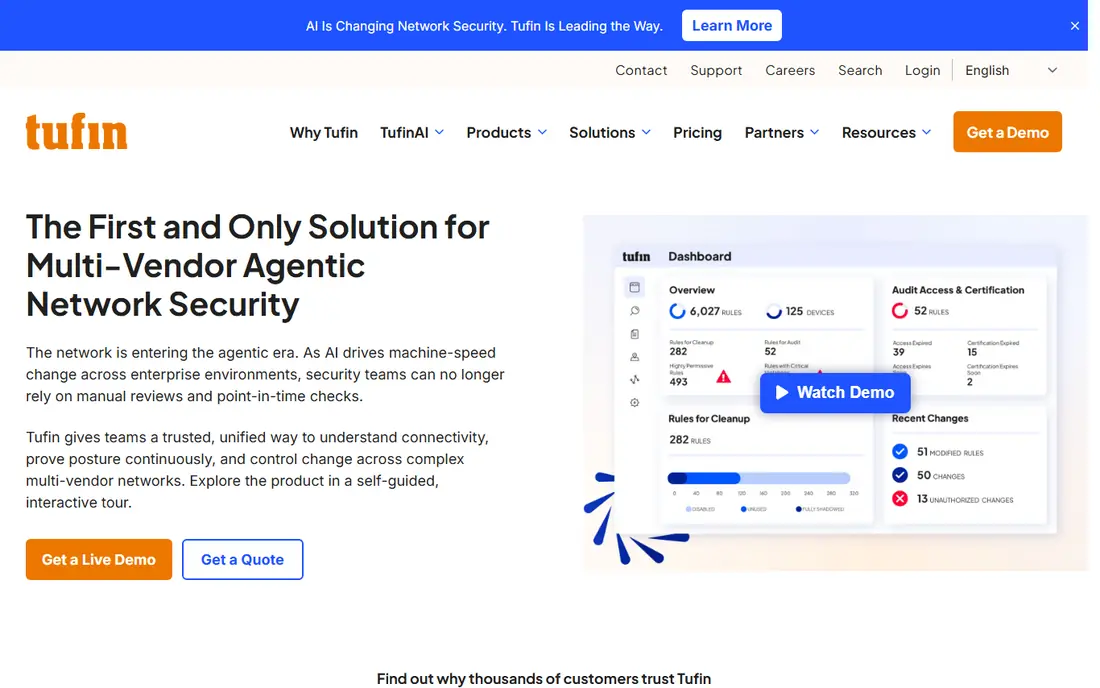
Tufin is the most direct Skybox replacement for firewall policy management. It analyses rules across vendors, flags risky or unused rules, and automates change workflows with approval steps. Compliance reports for common standards save security teams from manual evidence gathering.
Pricing is aimed at larger organisations, and a full rollout needs planning around firewall access and change processes. Smaller teams may find it more than they need. For enterprises managing many firewalls, Tufin is the leading alternative to consider.
Bottom line: Tufin suits firewall policy management best. Its strongest point is strong firewall policy automation, while the main drawback to weigh is enterprise pricing. Check the current pricing page before deciding, since plans and limits change.
- Strong firewall policy automation
- Broad vendor support
- Compliance reporting
- Enterprise pricing
- Implementation takes planning
FireMon
Ideal for: network security policy management
FireMon gives security teams a live view of firewall policies across vendors, with automation for rule reviews and changes. It highlights risky rules, tracks compliance and helps teams clean up years of accumulated rules. That visibility is the core value for organisations with complex networks.
Getting full value requires access to every firewall and time to tune the initial findings. Pricing is quoted based on the estate size. For teams that need continuous firewall policy oversight, FireMon is a strong contender.
Bottom line: FireMon suits network security policy management best. Its strongest point is real-time policy visibility, while the main drawback to weigh is setup needs firewall access and tuning. Check the current pricing page before deciding, since plans and limits change.
- Real-time policy visibility
- Automation for rule changes
- Good reporting
- Setup needs firewall access and tuning
- Pricing is quoted
AlgoSec
Ideal for: application and firewall security
AlgoSec links firewall policies to the applications they protect, which helps teams understand the impact of a rule change before making it. Its automation handles change requests, risk checks and cleanup, and it covers cloud firewalls alongside traditional ones. That application view sets it apart from pure rule managers.
The focus is enterprise, with pricing and implementation to match. Small networks will not need this depth. For organisations where application uptime depends on careful firewall changes, AlgoSec is a strong choice.
Bottom line: AlgoSec suits application and firewall security best. Its strongest point is application connectivity mapping, while the main drawback to weigh is enterprise focus. Check the current pricing page before deciding, since plans and limits change.
- Application connectivity mapping
- Policy automation
- Cloud firewall support
- Enterprise focus
- Smaller teams may find it costly
RedSeal
Ideal for: network modelling and risk
RedSeal builds a model of your network from device configurations, then shows how an attacker could move between segments. That model helps teams prioritise fixes that actually reduce exposure, rather than fixing issues in isolation. Compliance teams also use it to prove segmentation controls.
It is a specialised tool, and its interface reflects that focus rather than broad ease of use. Teams that want a general posture dashboard may prefer Tenable or Wiz. For network exposure modelling, RedSeal is a distinctive and useful option.
Bottom line: RedSeal suits network modelling and risk best. Its strongest point is models attack paths, while the main drawback to weigh is niche product. Check the current pricing page before deciding, since plans and limits change.
- Models attack paths
- Shows network exposure
- Useful for compliance
- Niche product
- Interface and reporting feel specialised
Tenable One
Ideal for: exposure management platform
Tenable One brings together vulnerability, cloud, identity and web application data into one exposure view. Its research base is large, and risk scoring helps teams focus on the issues attackers are most likely to use. For teams that want a broad picture of exposure, that breadth is the appeal.
Pricing depends on asset count and modules, so a large estate costs accordingly, and the module structure can confuse new buyers. Get a scoped quote for your asset count. As a broad exposure platform, Tenable One is a major alternative in this space.
Bottom line: Tenable One suits exposure management platform best. Its strongest point is broad vulnerability and exposure data, while the main drawback to weigh is pricing rises with assets. Check the current pricing page before deciding, since plans and limits change.
- Broad vulnerability and exposure data
- Clear prioritisation
- Large research base
- Pricing rises with assets
- Modules can be confusing
Qualys
Ideal for: vulnerability and compliance scanning
Qualys is a cloud platform for vulnerability management, policy compliance and web application scanning. It covers a wide range of assets, and its compliance modules help teams meet common standards. The cloud delivery model means no scanner hardware to maintain in most cases.
The interface packs in many modules, which can feel dense for new users, and pricing is module based. Teams should price the exact modules they need. For established vulnerability and compliance scanning, Qualys remains a leading platform.
Bottom line: Qualys suits vulnerability and compliance scanning best. Its strongest point is wide scanning coverage, while the main drawback to weigh is interface can feel dense. Check the current pricing page before deciding, since plans and limits change.
- Wide scanning coverage
- Compliance modules
- Cloud-based delivery
- Interface can feel dense
- Pricing is module based
Wiz
Ideal for: cloud security posture
Wiz is built for cloud security, connecting to cloud accounts quickly and showing risks across compute, storage, identity and network exposure. Its graph view shows how issues combine into real attack paths, which helps teams prioritise fixes that matter. Cloud-native teams value its speed of setup.
It is cloud focused, so traditional on-premises firewall policy management is not its strength. Teams with mostly on-premises networks should look at Tufin or FireMon instead. For cloud estates, Wiz is one of the fastest tools to get value from.
Bottom line: Wiz suits cloud security posture best. Its strongest point is fast cloud onboarding, while the main drawback to weigh is cloud focused. Check the current pricing page before deciding, since plans and limits change.
- Fast cloud onboarding
- Clear risk graphs
- Strong cloud coverage
- Cloud focused
- On-premises network policy is not the focus
Brinqa
Ideal for: unified cyber risk management
Brinqa sits above your existing security tools and combines their findings into one risk view. It lets teams build risk scores that reflect their own priorities, assign owners and track remediation. That unification helps organisations that already own scanners and posture tools but struggle to see the whole picture.
It needs those source tools to be useful, so it is not a standalone scanner or firewall manager. Pricing is aimed at larger organisations. For teams drowning in separate tool reports, Brinqa brings welcome order.
Bottom line: Brinqa suits unified cyber risk management best. Its strongest point is combines risk data from many tools, while the main drawback to weigh is needs existing security tools to feed it. Check the current pricing page before deciding, since plans and limits change.
- Combines risk data from many tools
- Flexible risk scoring
- Good reporting
- Needs existing security tools to feed it
- Enterprise pricing
How we picked these
We started from the original product and what people use it for, then compared official feature pages, pricing pages, app-store listings, privacy policies and public reviews for each candidate. We kept only products that exist, work in October 2026 and genuinely fit the topic, and we left out products that were discontinued, unrelated or too thin to recommend.
We weighed fit for the topic first, then price and free options, ease of setup and the honest downsides that show up in reviews and documentation. Prices are given as listed on the vendor's own site where we could verify them, and we wrote See website where a price was quoted, unclear or likely to change by plan.
We also left out products that no longer exist, that have been folded into a different product, or that only partly fit the topic. A longer list would have been easier to write, but a list padded with poor fits helps nobody choose, so we kept the list to products we can genuinely recommend for this use.
How to choose a security posture tool
Start by naming the problem you need to solve. Firewall policy management, vulnerability prioritisation and cloud exposure are related but different jobs, and no single tool covers all three equally well. Pick the tool that matches your biggest risk first, then check what else it covers.
Next, check data sources. A posture tool is only as good as the firewalls, scanners and cloud accounts it can read. Confirm it supports your specific vendors and versions before buying, since a missing integration can leave a blind spot in exactly the area you wanted to cover.
Finally, plan for the work after the report. A tool that finds thousands of issues without prioritisation will overwhelm a small team. Look for clear risk scoring, ownership assignment and tracking, so findings turn into fixes rather than another unread dashboard.
Run a real trial before you pay. Sign up for the free tier or trial, connect it to a real project, and test the exact tasks you do every week rather than the demo workflow. Check how long setup takes, how clear the reporting is and how quickly support replies, since those details decide whether a tool survives past the first month.
Plan the switch, not just the signup. Export your data from the old tool, check what imports cleanly and what must be rebuilt by hand, and keep the old system running until the new one has handled real work. A short overlap period avoids lost data and gives your team time to learn the new workflow.
Frequently asked questions
What is the best Skybox Security alternative?
Tufin is the closest match for firewall policy management, with FireMon and AlgoSec close behind. If your priority is vulnerability and cloud exposure, Tenable or Wiz may be a better fit.
What does a security posture tool actually do?
It collects data from firewalls, scanners and cloud accounts, then shows where your network is exposed and which issues matter most. Some tools focus on firewall rules, while others focus on vulnerabilities or cloud misconfigurations.
Do I need firewall management and vulnerability scanning?
Many teams need both, but they are different products. Firewall tools manage rules and access paths, while scanners find weak software and misconfigurations. Larger teams often run one of each and combine the results.
Are these tools suitable for small businesses?
Most tools on this list are built for mid-size and large organisations, with pricing to match. Small businesses usually get more value from a managed security service or a simpler scanner than from an enterprise posture platform.
How long does implementation take?
Firewall and posture tools often take weeks to connect to all data sources and tune. Allow time for that project, and expect early reports to need tuning before the risk scores reflect your real priorities.
Can I try these options before paying?
Yes, in most cases. Nearly every option on this list offers a free tier or a free trial, and we note that in the comparison table and in each product block. Use the trial for real work rather than a quick look, and check the renewal price before the trial ends so there are no surprises.