Stripe Alternatives in 2026: 7 Processors Compared

- Square is our pick for businesses that sell in person and online, with a free point-of-sale system and simple flat pricing.
- PayPal suits online stores that want checkout trust, with a widely recognized wallet and buy now, pay later options.
- Adyen suits high-volume, multi-country businesses that need interchange-plus pricing and global payment methods.
- Paddle suits software sellers who want tax handling included, since it acts as the merchant of record.
- Stripe itself charges 2.9 percent plus 30 cents for US online cards, so compare every alternative against that baseline, including monthly fees.
Quick comparison
| Product | Ideal for | Price from | Free version | |
|---|---|---|---|---|
 Square | In-person plus online | Free | Yes | Visit |
 PayPal | Trusted online checkout | Free | Yes | Visit |
 Braintree | Subscriptions and marketplaces | Free | Yes | Visit |
 Adyen | Enterprise global payments | See website | No | Visit |
 Helcim | Transparent interchange-plus | Free | Yes | Visit |
 Paddle | SaaS tax handling | See website | No | Visit |
 Authorize.net | Standalone gateway | $25 per month | No | Visit |
The best Stripe alternatives
Stripe is a capable processor, but it is not the right fit for every business. Some sellers need in-person point of sale, others need merchant-of-record tax handling, and others need lower costs at high volume. The alternatives below cover each gap, with fees stated as published for US online and in-person cards where available.
Square
Ideal for: In-person plus online

Square is our pick for businesses that sell in person and online. The free point-of-sale system, card readers and hardware options cover shops, markets, salons and service businesses, while online payments, invoices and a free online store cover digital sales. Flat-rate pricing is easy to understand, with in-person cards at 2.6 percent plus 10 cents and online cards at 2.9 percent plus 30 cents on standard plans.
Online-only businesses may find Stripe or PayPal cheaper in some cases, and Square account reviews can affect higher-risk sellers. For omnichannel small businesses, though, Square offers the most complete free starting package here.
- Free point-of-sale plan with hardware options
- Simple flat-rate pricing
- Next-business-day payouts in many cases
- Online rates run higher than in-person rates
- Account holds can affect higher-risk sellers
PayPal
Ideal for: Trusted online checkout
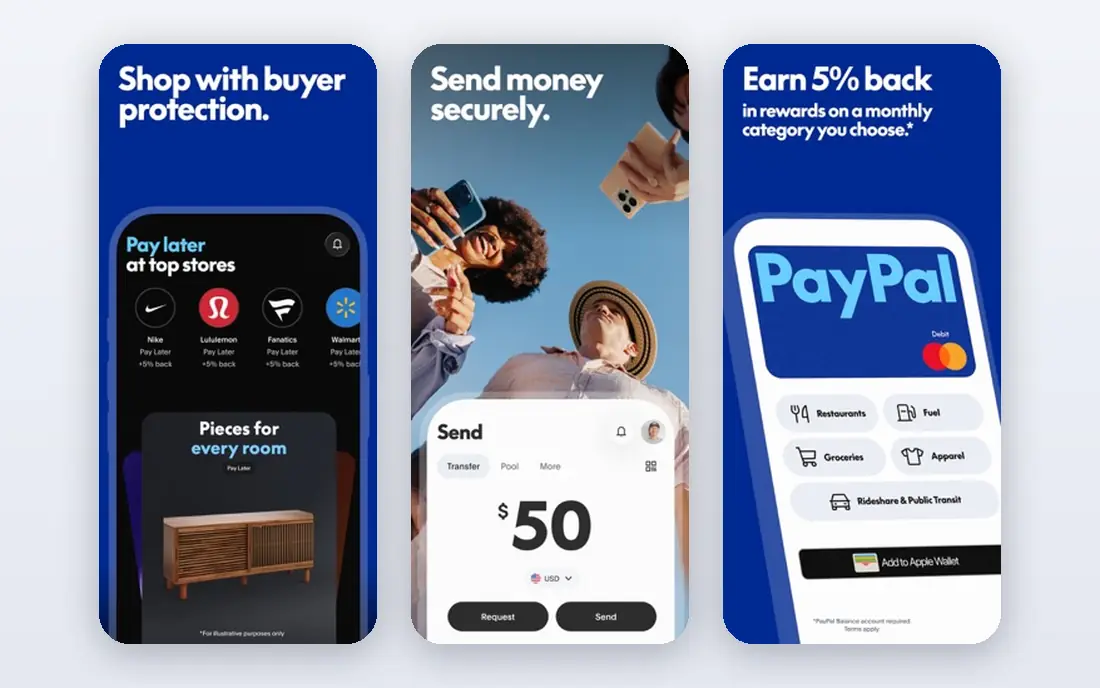
PayPal suits online stores that want checkout trust above all. Millions of buyers already have PayPal accounts, which removes card-entry friction, and Pay Later options let customers split purchases. Setup is fast with no monthly fee, and the brand recognition alone can justify the slightly higher card rate for many stores.
That rate, 2.99 percent plus a fixed fee for US online checkout, runs above Stripe standard pricing, and dispute handling has its own fee rules. For stores where checkout conversion matters more than shaving a fraction of a percent, PayPal is the natural Stripe alternative, and many stores offer both.
- Widely recognized checkout that can lift conversion
- Buy now, pay later options
- Fast setup with no monthly fee
- Online card rate of 2.99 percent plus 49 cents is higher than Stripe
- Dispute fees apply in some cases
Braintree
Ideal for: Subscriptions and marketplaces

Braintree, owned by PayPal, suits businesses that need more than a simple checkout button. Subscription billing, marketplace payouts, stored payment methods through Vault, and support for PayPal, Venmo and cards in one integration make it a strong choice for SaaS and marketplace models. Card rates run around 2.59 percent plus 49 cents for standard online transactions in published comparisons.
Setup needs developer time, which small stores without technical help may find heavy. For subscription and marketplace businesses that outgrow basic PayPal checkout, Braintree offers Stripe-like flexibility with PayPal backing.
- Owned by PayPal with strong subscription and marketplace tools
- Competitive card rates
- Vault for stored payment methods
- Developer setup takes more work than PayPal checkout
- Support is less hands-on than some rivals
Adyen
Ideal for: Enterprise global payments
Adyen suits high-volume, multi-country businesses that need one platform for cards, local payment methods, in-person terminals and online checkout worldwide. Interchange-plus pricing, with a markup around 0.60 percent plus a per-transaction fee on top of interchange, gives transparency at scale, and the platform handles currencies and local methods that smaller processors struggle with.
Custom pricing and enterprise onboarding make Adyen unsuitable for small sellers. For companies processing large volumes across countries, though, Adyen offers global reach and pricing transparency that flat-rate processors cannot match.
- Interchange-plus pricing with global payment methods
- Unified online, in-person and mobile payments
- Advanced fraud tools
- Enterprise focus with custom pricing
- Overkill for small businesses
Helcim
Ideal for: Transparent interchange-plus
Helcim suits growing small businesses that want transparent pricing without a monthly fee. Interchange-plus pricing passes card network costs through plus a markup, which often beats flat rates as volume grows, and automatic volume discounts lower the markup further. Built-in invoicing, payment links and an online store cover everyday selling needs.
Interchange-plus pricing confuses some new sellers, since the effective rate varies by card type. For businesses processing enough volume to care about a fraction of a percent, Helcim offers a clear, no-monthly-fee path to lower costs.
- Interchange-plus pricing with no monthly fee
- Automatic volume discounts
- Built-in invoicing and online store tools
- Less brand recognition than Square or PayPal
- Interchange-plus math takes learning for new sellers
Paddle
Ideal for: SaaS tax handling
Paddle suits software and digital product sellers who do not want to manage global tax registrations themselves. As merchant of record, Paddle becomes the legal seller, collects and remits sales tax, VAT and GST, and handles checkout, subscriptions and billing in one platform. That tax handling alone justifies the fee for many small SaaS teams.
The fee, 5 percent plus 50 cents per transaction including tax handling, is high compared with standard card processing, so low-margin products suffer. For SaaS sellers with global customers and limited tax expertise, Paddle removes a major compliance burden.
- Acts as merchant of record, handling global sales tax and VAT
- Subscription management included
- Checkout and billing in one platform
- Fee of 5 percent plus 50 cents per transaction is high for low-margin products
- Less suited to physical goods
Authorize.net
Ideal for: Standalone gateway
Authorize.net suits merchants who already have a processor relationship and need a reliable standalone gateway, or who want an all-in-one account with a long-established provider. It connects to most shopping carts and platforms, offers fraud detection tools, and has served merchants for decades.
The $25 monthly gateway fee plus processing costs makes it pricier than free processors for small sellers, and setup is more technical than Square checkout. For businesses that need a gateway specifically, or that value Authorize.net long track record, it remains a solid choice.
- Long-established gateway with broad platform support
- Fraud detection tools
- Flexible gateway-only or all-in-one options
- Monthly gateway fee plus processing costs
- Setup is more technical than Square or PayPal
How we picked these
We compared official pricing pages and public fee comparisons for payment processors available to US businesses in October 2026. We kept processors covering distinct needs, from in-person sales to global enterprise payments and merchant-of-record tax handling, and we stated fees as published for US transactions where available. Fees vary by card type, volume and region, so confirm current terms before switching. We did not claim hands-on testing.
How to choose the right Stripe alternative
Start with how you sell. In-person sellers need Square or Adyen terminals, online stores need trusted checkout from PayPal or Stripe-like APIs, subscription businesses need Braintree or Paddle, and high-volume global sellers need Adyen interchange-plus pricing. Matching the processor to the sales model matters more than a small fee difference.
Then calculate total cost on your real sales mix. Flat rates are simple but can cost more at volume, while interchange-plus pricing saves money only if you understand card mix and volume discounts. Check monthly fees, dispute fees, payout timing, chargeback handling and account stability rules for your industry. Finally, test checkout on your own site before switching fully, since a processor that frustrates buyers costs more in lost sales than it saves in fees.
A practical step before switching processors is to run the new processor alongside the old one for a few weeks on a small share of traffic, and compare approval rates, payout timing and support response, not just headline fees. That parallel run reveals integration problems and account review delays before they affect all revenue. Also confirm how chargebacks, refunds and held funds are handled, since those processes matter most when something goes wrong.
Frequently asked questions
What is the best Stripe alternative?
Square suits in-person and online small businesses, PayPal suits trusted online checkout, Adyen suits high-volume global businesses, and Paddle suits SaaS sellers who want tax handling. The best alternative depends on how you sell, your volume and whether you need in-person, subscription or global payment features.
Is Square cheaper than Stripe?
For in-person sales, Square at 2.6 percent plus 10 cents beats Stripe in-person pricing in many comparisons. For online sales, both charge around 2.9 percent plus 30 cents on standard plans, so the difference comes from features, hardware and payout timing rather than rate alone.
What is a merchant of record?
A merchant of record is the legal seller of a product, responsible for collecting and remitting sales tax, VAT and GST, handling refunds and chargebacks, and complying with local selling rules. Paddle, Lemon Squeezy and FastSpring act as merchants of record for software sellers, for a higher per-sale fee than standard processors.
Do Stripe alternatives charge monthly fees?
Some do and some do not. Square, PayPal, Braintree and Helcim offer no-monthly-fee options, while Authorize.net charges a $25 monthly gateway fee and some enterprise processors use custom monthly pricing. Always compare monthly fees plus transaction rates on your actual volume.
Can I use more than one payment processor?
Yes, many businesses offer several checkout options, such as cards through one processor plus PayPal as a wallet option. Multiple processors can improve conversion and provide a backup if one account has issues, but they add reconciliation work, so weigh that against the benefit.