Best LLM Prompt Tracking Software in 2026: 7 Tools Compared

- 1
 Peec AIIn-house marketing teams tracking competitorsVisit
- 2
 Semrush AI Visibility ToolkitExisting Semrush customersVisit
- 3
 ProfoundEnterprise brands with a large AI search budgetVisit
- 4
 LLMrefsKeyword-first tracking across numerous sitesVisit
- 5
 Ahrefs Brand RadarMarket-wide brand mention researchVisit
- Peec AI takes the first slot, best suited to in-house marketing teams tracking competitors.
- Rankscale fits adaptable, credit-based monitoring.
- Check the limits for Semrush AI Visibility Toolkit before you commit: sold as a separate toolkit, so it layers on to an existing Semrush bill.
- Neither Peec AI nor Rankscale, nor any of the other 5 tools, has a permanent free plan; trials and quotes are the norm.
- OtterlyAI is the lowest-priced starter here at $29/month.
Direct answer
This list puts Peec AI first for in-house marketing teams tracking competitors. If your case is different, Semrush AI Visibility Toolkit suits existing Semrush customers and Profound suits enterprise brands with a large AI search budget. The remaining 4 options are covered below with prices and limits.
Quick comparison
| Product | Ideal for | Price from | Free version | |
|---|---|---|---|---|
| Peec AI | In-house marketing teams tracking competitors | See website | Not stated | Visit |
| Semrush AI Visibility Toolkit | Existing Semrush customers | See website | Not stated | Visit |
| Profound | Enterprise brands with a large AI search budget | Free Trial plan; enterprise pricing See website | Free trial | Visit |
| LLMrefs | Keyword-first tracking across numerous sites | See website | Not stated | Visit |
| Ahrefs Brand Radar | Market-wide brand mention research | See website | Not stated | Visit |
 OtterlyAI | Small teams that want clear prompt-based pricing | $29/month (15 prompts; 15% off with annual billing) | Free trial | Visit |
 Rankscale | Adaptable, credit-based monitoring | See website | Not stated | Visit |
LLM Prompt Tracking Software, one by one
Short on time? The summary and table above give the quick view of 7 tools for LLM prompt tracking software, and the profiles that follow give the detail behind each entry.
Peec AI
Ideal for: In-house marketing teams tracking competitors
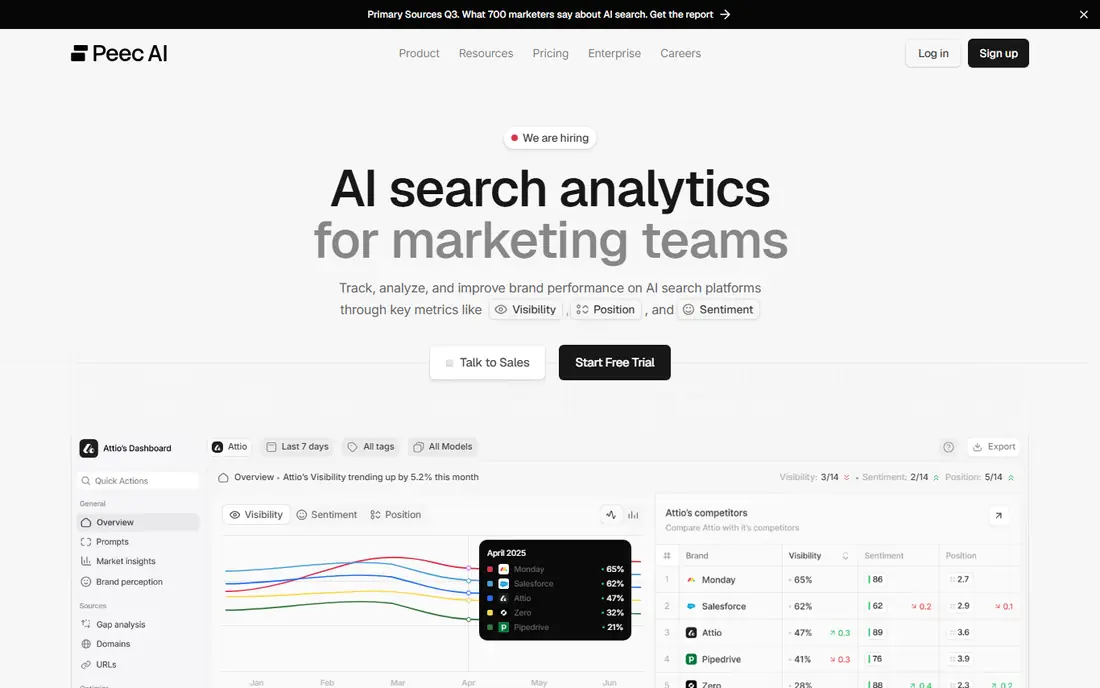
Peec AI is a good fit for in-house marketing teams tracking competitors. Peec AI is a Berlin-based startup that has grown rapidly by keeping the product narrow. From a buyer's view, you add the prompts your buyers are likely to ask, name your competitors, and Peec reports how frequently each brand appears, where it ranks in the answer and which sources the AI engines cite.
Honest limits: Pricing is listed in euros, which complicates US budgeting.
In daily use, lower levels cap prompts and contain a restricted set of engines, and adding models or prompts raises the bill. In daily use, the source analysis is the most handy part. That is more handy than a visibility score alone. In daily use, for a marketing manager who needs a weekly chart for leadership, the output is simple to read. Peec AI shows no starting price here, so confirm the cost on the vendor site. Free options: Not stated. Best features of Peec AI: Source analysis displays which sites feed AI answers.
- Capable competitor comparisons
- Clean dashboard concentrated on visibility
- Additional engines and prompts push costs up on lower levels
Semrush AI Visibility Toolkit
Ideal for: Existing Semrush customers
Pick Semrush AI Visibility Toolkit if this describes you: existing Semrush customers. For teams that live in Semrush, this toolkit removes the need for another login.
Honest limits: Less specialized than dedicated AI visibility startups.
It tracks how your brand presents up in AI answers from engines like ChatGPT, Google AI Mode, Gemini and Perplexity, and puts that next to the organic search data you already report on. The practical advantage is context. Pricing for Semrush AI Visibility Toolkit is not stated here, so ask the vendor for current figures. Free access: Not stated.
- Merges prompt tracking with keyword and traffic data
- Familiar reporting and user management
- Sold as a separate toolkit, so it layers on to an existing Semrush bill
Profound
Ideal for: Enterprise brands with a large AI search budget
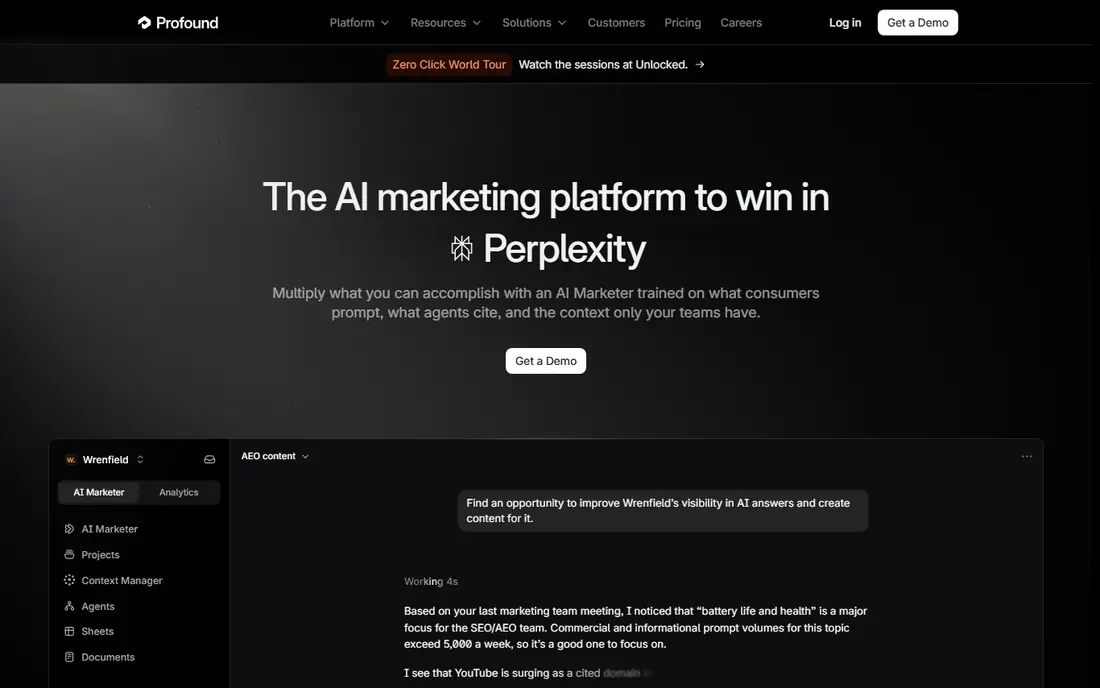
Profound targets enterprise brands with a large AI search budget. Profound is the name most large marketing teams bring up first, and it is designed for that buyer. In practice, the honest weakness is that there is no longer a mid-priced premium step between free and enterprise.
So a company that outgrows 50 prompts goes straight to a custom quote. For a small business, that free Trial is now a reasonable way to see where you stand. Premium plans now go through the sales team, so expect a demo and a custom quote instead of a credit card checkout. Its pricing has moved quick this year. On top of that, pricing tracker PricingSaaS recorded Profound removing its $99 and $399 self-serve levels in September 2026 and replacing them with a single free Trial plan. Profound cost at the entry level: Free Trial plan. Trial and free access: Free trial.
Points against: No self-serve premium level after September 2026.
- Aimed at large brands, with premium plans sold through a sales team
- Shared Projects included in the Trial plan
- Pricing changes frequently, so quotes can shift
LLMrefs
Ideal for: Keyword-first tracking across numerous sites
Where LLMrefs fits: keyword-first tracking across numerous sites. LLMrefs fits SEO-minded marketers who think in keywords instead of prompts.
Beyond that, bigger teams that require SSO or in-depth user permissions may also find the product too entry-level. No starting price is listed for LLMrefs here; confirm pricing on the vendor site. Free options: Not stated.
Downsides: Fewer enterprise controls than bigger vendors.
- Broad engine coverage for the price
- Opens from keywords and creates prompts for you
- Sites share one prompt budget, so heavy users hit limits
Ahrefs Brand Radar
Ideal for: Market-wide brand mention research
Think of Ahrefs Brand Radar for market-wide brand mention research. If you only need to watch 30 prompts each week, a dedicated tracker will likely be less expensive. Ahrefs approaches the problem from the data side.
The main drawbacks: Pricing structure confuses some buyers.
On top of that, Brand Radar does not rely only on a short list of prompts you type in. It draws on a large index of AI answers built from search demand. So you can see how an entire category talks about you and your rivals. That is handy for a first audit when you do not yet know which prompts matter. No starting price is listed for Ahrefs Brand Radar here; confirm pricing on the vendor site. Free plan details: Not stated.
- Solid for category and competitor research
- Draws on a very large prebuilt prompt dataset instead of only the prompts you enter
- Sold as an add-on on top of an Ahrefs plan
OtterlyAI
Ideal for: Small teams that want clear prompt-based pricing
Choose OtterlyAI for small teams that want clear prompt-based pricing. The Lite plan costs $29 per month for 15 search prompts, Standard is $189 for 100 prompts, and Premium is $489 for 400. As for the details, the main limit is that multiple engines are extras.
More specifically, Claude, Gemini and Google AI Mode are sold as extras, so a team that needs all seven engines will pay more than the headline price. Every plan tracks four engines daily: ChatGPT, Google AI Overviews, Perplexity and Microsoft Copilot. That last point matters for small firms, since nobody has to share a login. You can pay monthly or annually, and annual billing takes 15% off. The starting price for OtterlyAI: $29/month. As for free access: Free trial.
Downsides: Gemini and Google AI Mode cost additional.
- MCP access and a Looker Studio connector from the Standard plan
- Unlimited team members and brands on every plan
- The Lite plan's 15 prompts run out rapidly
Rankscale
Ideal for: Adaptable, credit-based monitoring
Rankscale is built with adaptable, credit-based monitoring in mind. Rankscale is a decent match for buyers who do not need daily tracking on a fixed prompt list. Its credit model lets you run checks when you need them, like before and after a content refresh or a product launch, rather than paying for a monthly prompt quota that sits idle.
Credits burn quicker when you add engines, prompts or frequency. A finance team that wants a fixed monthly number may prefer a flat-priced tool like OtterlyAI. It is also a smaller company, so check support response times during the trial. No starting price is listed for Rankscale here; confirm pricing on the vendor site. As for free access: Not stated.
- Credit-based model suits irregular or project-based tracking
- Bundles site audits that check whether pages are simple for AI engines to read
- Credits make monthly spend harder to predict
Our selection method
The comparison looks at four things: starting price, free access, how well the feature set matches LLM prompt tracking software, and the main limit of each tool. Seat minimums, billing terms and add-ons can move the real cost, so the starting prices here are a guide and not a quote. Tools are placed by general fit for LLM prompt tracking software, with price clarity and free access as tie-breakers. A different team can reasonably rank them differently.
What to confirm before you sign up
- Get a written quote from Peec AI, Semrush AI Visibility Toolkit, LLMrefs and others; the list shows no starting price for them.
- Run a trial of Profound and OtterlyAI with real work before paying for a year; your own workflow is the best test.
- Before choosing Peec AI, weigh its main limit: pricing is listed in euros, which complicates US budgeting.
- Confirm you can export your data from Ahrefs Brand Radar, so leaving later does not mean losing records.
- Map your must-have features to a specific Peec AI plan before you compare prices.
Frequently asked questions
Does any tool for LLM prompt tracking software here have a free plan?
No tool in this list, Peec AI and Rankscale included, has a permanent free plan. Profound, OtterlyAI offer a trial. Trials and quotes are the usual route, so plan a short evaluation period.
What is the cheapest option for LLM prompt tracking software in this list?
On published monthly entry prices, OtterlyAI is the lowest here at $29/month. Entry price is only part of the cost, because seats, add-ons and billing terms can change the total.
How accurate are these tools?
AI answers vary by run, location and account history, so no tracker sees exactly what each user sees. Decent tools cut the noise by running prompts often and reporting trends over time.
How are the tools for LLM prompt tracking software ordered?
Peec AI sits first and Rankscale last because the order follows typical fit for LLM prompt tracking software, then price clarity and free access. It is a judgement call, so read each profile for fit and limits.
Do these tools publish their prices?
Not all of them. Peec AI, Semrush AI Visibility Toolkit, LLMrefs and others publish no starting price, so expect a quote request for those. The rest, Profound included, show a starting price, though seats and billing terms still change the final cost.