Top RFP Software in 2026: 7 Tools Compared

- Loopio and Responsive suit teams that answer many RFPs and need a strong, searchable content library.
- Qvidian and RFP360 suit teams that want structured proposal workflows with collaboration and tracking.
- Proposify and PandaDoc suit smaller teams that want fast, good-looking proposals without heavy RFP process.
- Nusii suits freelancers and small agencies that need simple proposals and client approval.
- A clean, current content library matters more than AI drafting, since stale answers lose deals.
Quick comparison
| Product | Ideal for | Price from | Free version | |
|---|---|---|---|---|
 Loopio | RFP response teams | See website | No | Visit |
 Responsive | Enterprise RFP automation | See website | No | Visit |
 Qvidian | Proposal automation | See website | No | Visit |
 RFP360 | Structured RFP workflow | See website | No | Visit |
 Proposify | Fast sales proposals | See website | Free trial | Visit |
 PandaDoc | Proposals and e-signatures | See website | Free trial | Visit |
 Nusii | Simple client proposals | See website | Free trial | Visit |
The best RFP software
We compared official feature pages, pricing pages, and public reviews for seven RFP tools. Our pick for most response teams is Loopio for its library and workflow, with Responsive close behind for larger enterprises.
Loopio
Ideal for: RFP response teams
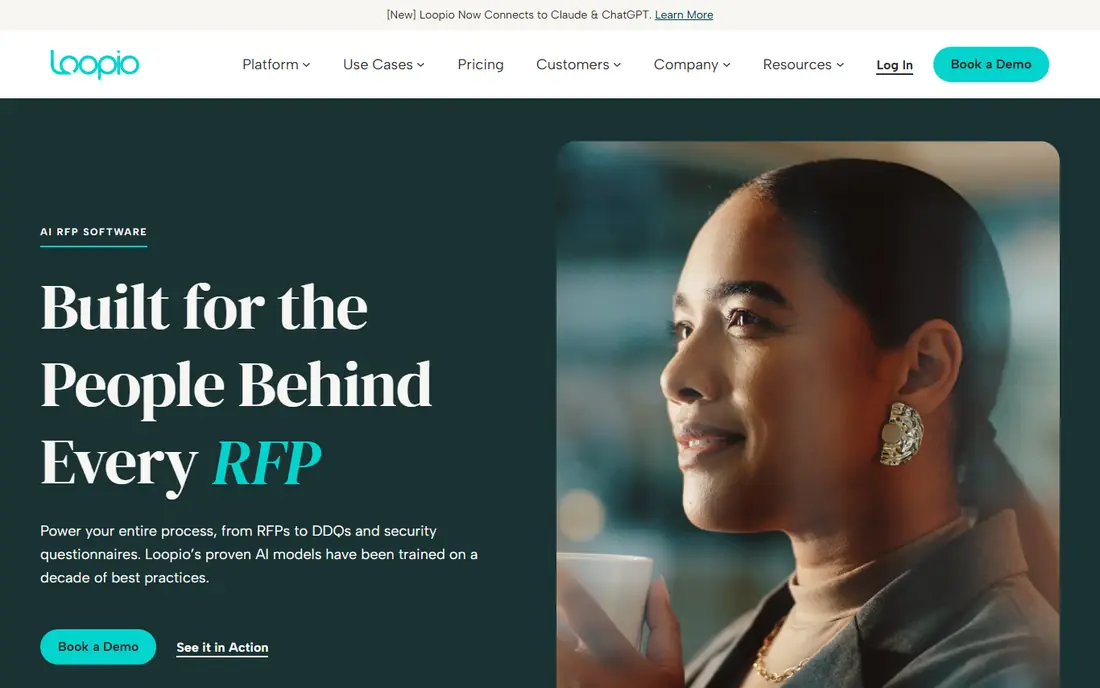
Loopio helps teams answer RFPs, security questionnaires, and due diligence requests from a central, searchable content library. Team members can assign questions, track progress, and reuse approved answers, which cuts copy-paste work and errors. A browser extension lets you pull library answers into web portals and documents.
Library setup takes effort, since old answers need review and tagging before they become useful. Pricing is quoted. For teams that answer RFPs often, Loopio pays off by making every future response faster and more consistent.
- Searchable content library
- Collaboration and tasks
- Browser extension
- Quoted pricing
- Library setup takes effort
Responsive
Ideal for: Enterprise RFP automation
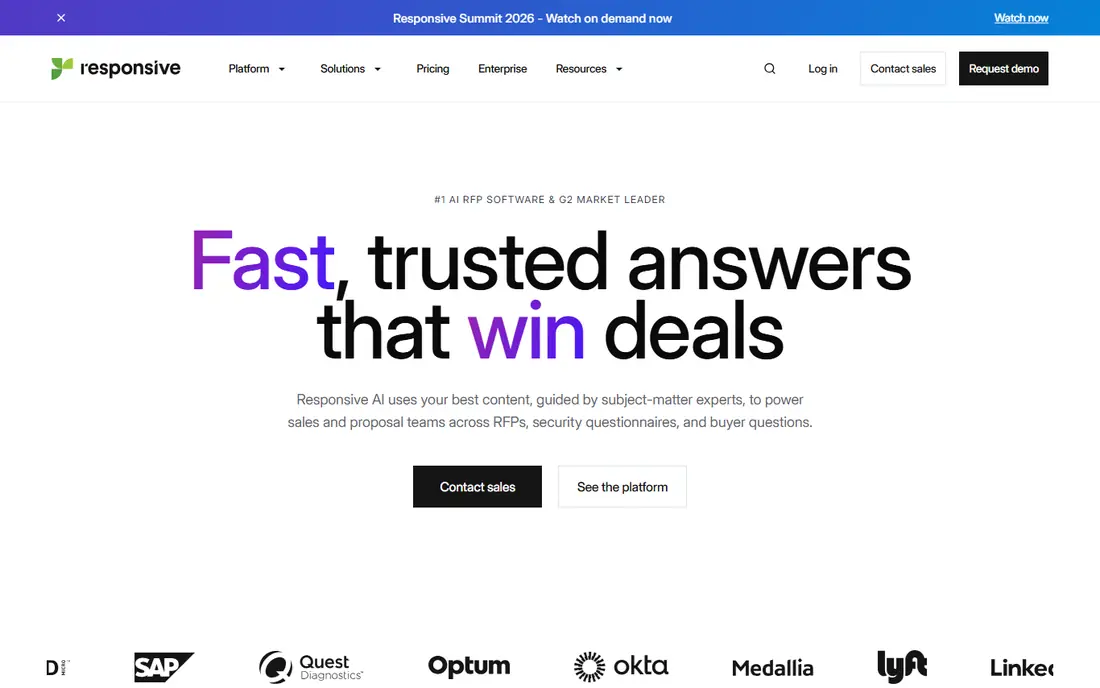
Responsive, formerly RFPIO, is an enterprise response platform for RFPs, questionnaires, and proposals, with AI help that suggests library answers for new questions. It integrates with common business tools and supports collaboration, review, and approval workflows at scale. Large sales and security teams use it to handle high response volumes without losing consistency.
Pricing and implementation suit enterprises rather than small teams. Smaller firms may find Loopio or Proposify more direct. For large organizations with heavy RFP loads, Responsive is a leading platform.
- AI-assisted responses
- Large content library
- Integrations
- Enterprise pricing
- Implementation takes time
Qvidian
Ideal for: Proposal automation
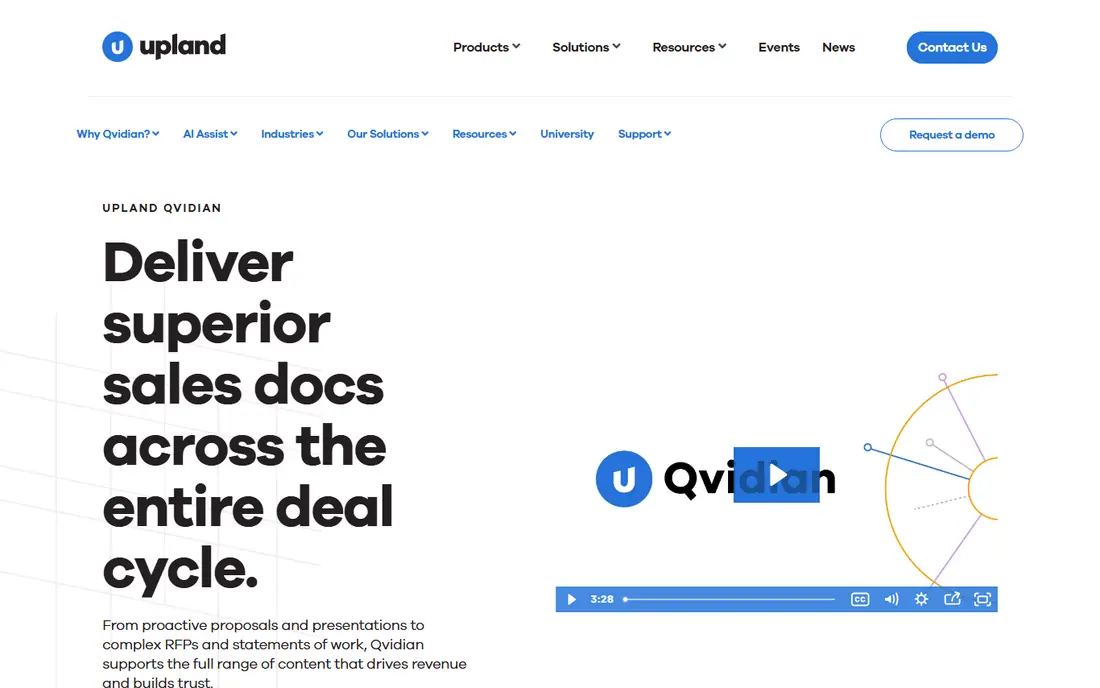
Qvidian, part of Upland Software, offers proposal automation with a content library, workflow, approvals, and analytics for RFP responses. Teams can manage content, assign sections, and track proposal progress in one system. That structure suits companies with formal proposal processes and review stages.
The interface feels enterprise-heavy, and pricing is quoted. Smaller teams may prefer a lighter tool. For companies that need formal proposal control with analytics, Qvidian is a solid choice.
- Proposal content library
- Workflow and approvals
- Analytics
- Quoted pricing
- Interface feels enterprise-heavy
RFP360
Ideal for: Structured RFP workflow
RFP360 covers both sides of the RFP process, with tools for companies that issue RFPs and vendors that respond. Response teams get a structured workflow, content library, and collaboration tools, while buyers get scoring and comparison features. That dual view helps vendors understand what buyers see.
Pricing is quoted, and the brand is smaller than Loopio or Responsive. For teams that want a clear, structured RFP workflow without enterprise complexity, RFP360 is a practical option.
- Clear RFP workflow
- Vendor and buyer tools
- Content library
- Quoted pricing
- Smaller brand than Loopio
Proposify
Ideal for: Fast sales proposals
Proposify helps sales teams create polished proposals fast, with templates, pricing tables, e-signatures, and tracking that shows when a client opens a proposal. It suits agencies, consultants, and SaaS sales teams that send many standard proposals. Reminders and approval flows keep deals moving.
RFP library depth is thinner than Loopio or Responsive, so complex questionnaire responses need another tool. For sales proposals rather than formal RFPs, Proposify is fast, attractive, and easy to adopt.
- Good-looking proposal templates
- E-signatures
- Tracking and reminders
- Less RFP library depth
- Better for sales proposals than complex RFPs
PandaDoc
Ideal for: Proposals and e-signatures
PandaDoc covers proposals, quotes, and contracts with templates, e-signatures, and document tracking in one platform. Sales teams can build a proposal, get it signed, and track its status without separate tools. That breadth suits small and mid-size companies that need documents beyond RFPs.
Dedicated RFP library and questionnaire features are lighter than Loopio. For teams that need proposals plus contracts and signatures, PandaDoc is a strong all-rounder.
- Proposals, quotes, and contracts
- E-signatures
- Templates and tracking
- RFP library features are lighter
- Pricing rises with features
Nusii
Ideal for: Simple client proposals
Nusii is a simple proposal tool for freelancers, consultants, and small agencies, with clean templates, client approval, and reminders. It keeps proposal work light: build, send, get approval, and move on. That simplicity suits solo professionals who do not need a content library or enterprise workflow.
The feature set is small, so larger RFP teams will outgrow it fast. For simple client proposals, Nusii is an affordable and easy choice that avoids the weight of enterprise tools.
- Simple proposal builder
- Client approval
- Reminders
- Small feature set
- Less suited to large RFP teams
How we picked these
We compared official feature pages, pricing pages, and public reviews for each tool, and we favored tools that still work in October 2026 and cover real RFP and proposal jobs. We did not claim hands-on testing, and we weighed content libraries, collaboration, approvals, and price. Where pricing was quoted rather than listed we wrote "See website" rather than guessing.
What to check before you choose
Start with volume and complexity. Teams that answer many formal RFPs need a library tool like Loopio or Responsive, while teams that send sales proposals need Proposify or PandaDoc. Audit your current answers before buying: a library full of stale, unapproved answers will hurt more than help, so plan a cleanup.
Next, test collaboration. Assigning questions, tracking progress, and approving sections must work smoothly under deadline pressure. Check integrations with your CRM, storage, and signing tools, since proposal work touches many systems. Finally, trial with a real RFP, not a demo, to see how the tool handles your actual questions and formats.
Also improve the content behind the tool, since a library of weak answers will lose deals no matter how slick the workflow looks. Review your most-used answers every quarter, checking facts, product names, security claims, and legal wording with the teams that own them. Retire answers for discontinued products, and flag answers that need a human review for regulated topics like security, privacy, and compliance. Write answers in plain language with proof where possible, such as certifications, uptime data, or customer examples that buyers can verify. Keep a style guide for tone, length, and formatting, so answers from different teams read as one company voice. Track which answers win and which draw follow-up questions, and rewrite the ones that confuse buyers.
Proposal process discipline matters under deadline pressure. Set a simple triage rule for incoming RFPs: score fit, value, and win chance before committing a team, since chasing every RFP burns out response teams and dilutes quality. Build a standard timeline with draft, review, and approval milestones, and protect review time even when deadlines tighten. Assign a single owner per response who can chase late sections and make final calls on wording. After each major loss, run a short debrief: what the buyer asked, where the response fell short, and which library answers need fixing. That loop turns each RFP, win or lose, into a stronger library for the next one.
One more habit separates strong response teams from average ones: a win-loss review that feeds the library. After each major bid, spend thirty minutes noting what the buyer valued, which answers drew questions, and where the response felt weak. Turn those notes into library updates, new proof points, or revised wording before the next bid arrives, while the details are still fresh. Share wins as well as losses, since a winning answer deserves to become the standard for similar questions. Over a year, those small updates compound into a library that reflects real buyer language, not just internal product descriptions. Teams that skip this step answer each RFP from scratch, no matter how good their tool is.
A final habit for response teams is to keep a short list of go-to proof points for common buyer concerns, such as security, support hours, and implementation time. When a buyer asks a tough question, a ready proof point with a real example answers faster and more convincingly than a generic assurance. Update that list after each bid, and retire proof points that no longer reflect the product. That small habit makes every future response sharper.
Frequently asked questions
What is the top rfp software?
Loopio is our pick for most RFP response teams, thanks to its library and workflow. Responsive suits larger enterprises, while Proposify and PandaDoc suit sales proposals. Match the tool to your response volume and proposal type.
How does RFP software save time?
RFP tools store approved answers in a searchable library, assign questions to owners, and track progress, so teams reuse content instead of rewriting it. AI suggestions can speed matching, but human review remains essential for accuracy. Time savings grow as the library stays current.
Can small businesses use RFP software?
Yes. Proposify, PandaDoc, and Nusii suit small teams and freelancers with simple proposals, while Loopio suits teams that answer RFPs often. Start with a trial and a small library, then expand only if response volume justifies it.
What is the difference between RFP software and proposal software?
RFP software focuses on answering questionnaires from a content library with collaboration and approvals. Proposal software focuses on creating and sending polished sales proposals with pricing and signatures. Some tools cover both, but depth differs, so check your main job first.
How do I keep an RFP content library accurate?
Assign owners to each answer, set review dates, and retire outdated content after product or policy changes. A library review after each major release prevents stale answers from reaching buyers. Track which answers are used most and review those first.