Top Veterinary Practice Management Software in 2026: 7 Tools Compared

- Veterinary practice management software, or PIMS, ties scheduling, medical records, billing, inventory, and client communication into one workflow.
- ezyVet, Avimark, and Digitail suit general practices that want broad, connected workflows with labs and payments.
- Vetspire, Shepherd, and Instinct suit practices that want modern cloud tools with AI notes, charge capture, and decision support.
- DaySmart Vet suits smaller or mobile practices that want simple, user-friendly scheduling and records.
- Our pick for most practices is a tool that fits exam-room workflow, captures charges automatically, and migrates records cleanly.
Quick comparison
| Product | Ideal for | Price from | Free version | |
|---|---|---|---|---|
 ezyVet | Connected cloud practice | See website | No | Visit |
 Avimark | Established practice workflows | See website | No | Visit |
 Vetspire | AI-assisted cloud practice | See website | No | Visit |
 DaySmart Vet | Simple vet scheduling | See website | Free trial | Visit |
 Shepherd | SOAP workflow and billing | See website | No | Visit |
 Digitail | All-in-one clinic platform | See website | No | Visit |
 Instinct | ER and specialty practice | See website | No | Visit |
The best veterinary practice management software
A veterinary practice runs on timing: check-in, exam, diagnostics, treatment, discharge, and billing all happen in a fast sequence, and missed charges or lost notes cost time and revenue. Good practice management software keeps that sequence in one workflow, so records, charges, and client messages follow the patient from room to room. The best tool depends on practice type, size, and whether emergency, specialty, or general care dominates.
We compared official product pages for veterinary practice management software used in the US, looking at medical records, scheduling, billing and charge capture, labs and inventory, client communication, and pricing. The list below covers established and modern cloud platforms, so practices can compare workflow fit against migration effort.
ezyVet
Ideal for: Connected cloud practice
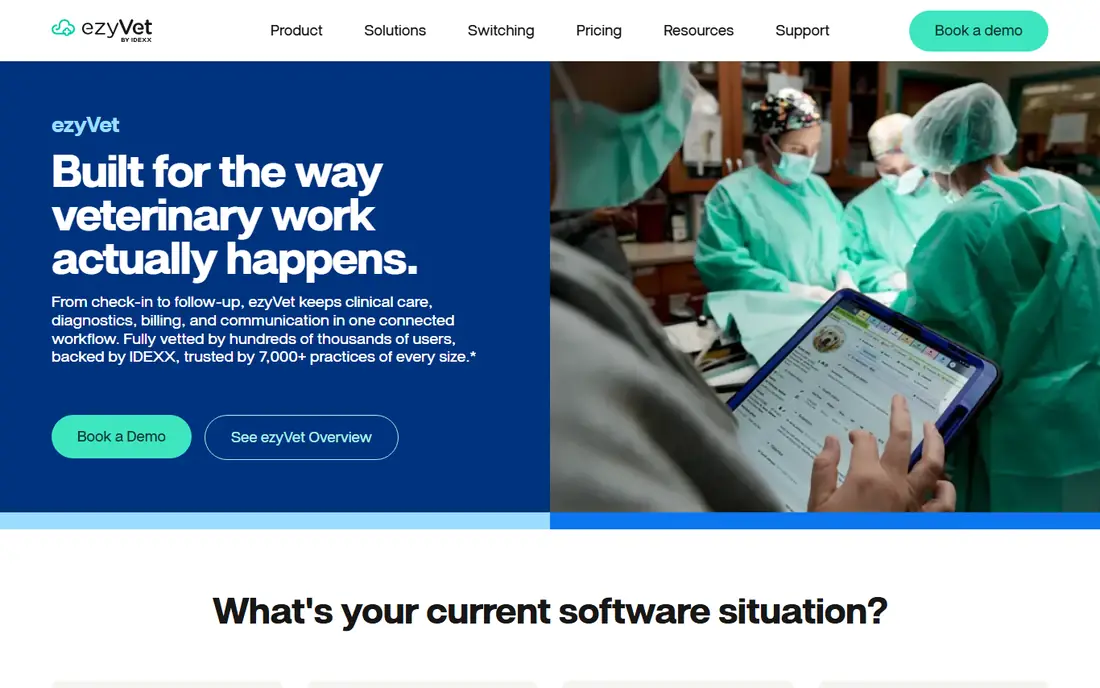
ezyVet is cloud veterinary software built for the way veterinary work happens, from check-in to follow-up, keeping clinical care, diagnostics, billing, and communication in one connected workflow. Its homepage highlights native diagnostics, imaging, payments, inpatient care, and client communication, plus more than 100 certified integrations, clinical templates, structured notes, and automatic charge capture as notes, treatments, and diagnostics are completed. Backed by IDEXX, ezyVet suits practices that want lab and diagnostic depth without separate systems.
The trade-off is implementation. ezyVet's breadth rewards onboarding and workflow design, and pricing depends on practice size and modules. Smaller practices should compare DaySmart Vet or Shepherd for simpler starts. For practices that want a connected cloud platform with diagnostics depth, ezyVet is a leading pick.
- Cloud workflow from check-in to follow-up
- Native diagnostics, imaging, payments, and communication
- Many integrations
- Pricing by practice size
- Implementation and training take planning
- Feature depth needs onboarding
Avimark
Ideal for: Established practice workflows

Avimark, from Covetrus, is veterinary appointment and practice software that puts client and patient information on a single screen, with integrated clinical tools for notes, worklists, follow-ups, prescriptions, and inventory. Its homepage highlights simplified data access, streamlined workflows, prescription management through vRxPro integration, inventory tracking with CUBEX and cloud-based Intelligent Inventory, payments that comply with EMV and PCI DSS standards, and client communication through Covetrus Comms. That established feature set suits practices that want proven, customizable workflows.
The catch is modern feel and hosting. Avimark's desktop heritage differs from cloud-native tools such as ezyVet or Shepherd, and mobile access depends on setup. Practices should confirm hosting, backup, and update paths. For practices that want a proven, feature-rich PIMS, Avimark remains a strong choice.
- Single-screen client and patient access
- Prescription and inventory tools
- Covetrus integrations
- Desktop heritage may feel dated
- Cloud access depends on setup
- Migration from older versions needs care
Vetspire
Ideal for: AI-assisted cloud practice
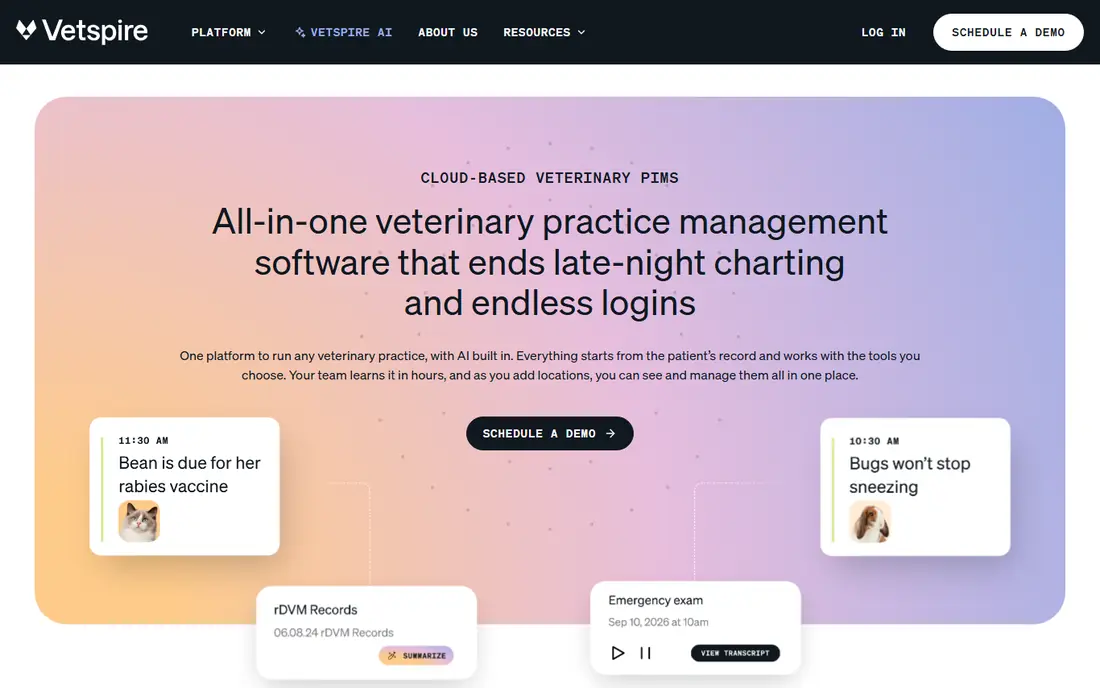
Vetspire is cloud-based veterinary software with AI tools for documentation and efficiency, covering medical records, scheduling, pricing, dashboards, messaging, and admin triggers. Its homepage highlights encounter-based records with real-time, multi-user editing, a drag-and-drop scheduler with templates, customizable pricing by clinic and service for multi-location practices, AI Scribe that transcribes conversations into record fields, AI Summary for visit overviews, and two-way messaging from the patient chart. That AI-first design suits practices that want faster charting.
The trade-off is maturity and pricing. Vetspire's integrations and AI accuracy should be tested in a trial, and pricing is by quote. Practices that prefer established platforms should compare ezyVet or Avimark. For cloud practices that want AI-assisted records, Vetspire is a strong pick.
- Cloud records with real-time collaboration
- AI scribe and summaries
- Scheduler and multi-location pricing
- Pricing by quote
- Newer platform, so integrations vary
- AI features need review for accuracy
DaySmart Vet
Ideal for: Simple vet scheduling
DaySmart Vet is the veterinary product from DaySmart, a business management software provider with cloud solutions for veterinary clinics, including scheduling, records, and reminders. Its homepage highlights industry-specific, cloud-based tools and a veterinary customer quote calling DaySmart Vet the most user-friendly, innovative, and cost-effective tool compared with other programs. That simplicity suits smaller, general, or mobile practices that want to start fast without a heavy implementation.
The catch is depth. DaySmart Vet suits general practice well, but ER, specialty, or multi-location hospitals may need the deeper workflows of Instinct, ezyVet, or Digitail. Buyers should confirm lab, inventory, and reporting scope. For simple, friendly vet practice software, DaySmart Vet is a practical pick.
- User-friendly and cost-effective
- Scheduling, records, and reminders
- Cloud-based with industry-specific design
- Less depth for ER or specialty workflows
- Advanced lab and inventory features vary
- Pricing by practice
Shepherd
Ideal for: SOAP workflow and billing
Shepherd is cloud-based veterinary practice management software designed around the way vets work, with a SOAP-based medical record workflow, automatic invoice capture, inventory tracking, reports, and AI tools. Its homepage stresses that administering treatments automatically adds them to an invoice with discharge instructions, estimates push to treatment plans before patients leave the room, and AI tools trained on real clinical cases save hours each week. That charge-capture design directly addresses missed revenue from unbilled treatments.
The trade-off is scope and access. Shepherd is cloud-based, so practices need reliable internet, and pricing is by demo. ER and specialty teams should compare Instinct for high-volume workflows. For general practices that want clean SOAP records and reliable billing, Shepherd is an excellent pick.
- Intuitive SOAP-based design
- Automatic invoice capture
- AI tools and inventory tracking
- Pricing by demo
- Cloud-only, so offline access is limited
- Specialty depth varies
Digitail
Ideal for: All-in-one clinic platform
Digitail is an all-in-one veterinary platform that consolidates many tools into one system, covering kennel and grooming, admin, exam room, treatment area, laboratory and pharmacy, reception, and pet home workflows. Its homepage highlights AI SOAP dictation, AI record summaries, treatment plans, flowboard and whiteboard tools, lab orders with automatic result import, online scheduling, automated reminders, wellness plans, and a pet parent app for booking, records, and messaging. More than 40 integrations and migration support from systems including Avimark and Cornerstone ease switching.
The catch is breadth and cost. Digitail's full platform rewards onboarding, and pricing is by quote, so very small practices should compare DaySmart Vet or Shepherd first. For clinics that want one platform across the whole practice, Digitail is a strong choice.
- One platform for kennel, exam, treatment, lab, pharmacy, and reception
- AI SOAP dictation
- Pet parent app
- Pricing by quote
- Breadth needs onboarding
- Smaller practices may find it more than needed
Instinct
Ideal for: ER and specialty practice
Instinct is modern cloud-based veterinary practice software that brings together EMR, AI SOAP notes, and trusted decision support for emergency, specialty, and primary care. Its homepage highlights Instinct EMR for complex cases and high volume, treatment plans that apply charges in real time as treatments are logged, ScribbleVet as a veterinary AI scribe, Standards for clinical monographs and procedure guides, Plumb's drug information with interaction checking, and Attending as an evidence-based AI assistant. That combination suits busy ER teams that cannot afford missed charges or disconnected records.
The trade-off is focus and price. Instinct's ER and specialty depth may be more than a small general practice needs, and pricing is by quote. General practices should compare Shepherd or Digitail for simpler starts. For ER and specialty hospitals, Instinct is a top pick.
- Cloud EMR built for ER and specialty pace
- AI scribe and decision support
- Treatment plans with real-time charges
- Pricing by quote
- ER focus may exceed general practice needs
- Implementation for complex hospitals takes planning
How we picked these
We compared official product pages for veterinary practice management software used in the US, looking at medical records, scheduling, billing and charge capture, labs and inventory, client communication, and pricing. We favored tools with clear practice workflows over generic scheduling or billing tools, and we kept a range from established platforms to modern cloud tools. We also favored tools with current homepages and active development in 2026.
We did not test these tools on live clinic workflows, and we did not review private contracts. Pricing, trial terms, and feature scope can change, so check the vendor site and trial each tool with real visit types before buying.
What to check before you choose
Start with a real visit, not a demo script. Walk a wellness exam, an emergency case, and a surgery through each tool, checking how fast notes, charges, labs, and discharge instructions flow, and whether the invoice matches the record without manual fixes. A tool that slows the exam room will not survive busy days.
Next, check migration and integrations. Confirm how records, clients, patients, inventory, and history move from your current system, which labs and payment tools connect natively, and how long the vendor supports the switch. Digitail and others offer migration help, but data quality should still be tested.
Finally, weigh support and training. Practices need fast help during clinic hours, so check support hours, onboarding, and training for vets, techs, and front desk staff separately. A tool with strong features but slow support will cost more in lost clinic time than a simpler tool with great help.
Frequently asked questions
What is veterinary practice management software?
Veterinary practice management software, or PIMS, manages scheduling, medical records, billing, inventory, labs, and client communication for a veterinary practice in one system, replacing separate tools and paper workflows.
Which veterinary software is best for small practices?
DaySmart Vet and Shepherd suit small and general practices with simpler, user-friendly workflows, while ezyVet and Digitail suit practices that want broader connected platforms. The best pick depends on visit volume and lab needs.
How do I switch veterinary software without losing records?
Ask vendors for migration plans, test data conversion on a sample of patients, and confirm how history, labs, and charges transfer. Plan training and a phased go-live so the clinic can keep seeing patients during the switch.
Is cloud veterinary software safe for patient records?
Cloud PIMS vendors offer encryption, backups, and access controls, but practices should confirm security, backup, and data export terms, plus compliance duties for their state and practice type.
How much does veterinary practice software cost?
Most vendors price by practice size, vets, locations, or modules, with demos rather than public list prices. Ask for totals that include onboarding, migration, integrations, and support.