Best AI Model Governance Platforms in 2026: 8 Platforms Compared

- 1
 Credo AITeams needing AI risk registersVisit
- 2
 Holistic AIAuditing and validating AI modelsVisit
- 3
 IBM watsonx.governanceEnterprises on IBM stacksVisit
- 4
 MonitaurTeams governing models in productionVisit
- 5
 Fiddler AIModel monitoring and explainabilityVisit
- Our pick for most people is Credo AI, because it covers teams needing ai risk registers with the fewest trade-offs in this group.
- If you want to start without paying, Saidot is the strongest free option here, though its paid tier adds the deeper features.
- Holistic AI is the best second look when Credo AI does not fit, since it serves auditing and validating ai models rather than the same audience.
- Prices and plan limits change often, so confirm the current terms on each vendor site and read the fine print on limits, renewals and cancellation.
Quick comparison
| Product | Ideal for | Price from | Free version | |
|---|---|---|---|---|
| Credo AI | Teams needing AI risk registers | See website | No | Visit |
| Holistic AI | Auditing and validating AI models | See website | No | Visit |
| IBM watsonx.governance | Enterprises on IBM stacks | See website | Free trial | Visit |
| Monitaur | Teams governing models in production | See website | No | Visit |
| Fiddler AI | Model monitoring and explainability | See website | Free trial | Visit |
 Arthur AI | Enterprises monitoring LLM and ML models | See website | No | Visit |
 Saidot | Public-sector and transparent AI registers | See website | Yes | Visit |
 Enzai | AI policy and compliance workflows | See website | Free trial | Visit |
The best AI model governance platforms
Choosing among options for what's the best ai model governance platform comes down to fit, not fame. We compared official feature pages, pricing pages, app store listings, privacy policies and public reviews for each option below, and we weighed what you actually get on the entry plan against what stays behind a paywall. Credo AI leads this list because it handles teams needing ai risk registers well for the widest range of readers, but the right choice depends on your budget, your team size and how much hand-holding you want. Read the shortlist with your own situation in mind. A cheaper tool that you actually use beats a powerful one that sits untouched, and a plan that looks cheap on the monthly line can cost more once add-ons and limits are counted. Take notes as you read, and shortlist two or three options to test before you decide.
Credo AI
Ideal for: Teams needing AI risk registers
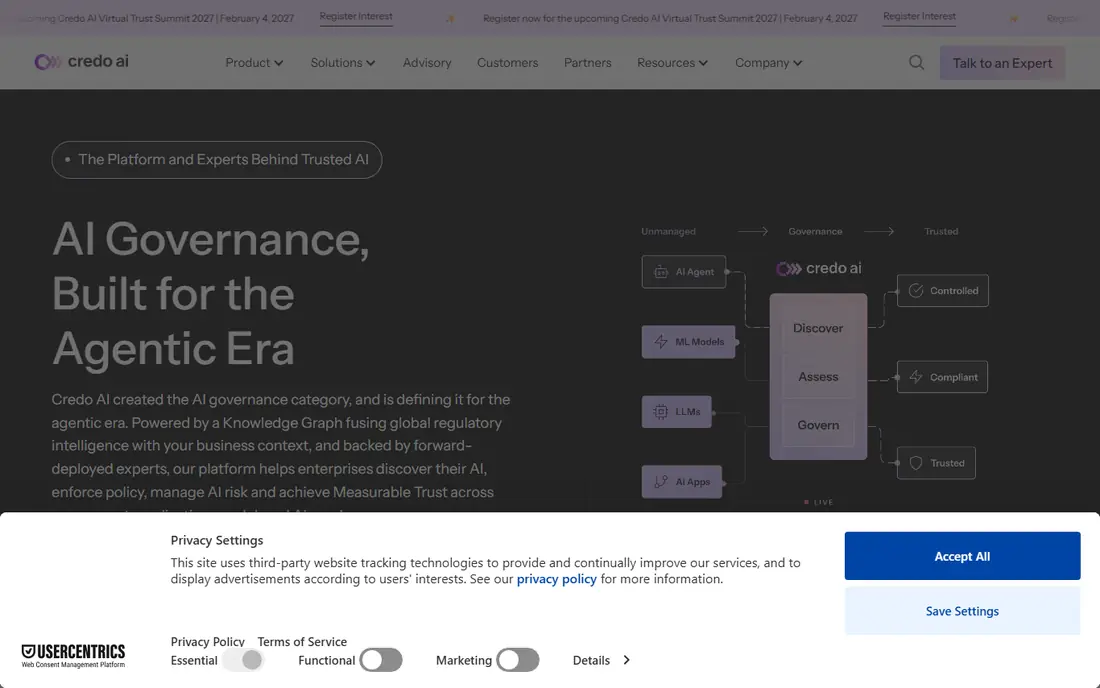
Credo AI gives teams a structured way to register AI systems, score their risk and track compliance work in one register. Its policy templates and audit-ready reporting suit companies that must show regulators and customers how AI decisions are made. For readers focused on teams needing ai risk registers, the appeal is structured AI governance and risk registers. That strength matters in daily use, because it is the part you will notice every week, not a feature you open once and forget. Compare it against the rest of the list on that one point first, then look at price, platform support and how the company handles your data. The honest weakness is pricing is quote-based. smaller teams may find the scope broad Try it on a real task before you pay, and check whether the entry plan covers the feature you actually need.
- Structured AI governance and risk registers
- Policy templates
- Audit-ready reporting
- Pricing is quote-based
- Smaller teams may find the scope broad
Holistic AI
Ideal for: Auditing and validating AI models
Holistic AI focuses on independent auditing and validation, testing models for bias, accuracy and risk before they reach production. Its reports give compliance teams concrete evidence, which matters when an internal review or an external auditor asks hard questions. For readers focused on auditing and validating ai models, the appeal is independent model audits and bias testing. That strength matters in daily use, because it is the part you will notice every week, not a feature you open once and forget. Compare it against the rest of the list on that one point first, then look at price, platform support and how the company handles your data. Watch out for audit projects can be costly. platform depth varies by engagement If you can live with that limit, the rest of the package is easy to recommend for its audience.
- Independent model audits and bias testing
- Clear risk scoring
- Good documentation output
- Audit projects can be costly
- Platform depth varies by engagement
IBM watsonx.governance
Ideal for: Enterprises on IBM stacks
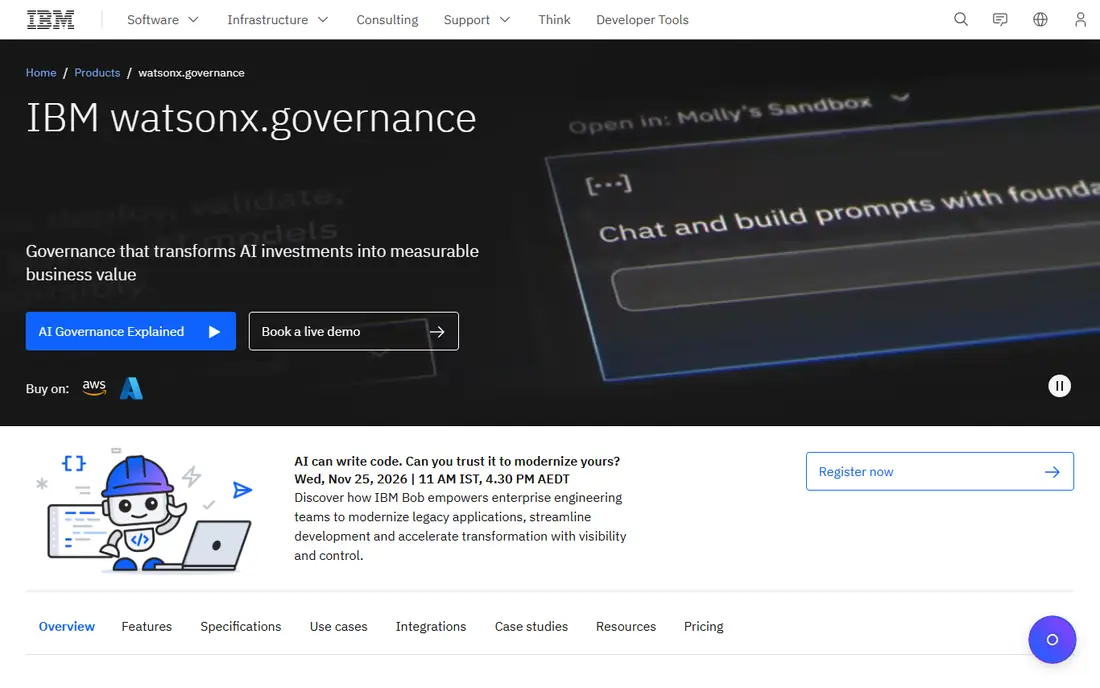
IBM watsonx.governance is built for enterprises that need model monitoring, fact sheets and approval workflows at scale. Its controls fit regulated industries, and it pairs naturally with other IBM data and AI tools already in the stack. For readers focused on enterprises on ibm stacks, the appeal is model monitoring and fact sheets. That strength matters in daily use, because it is the part you will notice every week, not a feature you open once and forget. Compare it against the rest of the list on that one point first, then look at price, platform support and how the company handles your data. The catch is works best inside IBM environments. setup can be complex If that trade-off is acceptable for how you work, this is a solid choice, and a short trial will tell you more than any review can.
- Model monitoring and fact sheets
- Strong enterprise controls
- Broad IBM integration
- Works best inside IBM environments
- Setup can be complex
Monitaur
Ideal for: Teams governing models in production
Monitaur keeps governance records for models in production, linking performance monitoring to the compliance record for each system. Its machine-readable records help teams prove what a model did, when it changed and who approved it. For readers focused on teams governing models in production, the appeal is governance records and monitoring. That strength matters in daily use, because it is the part you will notice every week, not a feature you open once and forget. Compare it against the rest of the list on that one point first, then look at price, platform support and how the company handles your data. The honest weakness is smaller vendor with a narrower partner list. pricing is quote-based Try it on a real task before you pay, and check whether the entry plan covers the feature you actually need.
- Governance records and monitoring
- Machine-readable system records
- Compliance mapping
- Smaller vendor with a narrower partner list
- Pricing is quote-based
Fiddler AI
Ideal for: Model monitoring and explainability
Fiddler AI watches models after deployment, flagging drift, bias and performance drops with explanations a team can act on. Its analytics help data scientists understand why a model changed its behavior, which is the first step to fixing it. For readers focused on model monitoring and explainability, the appeal is strong explainability and drift monitoring. That strength matters in daily use, because it is the part you will notice every week, not a feature you open once and forget. Compare it against the rest of the list on that one point first, then look at price, platform support and how the company handles your data. Watch out for governance workflow depth is thinner than pure governance tools. enterprise pricing If you can live with that limit, the rest of the package is easy to recommend for its audience.
- Strong explainability and drift monitoring
- Analytics for model behavior
- Good integrations
- Governance workflow depth is thinner than pure governance tools
- Enterprise pricing
Arthur AI
Ideal for: Enterprises monitoring LLM and ML models
Arthur AI covers both classic machine learning models and large language models, with monitoring and firewall controls for production systems. Its observability tools show how models behave on real traffic, which helps teams catch problems before users do. For readers focused on enterprises monitoring llm and ml models, the appeal is firewall and monitoring for LLMs. That strength matters in daily use, because it is the part you will notice every week, not a feature you open once and forget. Compare it against the rest of the list on that one point first, then look at price, platform support and how the company handles your data. The catch is enterprise pricing. smaller teams may find it heavy If that trade-off is acceptable for how you work, this is a solid choice, and a short trial will tell you more than any review can.
- Firewall and monitoring for LLMs
- Strong observability
- Enterprise security focus
- Enterprise pricing
- Smaller teams may find it heavy
Saidot
Ideal for: Public-sector and transparent AI registers
Saidot is known for public AI registers that let organizations publish what AI systems they use and how they are governed. Its transparency-first approach suits public bodies and companies that want visible accountability for their AI use. For readers focused on public-sector and transparent ai registers, the appeal is public AI registers and transparency tools. That strength matters in daily use, because it is the part you will notice every week, not a feature you open once and forget. Compare it against the rest of the list on that one point first, then look at price, platform support and how the company handles your data. The honest weakness is less depth for private enterprise model monitoring. smaller commercial footprint Try it on a real task before you pay, and check whether the entry plan covers the feature you actually need.
- Public AI registers and transparency tools
- Open approach
- Policy alignment features
- Less depth for private enterprise model monitoring
- Smaller commercial footprint
Enzai
Ideal for: AI policy and compliance workflows
Enzai helps teams write AI policies, keep an inventory of AI systems and track changing regulations in one workspace. Its collaboration tools make it easier for legal, security and product teams to agree on one set of rules. For readers focused on ai policy and compliance workflows, the appeal is aI policy builder and inventory. That strength matters in daily use, because it is the part you will notice every week, not a feature you open once and forget. Compare it against the rest of the list on that one point first, then look at price, platform support and how the company handles your data. Watch out for newer vendor. model monitoring is lighter than rivals If you can live with that limit, the rest of the package is easy to recommend for its audience.
- AI policy builder and inventory
- Regulatory tracking
- Collaboration tools
- Newer vendor
- Model monitoring is lighter than rivals
How we picked these
We started from the topic itself and kept only products that exist and work today and truly fit it. For each one we checked the official homepage, the pricing page and the free tier, and we read app store listings, privacy policies and public reviews where they were relevant. Products with a homepage we could not verify were left out, and prices we could not verify are shown as See website rather than guessed. We favored a mix of well-known leaders and strong smaller options, and we weighed entry price, free tier, platform coverage and honest weaknesses. No product here paid for its place, and we did not claim hands-on testing we did not do. What follows is a comparison of published facts, so you can check any claim on the vendor site before you buy.
How to choose an AI governance platform
Start by counting the models and AI systems you actually run, including vendor tools with embedded AI that teams often forget. A platform that only covers models your data science team built will leave gaps that auditors will find later. Next, check which regulations and frameworks you must map to, and test the approval workflow with a real model change. Compare two finalists on how quickly a reviewer can see a model record, its risks and its monitoring status in one place.
Frequently asked questions
What is AI model governance?
AI model governance is the set of policies, records and controls that track how models are built, approved, monitored and retired. It helps companies manage risk, meet regulations and explain model behavior when asked.
Why do companies need a governance platform?
Spreadsheets break down once dozens of models are in production across teams. A platform keeps one inventory, links approvals to evidence and flags drift or risk changes automatically.
What regulations affect AI governance?
Rules vary by region and sector, and the EU AI Act is the most prominent framework, alongside sector rules in finance and health care. A governance tool should map controls to the frameworks that apply to your business.
Is model monitoring part of governance?
Yes, monitoring is the part of governance that watches live models for drift, bias and performance drops. Governance adds the record-keeping, approvals and audit trail around that monitoring.
Can small teams use these platforms?
Smaller teams can start with an inventory and policy tool such as Enzai or Saidot before buying enterprise monitoring. The key is to record what you use now, then add monitoring as model counts grow.