What Is the Best App to Read PDFs in 2026: 8 Apps Compared

- 1
 Adobe Acrobat ReaderStandard PDF reading with broad compatibilityVisit
- 2
 Foxit PDF ReaderLight, fast PDF reading for business usersVisit
- 3
 PDFgearFree reading, annotation and editingVisit
- 4
 XodoMobile-first reading and annotationVisit
- 5
 PDF ExpertPolished PDF reading on Mac and iPadVisit
- Adobe Acrobat Reader remains the compatibility standard, while Foxit Reader suits users who want a lighter, faster viewer.
- PDFgear and Xodo offer strong free reading and annotation, which suit students and casual users.
- PDF Expert suits Mac and iPad users who want a polished reading and markup experience.
- For heavy annotation, check Apple Pencil or stylus support, cloud sync and export options before committing.
Quick comparison
| Product | Ideal for | Price from | Free version | |
|---|---|---|---|---|
| Adobe Acrobat Reader | Standard PDF reading with broad compatibility | Free | Yes | Visit |
| Foxit PDF Reader | Light, fast PDF reading for business users | Free | Yes | Visit |
| PDFgear | Free reading, annotation and editing | Free | Yes | Visit |
| Xodo | Mobile-first reading and annotation | Free | Yes | Visit |
| PDF Expert | Polished PDF reading on Mac and iPad | $79.99 per year | Yes | Visit |
 SumatraPDF | Ultra-light free reading on Windows | Free | Yes | Visit |
 PDF-XChange Editor | Powerful free tier for Windows power users | Free | Yes | Visit |
 Okular | Free open-source reading on Linux and more | Free | Yes | Visit |
The best apps to read pdfs
We compared official feature pages, pricing pages, app store listings, privacy policies and public reviews to build this list of 8 options for what's the best app to read pdfs. Prices were checked in October 2026 and can change, so confirm the current price on the vendor site before you buy. Our pick for most people is the first option that fits your budget and workflow, not necessarily the most expensive tool on the list. Read the quick comparison first to narrow the field, then read the full write-ups for the two or three options that fit your needs best.
Adobe Acrobat Reader
Ideal for: Standard PDF reading with broad compatibility

Adobe Acrobat Reader is the standard PDF reader, with the broadest compatibility for forms, signatures and complex files. Free features cover viewing, commenting, printing and basic signing, and Document Cloud sync moves files across devices. For a reader that opens almost anything correctly, Acrobat is the safe pick.
It is heavier than Foxit or SumatraPDF, and editing, OCR and advanced tools need a paid Pro subscription. Some AI features are also add-ons. For free, compatible reading, Acrobat Reader remains the default.
- Best compatibility
- Commenting and signing
- Cloud sync through Document Cloud
- Advanced editing needs Pro
- App is heavier than rivals
- Some AI features are add-ons
Foxit PDF Reader
Ideal for: Light, fast PDF reading for business users

Foxit PDF Reader is a fast, light viewer with annotations, form filling and signing, plus enterprise deployment tools for IT teams. It opens large files quickly and integrates with cloud storage. For business users who want speed without Acrobat weight, Foxit is strong.
Full editing needs the paid Foxit PDF Editor, and the interface can feel busy. AI features are also limited on the free tier. For free, fast business reading, Foxit Reader is a top pick.
- Fast and light
- Annotations and signing
- Enterprise deployment tools
- Full editing needs paid Editor
- Interface is busier than Acrobat for some users
- AI features are limited on free tier
PDFgear
Ideal for: Free reading, annotation and editing
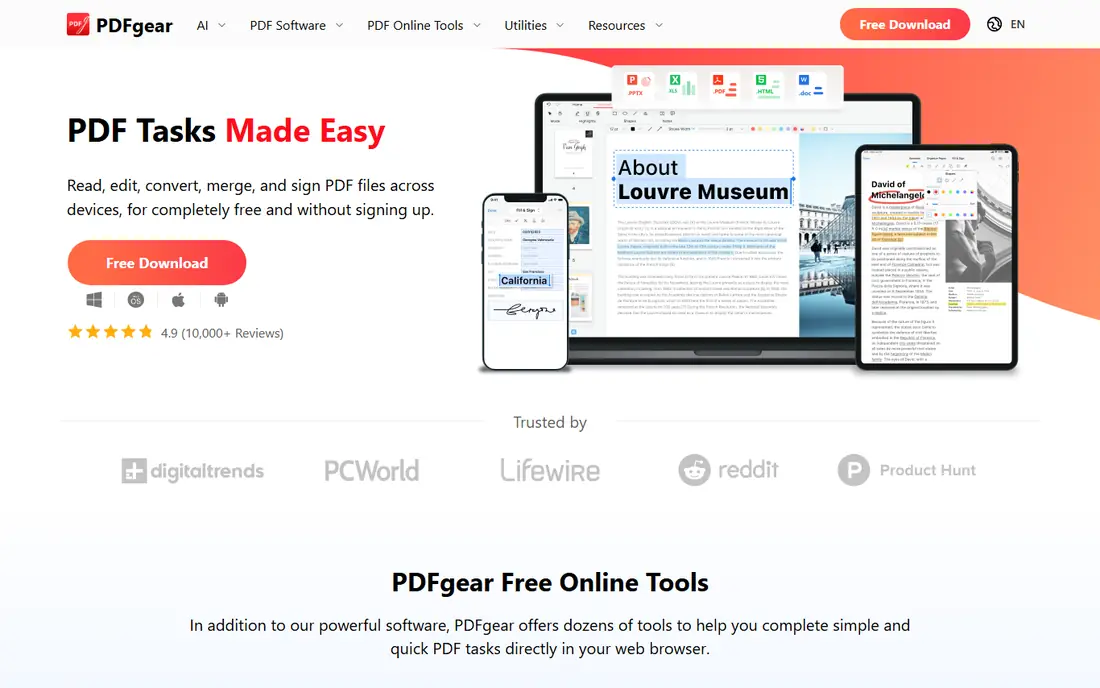
PDFgear offers free PDF reading, annotation, editing and OCR without a subscription, which suits students and casual users. The interface is simple, and core tools such as merging and compressing work without payment. For a free all-round PDF app, it is hard to beat.
Accuracy on complex files lags Acrobat and Foxit Editor, and enterprise tools and support are thinner. For everyday free reading and light editing, PDFgear is excellent.
- Fully free core features
- OCR included
- Simple interface
- Accuracy lags paid editors on complex files
- Support is community led
- Fewer enterprise tools
Xodo
Ideal for: Mobile-first reading and annotation
Xodo is a mobile-first PDF reader with clean iOS and Android apps for annotation, form filling and signing. Cross-platform sync keeps reading progress across devices, and the free app covers most daily reading needs. For tablet and phone reading, Xodo is a favorite.
Advanced OCR and AI features need paid Studio plans, and desktop depth lags Acrobat. Support is also limited compared with Adobe. For free mobile reading and markup, Xodo is a strong pick.
- Clean mobile apps
- Annotation and form filling
- Cross-platform sync
- Advanced OCR and AI need paid Studio
- Desktop depth lags Acrobat
- Support is limited
PDF Expert
Ideal for: Polished PDF reading on Mac and iPad
PDF Expert is the polished PDF reader for Mac and iPad, with Apple Pencil markup, page editing, OCR and smooth file management. It feels native to Apple devices in a way cross-platform readers do not. For Apple users who annotate daily, it is the best experience.
It is Mac and iOS only, so Windows and Android users must look elsewhere. The subscription also adds up. For Apple-only reading and markup, PDF Expert is the premium pick.
- Mac-native design
- Apple Pencil markup
- Page editing and OCR
- Mac and iOS only
- Subscription cost
- No Windows or Android version
SumatraPDF
Ideal for: Ultra-light free reading on Windows
SumatraPDF is an ultra-light, free, open-source reader for Windows that launches instantly, even on old hardware. It also reads e-book formats, which suits readers with mixed libraries. For minimal, fast reading, nothing beats it.
It is Windows only, and annotation is basic, with no editing or signing depth. Users who markup heavily should pick Xodo or PDF Expert. For fast, free Windows reading, SumatraPDF is ideal.
- Very fast and light
- Portable version
- Supports e-book formats
- Windows only
- Annotation is basic
- No editing or signing depth
PDF-XChange Editor
Ideal for: Powerful free tier for Windows power users
PDF-XChange Editor offers a feature-rich free tier for Windows, with tabbed reading, annotations, OCR and measurement tools that suit power users. It covers more than most free readers, including engineering and technical documents. For Windows power users, it is a deep free option.
It is Windows only, and some paid features add watermarks on the free tier. The interface is also dense for casual users. For powerful free Windows reading, PDF-XChange Editor is a strong pick.
- Feature-rich free tier
- Tabbed reading
- OCR and measurement tools
- Windows only
- Paid license removes watermarks on some features
- Interface is dense
Okular
Ideal for: Free open-source reading on Linux and more
Okular is a free, open-source document viewer with annotations, bookmarks and accessibility options, popular on Linux and available elsewhere. It handles PDFs and other document formats in one app. For open-source users, it is a reliable, no-cost reader.
Editing is limited compared with paid editors, and the interface varies by platform. Support is community led. For free, open reading with annotation, Okular is a solid pick.
- Free and open source
- Annotations and bookmarks
- Accessibility options
- Interface varies by platform
- Editing is limited
- Support is community led
How we picked these
We started from the topic and shortlisted products that exist and work today, then checked each vendor homepage, pricing page and free tier. We compared feature pages, app store listings, privacy policies and public reviews, and we dropped any product whose homepage could not be verified or whose price could not be checked. Where a price was unclear or varied by region, we wrote See website rather than guessing a number. That rule kept the list honest, even where a neat price would have made the comparison table look tidier.
We also weighed fit over fame. A well-known product stayed on the list only if it truly fits the topic, and smaller tools earned a place when they served a clear use case better. No product here was tested hands-on for this article, and no vendor paid for placement.
Price and free-tier details matter most when plans change often, so we favoured products with clear published pricing and a trial or free tier where one exists. If a vendor changed a plan after our check, the vendor site is the correct source, and the ranking here still reflects fit, not just price. That check takes extra time, but it prevents a shortlist built on outdated pricing or a product that no longer exists.
Choosing a PDF reader by device and annotation need
Start with your device: Mac and iPad users get the best experience from PDF Expert, Windows users from Foxit or SumatraPDF, and mobile users from Xodo. Then check annotation needs: simple highlighting suits any free reader, while forms, signing and OCR need a paid editor. Test a large file, because speed varies widely.
Before you pay, run a trial on a real task from your own work, not a demo file. Check export formats, mobile access and support hours, because those details decide whether a tool survives daily use. Also check renewal terms and cancellation steps, since a cheap first year can become an expensive second year if renewal jumps. Finally, ask who will own setup and training, because a tool nobody is responsible for tends to fall out of use within a few months. Keep a short note on why you picked the winner, so a future review can judge it against the same criteria instead of starting from scratch.
A useful final test is to imagine the tool in six months, when the first excitement has faded and the work is routine. If the daily steps are still quick, the cost is still clear, and the support route is still obvious, the choice is likely sound. If any of those three answers is unclear, use the trial period to get a clear answer before committing to an annual plan.
Frequently asked questions
What is the best free PDF reader app?
Adobe Acrobat Reader, Foxit Reader, PDFgear and Xodo all offer free reading, with PDFgear and Xodo offering strong free annotation. SumatraPDF is free and very light on Windows.
Is Adobe Acrobat Reader free?
Yes, Acrobat Reader is free for viewing, commenting, printing and signing basic PDFs. Editing, OCR and advanced tools need a paid Acrobat Pro subscription.
Which PDF reader is best for iPad?
PDF Expert is the polished pick for iPad, with Apple Pencil markup and good file management. Xodo and Acrobat Reader also work well on iPad.
Can I read PDFs offline?
Yes. Most desktop and mobile readers work offline once files are downloaded. Browser-only tools need internet, so download files first for travel.