Which Auto Marketplace App Is Best in 2026: 8 Apps Compared

- 1
 CarGurusPrice ratings and huge inventoryVisit
- 2
 AutotraderBroad search and filtersVisit
- 3
 Cars.comReviews and dealer toolsVisit
- 4
 CarvanaFully online buyingVisit
- 5
 Facebook MarketplaceLocal private sellersVisit
- CarGurus is the best all-round auto marketplace, with price ratings, dealer ratings, and a huge inventory of new and used cars.
- Autotrader and Cars.com suit broad searches with detailed filters, reviews, and dealer tools for serious buyers.
- Carvana suits buyers who want a fully online purchase with delivery and a return window, though prices can run higher.
- Facebook Marketplace and Craigslist suit local deals and private sellers, with lower prices and higher scam risk.
- Edmunds, TrueCar, and dealer tools help you check fair prices before you negotiate, which matters more than any single app.
Quick comparison
| Product | Ideal for | Price from | Free version | |
|---|---|---|---|---|
| CarGurus | Price ratings and huge inventory | Free | Yes | Visit |
| Autotrader | Broad search and filters | Free | Yes | Visit |
| Cars.com | Reviews and dealer tools | Free | Yes | Visit |
| Carvana | Fully online buying | Free | Yes | Visit |
| Facebook Marketplace | Local private sellers | Free | Yes | Visit |
 Edmunds | Fair price checks | Free | Yes | Visit |
 TrueCar | Upfront dealer pricing | Free | Yes | Visit |
 Craigslist | Local classifieds for cars | Free | Yes | Visit |
The best auto marketplace apps
We compared official feature pages, pricing pages, app store listings, and public reviews for the apps below. Our pick for most buyers is CarGurus, because its price ratings, dealer ratings, and huge inventory make it easy to spot good deals and avoid overpriced cars.
CarGurus
Ideal for: Price ratings and huge inventory
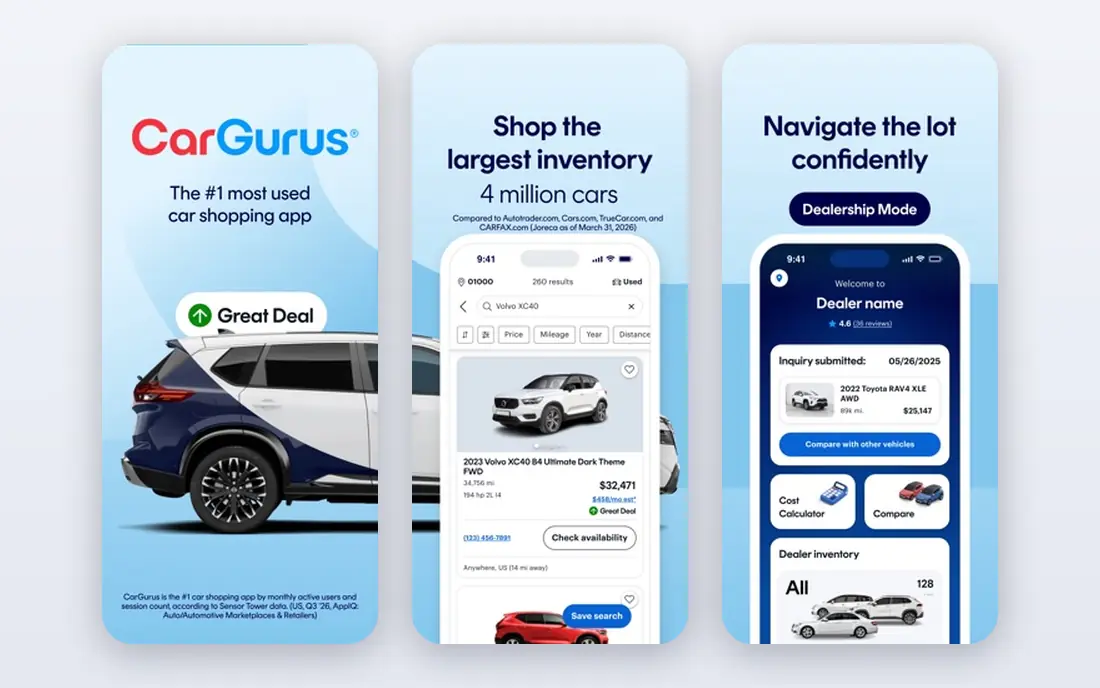
CarGurus rates every listing against market value, so you can see at a glance whether a car is a great deal, fairly priced, or overpriced. Dealer ratings add trust signals, and the inventory covers new and used cars across the US, with strong search filters for price, mileage, and features.
Dealer listings dominate, and some listings linger after a car sells. For spotting fair prices and comparing many cars quickly, CarGurus is our pick.
- Price ratings show great, good, fair, and high deals
- Dealer ratings
- Huge new and used inventory
- Dealer listings dominate
- Some listings are outdated
- Financing tools vary by dealer
Autotrader
Ideal for: Broad search and filters
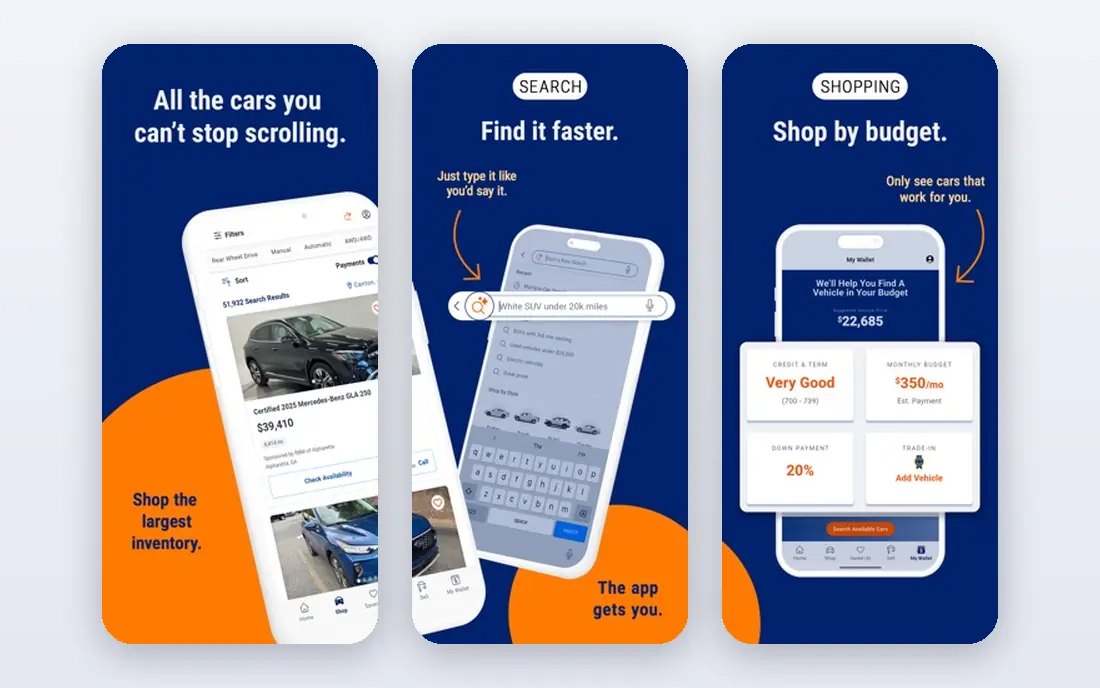
Autotrader is one of the oldest and largest car marketplaces, with inventory from dealers and private sellers, detailed filters, price alerts, and reviews. Search tools let you narrow by make, model, trim, mileage, and features, and alerts notify you when matching cars appear.
Listings can go stale, and private sellers pay to list. For broad search and serious comparison shopping, Autotrader remains a top choice.
- Huge inventory from dealers and private sellers
- Detailed filters and alerts
- Reviews and pricing tools
- Dealer-heavy inventory
- Some listings are stale
- Selling fees for private listings
Cars.com
Ideal for: Reviews and dealer tools
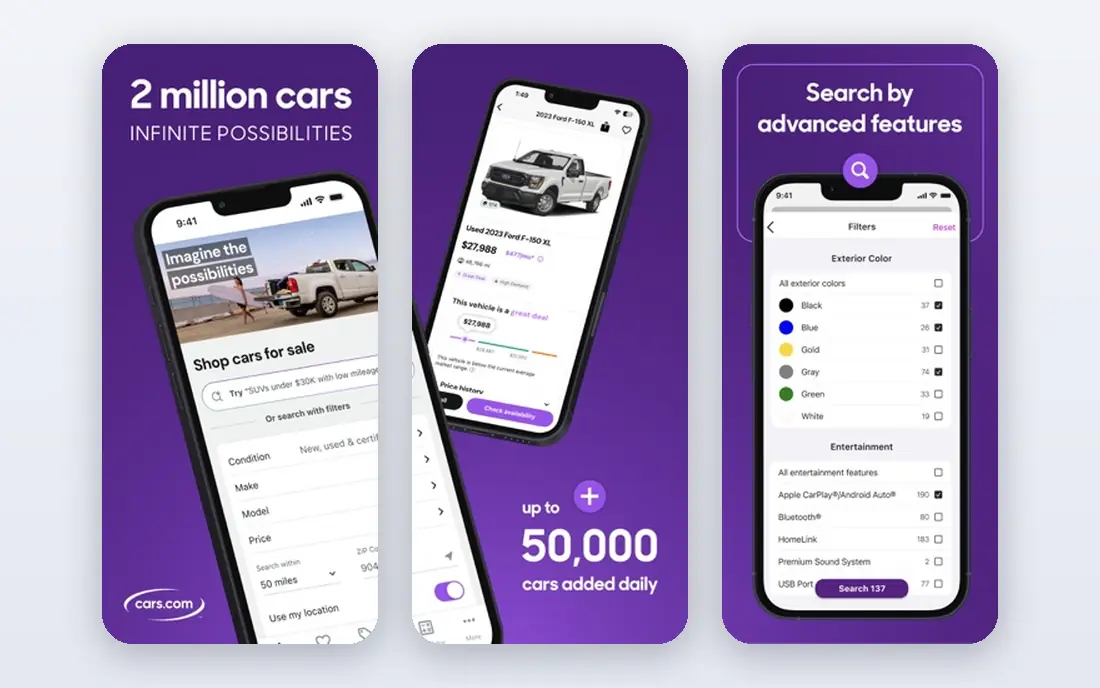
Cars.com combines a large inventory with expert and consumer reviews, dealer ratings, and pricing tools that help buyers judge deals. Buying guides and comparison tools suit first-time buyers and researchers.
Private seller listings are thinner than dealer listings, and some tools are built for dealers. For research-backed buying with reviews and price context, Cars.com is a strong option.
- Large inventory with reviews
- Dealer ratings and price tools
- Helpful buying guides
- Dealer listings dominate
- Some features are dealer-focused
- Smaller private seller pool
Carvana
Ideal for: Fully online buying
Carvana lets you buy a car entirely online, with delivery to your door, a 7-day money-back return window, and no-haggle pricing. Financing and trade-in tools are built in, and the experience is far simpler than visiting multiple dealers.
Prices can run higher than private seller deals, inventory is limited to what Carvana owns, and delivery coverage varies. For buyers who value convenience and a return window over the lowest price, Carvana is appealing.
- Fully online purchase with delivery
- 7-day return window
- No-haggle pricing and financing tools
- Prices can run higher than private sellers
- Inventory is limited to Carvana stock
- Delivery areas vary
Facebook Marketplace
Ideal for: Local private sellers
Facebook Marketplace is where many private car sales happen, often at lower prices than dealers, with easy messaging and local pickup. For older or budget cars, the private seller pool is unmatched.
Scams, title problems, and hidden damage are real risks, and there is no buyer protection for vehicle sales. Always check the title, run a vehicle history report, and get a pre-purchase inspection. For local private deals with care, Marketplace is useful.
- Huge local private seller pool
- Often lower prices than dealers
- Easy messaging with sellers
- Scams and title problems are common
- No buyer protection for cars
- Vehicle history needs independent checks
Edmunds
Ideal for: Fair price checks
Edmunds is best known for true market value pricing, which shows what a car should sell for based on condition, mileage, and market data. Expert reviews, comparisons, and inventory search make it a research-first marketplace.
Inventory is smaller than CarGurus or Autotrader, and new cars get more attention. For checking fair prices before you negotiate, Edmunds is an essential companion app.
- True market value pricing
- Expert reviews and comparisons
- Inventory search with price context
- Marketplace inventory is smaller than CarGurus
- Some tools favor new cars
- Dealer listings dominate
TrueCar
Ideal for: Upfront dealer pricing
TrueCar shows upfront pricing from certified dealers, with price curves that place each offer in market context. That transparency suits buyers who dislike haggling and want a clear starting price before visiting a dealer.
Choice is limited to the dealer network, and listed prices are starting points, not guaranteed final prices. For transparent dealer pricing, TrueCar is a helpful tool.
- Upfront pricing from certified dealers
- Price curves show market context
- New and used inventory
- Dealer network limits choice
- Prices are offers, not final deals
- Smaller inventory than rivals
Craigslist
Ideal for: Local classifieds for cars
Craigslist remains a source of local private car sales, often at the lowest prices, with simple search and direct seller contact. Budget buyers and project car hunters still find deals here that never reach dealer sites.
There is no verification, protection, or payment system, so scams and title issues are common. Inspect cars in person, verify titles, and never wire money. For local bargain hunting with caution, Craigslist still works.
- Free local listings from private sellers
- Simple search
- Often the lowest prices
- No protection or verification
- Scams and curbstoners are common
- Interface is dated
How we picked these
We compared official feature pages, pricing pages, app store listings, and public reviews for each app, and we favored marketplaces still operating in October 2026 with real car inventory for buyers in the US. We left out defunct marketplaces and dealer-only tools with no consumer search. Note that homepage checks for this article were limited by a browser rate-limit error during our work, so readers should confirm current inventory and features on each vendor site.
Buying a car safely online
Check the price on at least two marketplaces before you negotiate, and run a vehicle history report on any used car you seriously consider. A pre-purchase inspection by an independent mechanic is the best money you can spend on a used car, often catching hidden damage or needed repairs.
For private sales, verify the title matches the seller's ID, meet in a public place, and pay through a bank or secure method, never with gift cards or wire transfers to strangers. For dealer sales, get the out-the-door price in writing, including fees and taxes, before you sign anything.
Negotiation starts before you contact a seller. Research the car's fair price on at least two marketplaces, check its history report, and list any issues you find, since documented flaws are your strongest bargaining points. For dealer cars, ask for the out-the-door price in writing, including fees, taxes, and add-ons, because a low advertised price often grows once fees appear. For private sellers, a polite offer backed by comparable listings works better than a lowball, and being ready to buy, with financing or cash arranged, gives your offer weight.
Financing preapproval is worth arranging before you shop seriously. A preapproved loan tells you your real budget, strengthens your position with dealers, and prevents high-pressure financing decisions in the showroom. Always get a pre-purchase inspection for used cars, even when the seller seems honest and the car looks clean, since inspections catch worn brakes, leaks, and accident repairs that photos hide. Finally, read every document before signing, check that the vehicle identification number matches the car, and confirm title status, since paperwork problems after payment are far harder to fix than ones caught beforehand. Selling your current car well starts with presentation. Clean the car inside and out, fix small issues such as burnt bulbs or worn wipers, and photograph it in daylight from several angles, including the interior, dashboard, and any flaws, since honest photos attract serious buyers and reduce wasted viewings. Gather service records, the title, and a recent history report, and price the car from completed sales of similar models in your area, not from asking prices. A fair price with good photos usually sells faster than a high price with poor photos, and faster sales mean fewer strangers visiting your home.
Timing a purchase also matters. End-of-month dealer quotas, model-year changeovers, and seasonal demand all affect prices, so patience can save money if you are not in a rush. For private purchases, meet in daylight in a public place, bring a friend, and never pay before seeing the car and title in person. Test drive on varied roads, listen for unusual noises, check tires and fluids, and trust your instincts: a seller who rushes you, hides records, or refuses an inspection is telling you something important about the car.
Frequently asked questions
Which auto marketplace app is best?
CarGurus is our pick for most buyers, with price ratings, dealer ratings, and huge inventory. Autotrader and Cars.com suit broad searches, while Carvana suits fully online buying.
Is Carvana or CarGurus better?
CarGurus is better for comparing prices across many dealers and private sellers, while Carvana is better for a simple, fully online purchase with delivery and a return window.
Can I trust Facebook Marketplace for cars?
Marketplace can work for private sales, but verify titles, run a vehicle history report, get a pre-purchase inspection, and never wire money. Scams are common, so caution is essential.
What is the best app to sell a car?
CarGurus, Autotrader, and Cars.com reach serious buyers, while Facebook Marketplace and Craigslist reach local private buyers for free or low cost. Compare fees and audience before listing.
Should I check prices on multiple apps?
Yes. Prices vary across marketplaces, and checking CarGurus, Edmunds, and Autotrader gives you a fair price range before you negotiate with any dealer or seller.