ZoomInfo Alternatives in 2026: 8 Tools Compared

- Apollo is the best overall ZoomInfo alternative for most teams, combining data, sequences and analytics at a lower price.
- Cognism is the best choice for European prospecting, with compliance-first data and verified mobiles.
- Lusha and LeadIQ suit LinkedIn-first prospecting, while RocketReach suits quick contact lookup.
- Clay suits teams that want enrichment workflows from many providers, and Clearbit suits HubSpot users.
Quick comparison
| Product | Ideal for | Price from | Free version | |
|---|---|---|---|---|
 Apollo.io | Best overall alternative | See website | Yes | Visit |
 Cognism | European prospecting | See website | No | Visit |
 Lusha | Quick LinkedIn lookup | See website | Yes | Visit |
 Clearbit (HubSpot) | Enrichment for HubSpot teams | See website | No | Visit |
 LeadIQ | LinkedIn capture and sync | See website | Yes | Visit |
 Hunter | Email finding and verification | See website | Yes | Visit |
 Clay | Enrichment workflows | See website | Free trial | Visit |
 RocketReach | Contact lookup at scale | See website | Yes | Visit |
The best ZoomInfo alternatives
ZoomInfo is powerful but expensive and contract-heavy, so many teams look for alternatives that cover their market at a fairer price. The eight tools below are the most credible substitutes in 2026, from full platforms to focused lookup tools. We compared official product pages, pricing pages and documentation.
Apollo.io
Ideal for: Best overall alternative

Apollo is the most common ZoomInfo replacement because it combines a large contact database with email sequences, call tools and analytics in one affordable platform. A team can prospect, outreach and track results without buying separate tools, and the free plan lets you test data on your market first.
Enterprise data depth and intent signals trail ZoomInfo, and accuracy varies by segment. For a growing team that wants most of ZoomInfo's value at a fraction of the price, Apollo is the first alternative to try.
- Large database plus sequences and analytics
- Free plan to start
- Much lower cost than ZoomInfo
- Data accuracy varies by segment
- Enterprise depth below ZoomInfo
Cognism
Ideal for: European prospecting
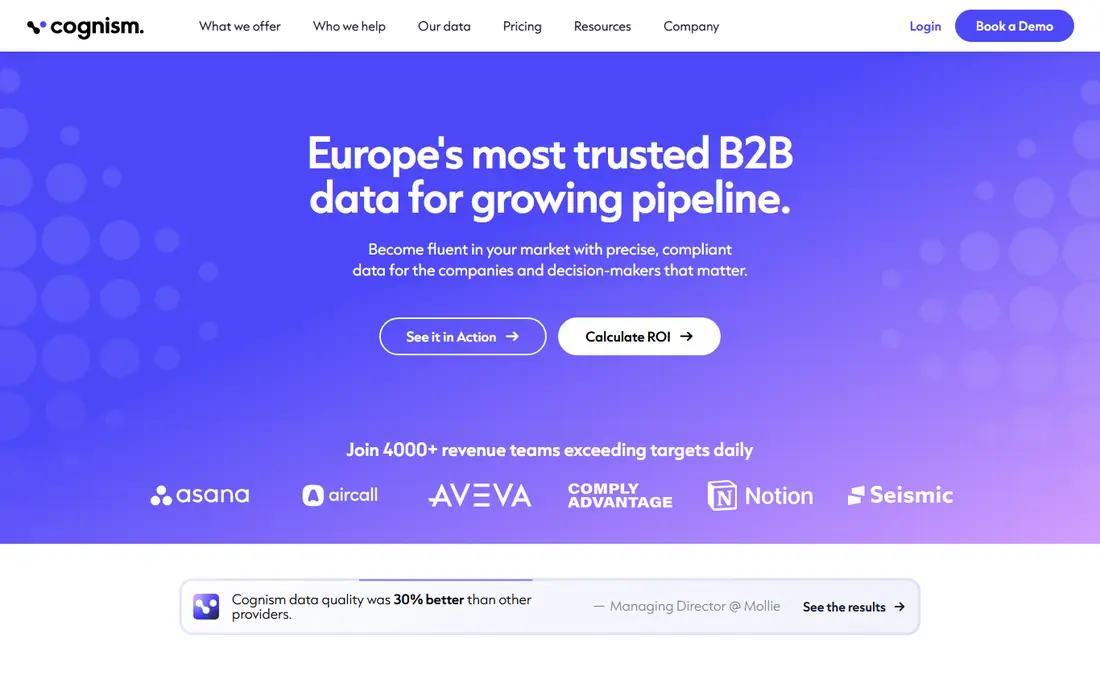
Cognism is the alternative European teams choose first, with strong coverage, phone-verified mobile numbers and a compliance-first approach that matters for GDPR prospecting. Its intent data helps reps prioritize accounts showing buying signals.
Pricing is quoted and enterprise-oriented, and US coverage trails ZoomInfo. For a team selling into Europe, Cognism is often more accurate and safer than ZoomInfo, not just cheaper.
- Strong European coverage and GDPR focus
- Phone-verified mobiles
- Intent and signal data
- Quoted enterprise pricing
- Less US depth than ZoomInfo
Lusha
Ideal for: Quick LinkedIn lookup

Lusha's browser extension reveals contact details while browsing LinkedIn and company sites, making it the fastest alternative for a rep who prospects account by account. Credit pricing is simple, and a free plan covers light use.
It is a lookup tool rather than a full platform, so teams pair it with a sequencer, and heavy users burn credits quickly. For fast, individual prospecting, Lusha is a practical ZoomInfo substitute.
- Browser extension for LinkedIn prospecting
- Simple credit pricing
- Good for individual reps
- Credit limits frustrate heavy users
- Not a full sales platform
Clearbit (HubSpot)
Ideal for: Enrichment for HubSpot teams
Clearbit, now part of HubSpot, enriches leads and accounts with firmographic and technographic data, powering routing, scoring and personalization. For a HubSpot team, it replaces ZoomInfo's enrichment role cleanly without a separate database contract.
Outside HubSpot, its value drops, and pricing is quoted. For a HubSpot shop that mainly needs enrichment rather than bulk prospecting, Clearbit is a strong alternative.
- Strong company enrichment
- Tight HubSpot integration
- Good for routing and scoring
- Best value inside HubSpot
- Pricing is quoted
LeadIQ
Ideal for: LinkedIn capture and sync
LeadIQ captures contacts from LinkedIn in one click and syncs them to CRMs and sales engagement tools, which suits outbound teams that live on LinkedIn. Its team features and integrations keep lists clean without manual entry.
Credit pricing limits heavy use on lower plans, and database depth trails ZoomInfo. For a LinkedIn-first team leaving ZoomInfo, LeadIQ is a focused and effective replacement.
- One-click capture from LinkedIn
- Syncs with CRMs and sequencers
- Good team features
- Credit-based pricing
- Database depth below ZoomInfo
Hunter
Ideal for: Email finding and verification
Hunter finds professional email addresses by person or company domain, with verification that checks deliverability before you send. It suits teams that need accurate emails quickly and cheaply, especially for top-of-funnel prospecting.
Hunter is email-focused rather than a full database, so enterprise features trail ZoomInfo, but verification quality is its strength. For a budget-conscious team that mainly needs emails, Hunter is a useful alternative.
- Finds and verifies professional email addresses
- Domain search for companies
- Free plan to start
- Email-focused, not a full database
- Verification credits limit heavy use
Clay
Ideal for: Enrichment workflows
Clay replaces a single database with a workflow: pull data from many providers, enrich with AI research, score and filter, and export a targeted list. Growth teams use it to build precise prospect lists that a bulk database cannot match.
The learning curve is real, and enrichment credits cost money at scale. For a team that values precision over volume, Clay is the most powerful ZoomInfo alternative here.
- Combines many data providers
- AI research and scoring
- Highly targeted lists
- Learning curve
- Pricing scales with enrichment volume
RocketReach
Ideal for: Contact lookup at scale
RocketReach offers a large database for email, phone and social lookup, with bulk options for teams building lists from names or companies. Recruiters and sales reps alike use it for quick, reliable-enough contact finding.
Accuracy varies, as with every database, and it is a lookup tool rather than a full outreach platform. For a team that mainly needs contact details, RocketReach is a solid and affordable alternative.
A further tactic is combining a database with a workflow tool rather than replacing one database with another. Use Apollo or Lusha for contacts, then enrich and score lists in Clay, so your outreach targets fewer, better prospects instead of more names. That combination often outperforms a single expensive database, since precision beats volume in modern outbound sales.
- Large contact database with email and phone lookup
- Bulk lookup options
- Good for recruiters too
- Accuracy varies by segment
- Less of a full outreach platform
How we picked these
We compared official product pages, pricing pages and documentation, focusing on database coverage, accuracy, compliance, integrations and total cost. We favored tools that are actively sold today and transparent about credit or contract models.
We also stress testing: the best alternative for your team depends on your market, not on a general ranking. Trial each shortlisted tool on your real target accounts before signing anything.
How to switch from ZoomInfo without losing pipeline
Audit what you actually use in ZoomInfo before replacing it. Many teams pay for intent, technographics and integrations they rarely open, while their real use is contact lookup and list building. If that is you, a cheaper tool like Apollo or Lusha may cover 90 percent of the value.
Trial on your market, not a demo list
Pull contacts for your actual titles, industries and regions in each alternative, and measure bounce rates and connect rates. A tool that excels for US SaaS may be weak for European manufacturing, and only your test shows it. Run trials in parallel for two weeks.
Plan the CRM and sequencer migration
Map how ZoomInfo data flows into your CRM and outreach tools, then replicate those flows in the new tool before canceling. Test field mappings, deduplication and sync rules with a sample list, since a messy migration pollutes the CRM for months.
Time the contract end carefully
ZoomInfo contracts often auto-renew, so check renewal dates early and start trials months before expiry. A rushed switch under renewal pressure leads to a second bad contract, while a planned switch lets you negotiate from strength. Also negotiate contract length and credit rollover before signing, since unused credits and auto-renewals are the two most common complaints about data contracts of every kind. Document the new workflow for the sales team, including who verifies contacts, how lists are built, and where data problems are reported, so the switch survives staff changes. Review the new tool's results after the first month and compare meeting rates with the old system. Keep the comparison honest and data driven throughout.
If you are still unsure, start with a free plan and move to a paid plan only when you hit its limits.
Frequently asked questions
What is the best alternative to ZoomInfo?
Apollo is the best overall alternative for most teams, Cognism leads for Europe, and Lusha, LeadIQ and RocketReach suit LinkedIn and lookup use. Clay suits enrichment workflows, and Clearbit suits HubSpot teams.
Is Apollo better than ZoomInfo?
Apollo is better value for growing teams, combining data with sequences at a lower price. ZoomInfo remains deeper for large enterprises that need intent signals and maximum database depth, so the better tool depends on size and budget.
Are there free ZoomInfo alternatives?
Apollo, Lusha, LeadIQ, Hunter and RocketReach offer free plans or trials with limits, which suit light prospecting. Heavy use needs paid plans, but free tiers let you test data quality before paying.
How accurate are ZoomInfo alternatives?
Accuracy varies by vendor and market, and no database is perfect. Test each tool on your real target accounts during a trial, measure bounces, and verify key contacts before campaigns.
Can I use a ZoomInfo alternative with my CRM?
Yes. Apollo, Cognism, Lusha, LeadIQ, Clearbit and Clay all integrate with major CRMs like Salesforce and HubSpot, plus sales engagement tools. Confirm your exact CRM and field mappings during the trial.
Can I replace ZoomInfo with free tools?
Partly. Free plans from Apollo, Lusha and RocketReach cover light prospecting, but heavy use needs paid plans for credits and volume. Most teams replace ZoomInfo with a paid Apollo or Lusha plan plus Clay for enrichment, at a lower total cost.