If you need AI-ready data management foundations, Informatica is the first tool to look at here. Collibra is better for governing context across data and models, and Credo AI is better for policy enforcement across models and agents. The full list of 5 tools follows, with prices and free plan facts.
If you are comparing AI governance tools for remote teams, this page covers 5 tools in one place: what each is best for, what it costs to start, whether it has a free plan, and the main limit to know about.
Key takeaways
Number one here is Informatica, a fit for AI-ready data management foundations.
A fair warning about Informatica: data management focus instead of policy workflow.
Microsoft Purview suits data security and governance in Microsoft estates.
Informatica, Microsoft Purview and the 3 others all sell by quote; expect sales conversations before you see a price.
Think of Informatica for AI-ready data management foundations. For remote teams, the appeal is a governed data foundation underneath AI initiatives, so models and agents draw on data that has been managed instead of assembled ad hoc.
Limits to weigh: Data management focus instead of policy workflow.
No starting price is listed for Informatica here; confirm pricing on the vendor site. Trial and free access: Not stated.
Best for: Governing context across data and models
Collibra is designed for governing context across data and models. Collibra describes itself as the Enterprise AI Control Plane, built over years of ontology engineering to govern context and control across any data, any model, and any agent. Remote teams that require certainty about what data feeds which models can use it to keep that context organized and governed as AI adoption spreads.
Getting value relies on maintaining well-structured context and metadata, which takes ongoing effort. Smaller teams without a data governance foundation may find lighter tools simpler to adopt first. Pricing for Collibra is not stated here, so ask the vendor for current figures. Free options: Not stated.
Watch-outs: Needs investment in cataloging context. Best features of Collibra: Governs context across data, models, agents.
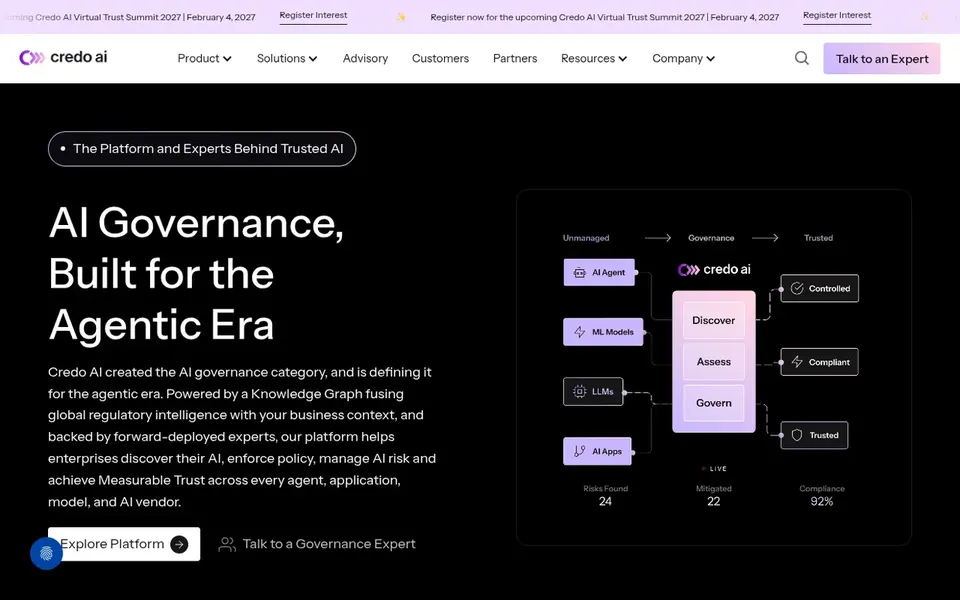
Best for: Policy enforcement across models and agents
Where Credo AI fits: policy enforcement across models and agents. That makes it a reasonable fit for remote organizations that require consistent rules applied wherever teams build or adopt AI tools, with evidence to present compliance when asked.
The system relies on well-defined policies to deliver its value. So teams still figuring out their governance stance may have to do that groundwork first. No starting price is listed for Credo AI here; confirm pricing on the vendor site. On free options: Not stated.
Where it falls short: Governance scope may exceed entry-level needs.
IBM watsonx.governance works best for lifecycle-wide AI oversight with GRC. IBM watsonx.governance is built to help enterprises govern AI across the lifecycle, offering visibility, control, and accountability across any AI, anywhere.
Trade-offs to know: Wide scope may feel heavy for small teams.
It merges AI-native governance with enterprise-grade GRC, which makes it a fit for remote teams inside larger organizations that already run formal risk and compliance programs and need one place to track models and agents. Check the vendor site for IBM watsonx.governance pricing; none is listed in this comparison. Free plan details: Not stated.
Best for: Data security and governance in Microsoft estates
Microsoft Purview was built for data security and governance in Microsoft estates. Microsoft Purview centres on strengthening data security, management, and governance, helping teams secure and handle the data estate with full visibility, control, and compliance.
The main drawbacks: Data-centric instead of model-centric.
Worth adding: for remote teams already working in Microsoft environments, it gives you a familiar way to keep distributed data under consistent oversight whereas supporting compliance expectations. Check the vendor site for Microsoft Purview pricing; none is listed in this comparison. As for free access: Not stated.
Request quotes from Informatica, Microsoft Purview and the others; the list shows no fixed prices.
Before choosing Informatica, weigh its main limit: data management focus instead of policy workflow.
Pick one real project and run it in Informatica first; a small pilot shows fit faster than a checklist.
Get the contract term, renewal terms and any onboarding fees from Microsoft Purview in writing.
Ask IBM watsonx.governance which support channels and response times come with the plan you would buy.
How we picked
Each tool was reviewed on what its vendor publishes: price, plan limits, core features and stated drawbacks. We did not run hands-on tests. Where a price is missing, the vendor does not list one publicly or ties it to a quote. Always confirm before budgeting. Tools are placed by general fit for AI governance tools for remote teams, with price clarity and free access as tie-breakers. A different team can reasonably rank them differently.
Every price and plan detail on this page comes from the vendors’ own websites. We did not run hands-on tests unless the text says so, and we do not publish star ratings or review scores. See how we score and our disclosure.
Keep your shortlist in one place
Paste prices, trial dates and notes from this guide into Ainotely, our AI note app. It files them into a topic and pulls out tasks like “cancel trial by Friday”. Free 7-day trial, no card needed.
Not by default. None of the tools, from Informatica to Microsoft Purview, lists a free plan or a free trial here, so ask each vendor for a demo before committing.
Is Informatica the right pick for everyone comparing AI governance tools for remote teams?
No single tool suits every team. Informatica comes first because it fits AI-ready data management foundations, while Collibra suits governing context across data and models and Credo AI suits policy enforcement across models and agents. Match the tool to your own size, budget and workflow before deciding.
Do these tools publish their prices?
No. None of the tools, from Informatica to Microsoft Purview, shows a fixed starting price here, so budget time for quotes.
Does any tool for AI governance tools for remote teams here have a free plan?
No tool in this list, Informatica and Microsoft Purview included, has a permanent free plan. Trials and quotes are the usual route, so plan a short evaluation period.
What should remote teams look for in AI governance tools?
Look for visibility across models and agents, consistent policy enforcement regardless of location, and evidence trails for compliance. Integration with the clouds and data systems your distributed team already uses matters just as much as the feature list.