Algolia comes first here, mainly for AI search and retrieval across retail experiences. Listed starting prices: Klaviyo from $20 a month. Look at BigCommerce for selling across brands, regions and channels from one foundation, and at Klaviyo for AI-driven email, SMS and retention marketing. The other 3 tools in the list cover narrower or pricier cases.
Choosing AI multichannel retail software usually comes down to price, fit and limits. This Ainotely guide sets 6 tools side by side on those three points, with the facts kept short and checkable.
Key takeaways
The list opens with Algolia, aimed at AI search and retrieval across retail experiences.
A free plan is available from 2 of the 6 tools: Algolia, Klaviyo.
Before buying Algolia, weigh this: search layer only, not full commerce.
For live, customer-centric engagement across channels, Braze is worth a look.
Starting prices begin at $20 per month with Klaviyo.
Best for: AI search and retrieval across retail experiences
Algolia is built with AI search and retrieval across retail experiences in mind. Retailers whose primary pain is discovery and relevance will see the clearest benefit, whereas those needing a full commerce suite should look elsewhere.
Trade-offs to know: Search layer only, not full commerce.
From a buyer's view, teams without engineering support should plan that work in advance. Algolia shows no starting price here, so confirm the cost on the vendor site. You can start on Algolia without paying.
Best for: Selling across brands, regions and channels from one foundation
For selling across brands, regions and channels from one foundation, BigCommerce is a natural candidate. BigCommerce presents itself as commerce made for momentum, powering buying experiences across brands, regions and channels from a single, scalable foundation.
Points against: Advanced customization can need development help.
As with any product, advanced customization and integrations can call for developer involvement, and the fit relies on your catalog and sales model. This comparison lists no price for BigCommerce; ask the vendor. Free access: Not stated.
Best for: AI-driven email, SMS and retention marketing
Klaviyo is aimed squarely at AI-driven email, SMS and retention marketing. Klaviyo is a B2C CRM centered on AI-powered email marketing and SMS, with messaging that extends to channels for example WhatsApp and ecommerce. In daily use, results rely on the quality of customer and event data flowing in.
Watch-outs: Not a full storefront or commerce system.
What works well: Brings together AI-powered email marketing and SMS. Klaviyo takes care of engagement, not catalog, checkout or fulfillment, so it complements instead of replaces commerce software. Also, retailers frequently pair it with a commerce product instead of treating it as a storefront replacement. Beyond that, teams wanting a single system for both storefront and messaging should plan integrations carefully, while retention-focused brands will find the channel coverage relevant. Starting cost for Klaviyo: $20 per month. Klaviyo offers a free plan.
Best for: Fast-growing brands wanting enterprise commerce without heavy operations
In short, Shopify Plus is for fast-growing brands wanting enterprise commerce without heavy operations. Shopify Plus is the enterprise offering from Shopify, described as a commerce product for bold brands with plans designed for unrivaled scale. It appeals to retailers that want a dependable commerce foundation without building infrastructure from scratch, letting teams focus on merchandising, marketing and expansion across channels.
For plenty of expanding retailers, though, the balance of speed and scale is the central draw. Brands with unusual technical requirements should compare it against composable alternatives. No starting price is listed for Shopify Plus here; confirm pricing on the vendor site. Trial and free access: Not stated.
Points against: Complicated requirements may need outside apps.
Best for: Enterprises wanting commerce tied to customer data
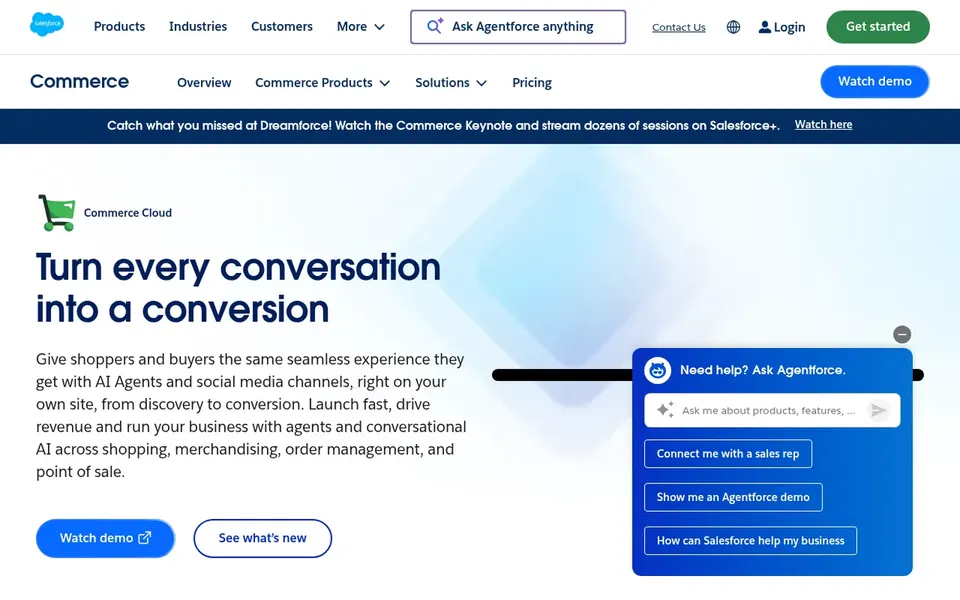
Salesforce Commerce Cloud is a good fit for enterprises wanting commerce tied to customer data. Salesforce Commerce Cloud is an enterprise commerce product that sits within the broader Salesforce customer product. It is aimed at retailers that want storefronts, customer data and service operations connected rather than scattered across separate systems.
Trade-offs to know: Full value relies on wider Salesforce adoption.
Projects tend to involve specialist implementation partners, and the product rewards organizations with dedicated technical resources. In practice, smaller retailers or teams wanting a fast launch may prefer a more straightforward commerce foundation, whereas brands with deep integration needs and existing Salesforce investment are more likely to see the benefit. Worth adding: teams already using Salesforce for sales or service commonly find it the most natural fit, since commerce can share the same customer records and workflows across channels. No starting price is listed for Salesforce Commerce Cloud here; confirm pricing on the vendor site. Free options: Not stated.
Best for: Live, customer-centric engagement across channels
Think of Braze for live, customer-centric engagement across channels. It fits organizations that want to orchestrate messaging and experiences across channels based on live customer behavior, especially where timely, coordinated communication is central to the strategy.
Limits to weigh: Engagement scope only, not commerce.
Beyond that, smaller teams without technical support may find the setup demanding, whereas bigger brands with complicated journeys are the more natural fit. Check the vendor site for Braze pricing; none is listed in this comparison. As for free access: Free trial.
Confirm the entry price on the vendor page. For Algolia, BigCommerce, Shopify Plus and others that means a quote rather than a fixed price.
Read the fine print on the free plans from Algolia and Klaviyo; seat, project and feature caps differ.
Use real work to test the free trial from Braze, rather than a demo project.
Before choosing Algolia, weigh its main limit: search layer only, not full commerce.
Map your must-have features to a specific Klaviyo plan before you compare prices.
Test the integrations you rely on with BigCommerce before committing; some connectors sit on upper tiers.
How we picked
Selection started from tools commonly considered for AI multichannel retail software, then narrowed to 6 that have clear pricing information or a clear quote process. Prices and plan limits come from vendor pages and can change, so confirm them on the vendor site before you buy. The order reflects how well each tool fits the most common buying scenario for AI multichannel retail software, then price clarity, then free plan access. It is a starting point, not a verdict.
Every price and plan detail on this page comes from the vendors’ own websites. We did not run hands-on tests unless the text says so, and we do not publish star ratings or review scores. See how we score and our disclosure.
Keep your shortlist in one place
Paste prices, trial dates and notes from this guide into Ainotely, our AI note app. It files them into a topic and pulls out tasks like “cancel trial by Friday”. Free 7-day trial, no card needed.
Is Algolia the right pick for everyone comparing AI multichannel retail software?
No single tool suits every team. Algolia comes first because it fits AI search and retrieval across retail experiences, while BigCommerce suits selling across brands, regions and channels from one foundation and Klaviyo suits AI-driven email, SMS and retention marketing. Match the tool to your own size, budget and workflow before deciding.
Which tool is a good match for AI-powered product search?
Algolia is the pick this page puts first, mainly for AI search and retrieval across retail experiences. If your situation differs, BigCommerce suits selling across brands, regions and channels from one foundation, and Klaviyo suits AI-driven email, SMS and retention marketing. Compare price and limits before you decide.
Do these tools publish their prices?
Not all of them. Algolia, BigCommerce, Shopify Plus and others publish no starting price, so expect a quote request for those. The rest, Klaviyo included, show a starting price, though seats and billing terms still change the final cost.
Can I try these options before paying?
Often, yes. Algolia and Klaviyo have a free plan and Braze offers a free trial. Use your own data and a real task during the test, and check what the free tier or trial limits before you rely on it.
How are the tools for AI multichannel retail software ordered?
Algolia sits first and Braze last because the order follows typical fit for AI multichannel retail software, then price clarity and free access. It is a judgement call, so read each profile for fit and limits.