Amazon Neptune leads the list, best for managed graphs on AWS. Listed starting prices: Neo4j from $0.09 per GB per hour. ArangoDB is the stronger choice for unified context for AI applications, while Ontotext GraphDB suits semantic and RDF knowledge graphs. The full list of 6 tools follows, with prices and free plan facts.
This Ainotely guide covers 6 options for knowledge graph database. Each profile lists a starting price, free plan details, strengths and drawbacks, so you can drop poor fits quickly.
Key takeaways
Amazon Neptune sits first on this list: managed graphs on AWS.
Expect to ask for a quote from Amazon Neptune, ArangoDB, Ontotext GraphDB and others; the other tools show a starting price.
Free plans exist at 3 of 6 tools (Amazon Neptune, ArangoDB, Neo4j).
A fair warning about Microsoft Azure Cosmos DB: not graph-only, so graph is one model among multiple.
For general graph-native knowledge graphs, Neo4j is worth a look.
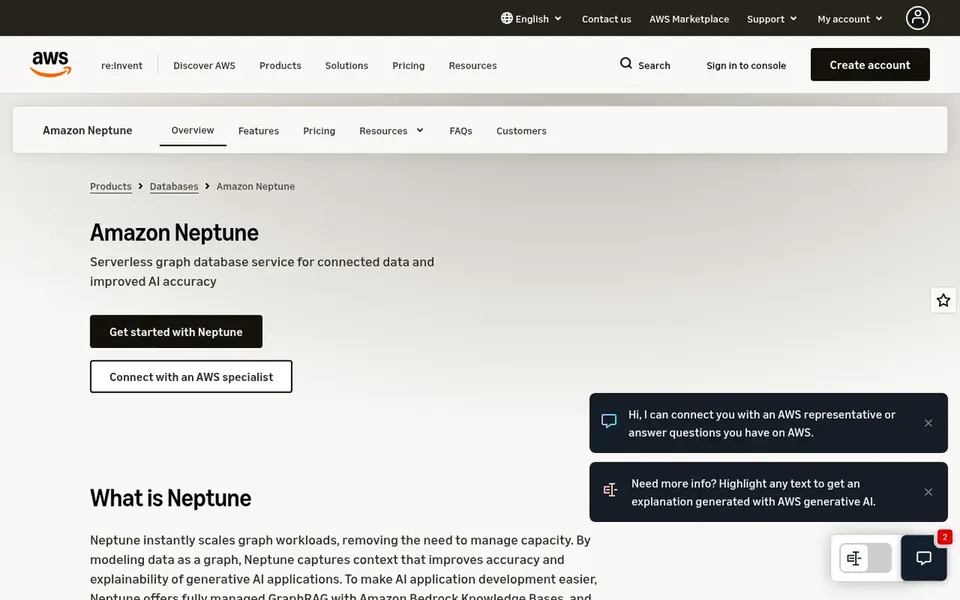
Choose Amazon Neptune for managed graphs on AWS. For teams already running workloads on AWS, a managed graph service can cut operational overhead and fit existing account, networking and identity practices.
Drawbacks to consider: Managed model cuts low-level control.
Check the vendor site for Amazon Neptune pricing; none is listed in this comparison. Amazon Neptune has a free plan.
ArangoDB is aimed squarely at unified context for AI applications. Teams needing a narrowly scoped graph store may prefer a more focused engine.
Pick ArangoDB when unified, trusted context for AI applications is the central goal and you can invest in evaluating the broader product. Check the vendor site for ArangoDB pricing; none is listed in this comparison. ArangoDB includes a free tier.
Downsides: Fit relies on your AI context requirements.
Where Ontotext GraphDB fits: semantic and RDF knowledge graphs. Ontotext GraphDB is a semantic graph database with quick queries and semantic linking, positioned for extracting meaning from unstructured data for analytics and cost reduction. That makes it a fit for knowledge graph projects built on semantic standards, where shared vocabularies and linked entities matter more than plain property graph storage.
Where it is weaker: Semantic modeling needs specialized skills.
On top of that, if your knowledge graph is a straightforward property graph, a general graph engine may be more straightforward. More specifically, semantic graph work calls for familiarity with RDF-style modeling and vocabularies, which can be a steep step for teams coming from relational or property graph backgrounds. Teams working with ontologies or content enrichment should shortlist it. Check the vendor site for Ontotext GraphDB pricing; none is listed in this comparison. As for free access: Not stated.
Microsoft Azure Cosmos DB is a good fit for multi-model apps on Azure. That appeals to teams building applications on Azure that want one managed service rather than multiple separate databases.
Honest limits: Not graph-only, so graph is one model among multiple.
Consider a specialized graph database when graph queries are the primary workload instead of one feature among plenty of. Check the vendor site for Microsoft Azure Cosmos DB pricing; none is listed in this comparison. Free plan details: Not stated.
Memgraph is designed for in-memory GraphRAG and AI memory. Memgraph describes itself as an in-memory graph engine for AI context, handling GraphRAG, AI memory, agentic AI and live analytics for example fraud detection. Its Cypher compatibility helps teams with existing graph query skills begin, and the in-memory design targets low-latency access to connected data.
In practice, an in-memory engine means capacity planning and persistence choices deserve early attention, and workloads dominated by large batch processing may fit other architectures better. Teams needing a purely disk-oriented managed service should compare choices. For everyday use, choose Memgraph when live graph access for AI context is the priority and your team is comfortable with Cypher. This comparison lists no price for Memgraph; ask the vendor. As for free access: Free trial.
What to check first: Live focus may not suit batch-heavy work. Reasons to shortlist it: Cypher-compatible query approach; In-memory graph engine.
Neo4j makes the most sense for general graph-native knowledge graphs. Pick Neo4j when connected data and multi-hop queries are central to the product. For everyday use, Neo4j is a graph data product built around storing data as it is connected, so relationships are first-class instead of joined at query time.
That makes it a good fit for teams building knowledge graphs, recommendation structures or dependency maps where traversal depth matters and where the graph model should drive the application design. As for the details, if your workload is largely tabular reporting or straightforward key-value lookups, a different database type may be more straightforward. Neo4j starts at: $0.09 per GB per hour. Free access exists with Neo4j.
What to check first: Less natural for purely relational workloads.
Confirm the entry price on the vendor page. For Amazon Neptune, ArangoDB, Ontotext GraphDB and others that means a quote rather than a fixed price.
Check what the free option really includes: Amazon Neptune, ArangoDB and Neo4j offer a free plan, and usage caps differ.
Run a trial of Memgraph with real work before paying for a year; your own workflow is the best test.
Read the limits listed for Amazon Neptune first: most natural inside the AWS ecosystem.
Pick one real project and run it in Neo4j first; a small pilot shows fit faster than a checklist.
Look at the help docs and support options for Ontotext GraphDB before you commit.
How we picked
Ainotely looked at what each vendor publishes: pricing, plan limits, feature coverage for knowledge graph database and stated drawbacks. No hands-on testing is claimed. Where a vendor does not publish a price, the entry says quote. Where a price depends on seats or billing term, the entry says so. The ranking is editorial: typical fit first, then clear pricing, then free access. If your needs are unusual, read the profiles rather than relying on position.
Every price and plan detail on this page comes from the vendors’ own websites. We did not run hands-on tests unless the text says so, and we do not publish star ratings or review scores. See how we score and our disclosure.
Keep your shortlist in one place
Paste prices, trial dates and notes from this guide into Ainotely, our AI note app. It files them into a topic and pulls out tasks like “cancel trial by Friday”. Free 7-day trial, no card needed.
Often, yes. Amazon Neptune, ArangoDB and Neo4j have a free plan and Memgraph offers a free trial. Use your own data and a real task during the test, and check what the free tier or trial limits before you rely on it.
Is Amazon Neptune the right pick for everyone comparing knowledge graph database?
No single tool suits every team. Amazon Neptune comes first because it fits managed graphs on AWS, while ArangoDB suits unified context for AI applications and Ontotext GraphDB suits semantic and RDF knowledge graphs. Match the tool to your own size, budget and workflow before deciding.
How are the tools for knowledge graph database ordered?
Amazon Neptune sits first and Neo4j last because the order follows typical fit for knowledge graph database, then price clarity and free access. It is a judgement call, so read each profile for fit and limits.
What should a knowledge graph database do well?
It should store entities and relationships naturally and answer multi-hop traversal queries efficiently. As for the details, look for a query language your team can learn, a hosting model that matches your operations. Support for the data standards your project uses.
Which options for knowledge graph database have a free plan?
Amazon Neptune, ArangoDB and Neo4j offer a free plan in this list. Free plans usually cap users, projects or features, so check the limits on the vendor page. One other tool offers a trial instead.