Fabric is the first pick on this list for AI visibility and catalog enrichment. commercetools is the stronger choice for API-first composable commerce builds, while BigCommerce Enterprise suits adaptable SaaS commerce on your terms. Prices, free plans and limits for all 5 tools follow.
This Ainotely guide covers 5 options for mobile E-commerce software for enterprise. Each profile lists a starting price, free plan details, strengths and drawbacks, so you can drop poor fits quickly.
Key takeaways
Top of the list is Fabric, which targets AI visibility and catalog enrichment.
None of the 5 tools, from Fabric to Salesforce Commerce Cloud, has a free plan, so budget for a subscription or use a trial.
One limit worth knowing about Fabric: narrower than full storefront suites.
Salesforce Commerce Cloud suits teams inside the Salesforce ecosystem.
No starting price is shown for any of the 5 tools, Fabric and Salesforce Commerce Cloud included, so plan time for sales calls.
Pick Fabric if this describes you: AI visibility and catalog enrichment. Fabric centres on merchandising for AI shopping, enriching your product catalog so answer engines like ChatGPT, Gemini and Perplexity can recommend your brand, and tracking AI visibility so you can be the answer when shoppers ask. For everyday use, teams not yet prioritizing AI-driven discovery may get more immediate value elsewhere.
Limits to weigh: Value relies on AI channel goals.
As for the details, Fabric's stated focus is catalog enrichment and AI visibility instead of a complete storefront and checkout stack. So most enterprises will pair it with a commerce system. Fabric does not show a starting price in this comparison, so check the vendor site for current pricing. As for free access: Not stated.
commercetools is a good fit for API-first composable commerce builds. commercetools describes itself as a digital commerce AI company offering enterprise commerce infrastructure for AI agents.
Beyond that, teams build and operate commerce experiences across online, in-store, in-chat and agent-to-agent channels from one unified engine. This comparison lists no price for commercetools; ask the vendor. As for free access: Free trial.
Drawbacks to consider: No turnkey storefront included.
BigCommerce Enterprise is built with adaptable SaaS commerce on your terms in mind. It supports B2B and B2C selling, headless storefronts and integrations through APIs, which makes it a reasonable fit for mid-market and enterprise retailers wanting SaaS convenience with room to customize.
Limits to weigh: Some advanced features need apps.
In daily use, certain advanced capabilities rely on external apps or custom development, which brings cost and management overhead over time. This comparison lists no price for BigCommerce Enterprise; ask the vendor. As for free access: Not stated.
In short, Shopify Plus is for managed enterprise commerce at scale. Shopify Plus is the enterprise level of Shopify's commerce product, positioned for high-volume brands that want unrivaled scale without running their own infrastructure.
Worth adding: since it is a hosted SaaS system, highly bespoke backend logic or unusual data models can need workarounds or external services. In practice, merchants with strict requirements for full code-level control may prefer a composable or self-managed choice instead. This comparison lists no price for Shopify Plus; ask the vendor. As for free access: Not stated.
Where it falls short: Less deep backend customization.
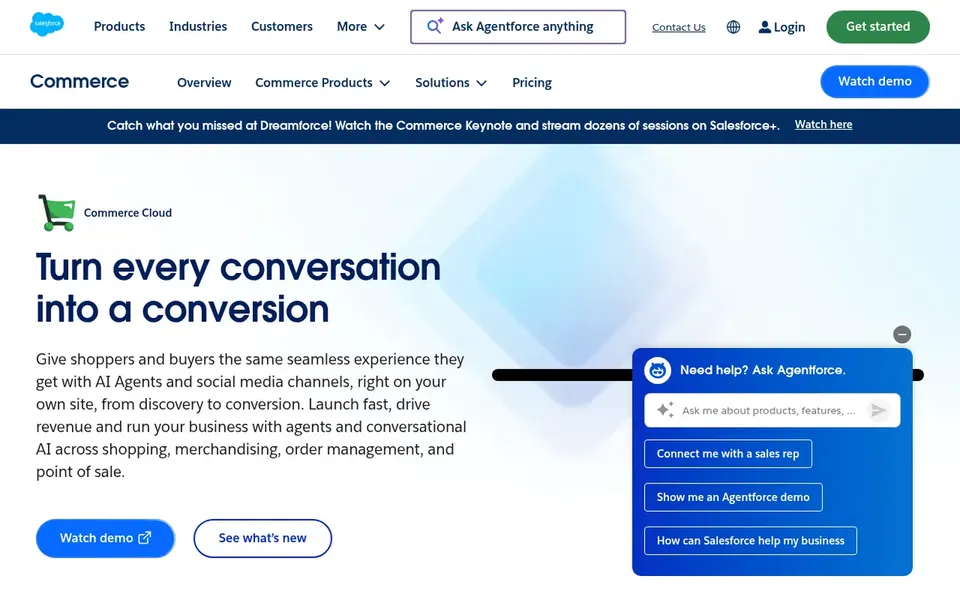
Salesforce Commerce Cloud is designed for teams inside the Salesforce ecosystem. It fits enterprises that already run Salesforce for CRM or marketing and want mobile shopping experiences informed by unified customer profiles, including B2C and B2B scenarios.
The platform's strengths are most apparent when paired with other Salesforce products, so organizations outside that ecosystem may not capture the full benefit. No starting price is listed for Salesforce Commerce Cloud here; confirm pricing on the vendor site. Free options: Not stated.
What to check first: Best value assumes Salesforce adoption.
Request quotes from Fabric, Salesforce Commerce Cloud and the others; the list shows no fixed prices.
Run a trial of commercetools with real work before paying for a year; your own workflow is the best test.
Read the limits listed for Fabric first: narrower than full storefront suites.
Compare total cost, not headline price: for commercetools, add extra seats, add-ons and any usage-based charges.
Find out whether the entry plan of Shopify Plus covers your must-haves or only a trimmed-down version.
How we picked
Ainotely used vendor pricing pages and product documentation as the base, then compared plans, free access and documented limits for 5 tools. Seat minimums, billing terms and add-ons can move the real cost, so the starting prices here are a guide and not a quote. Position on the page reflects fit for a typical buyer first, with price clarity and free access breaking ties. Treat it as a guide, not a ruling. Keep it in mind while reading the 5 mobile E-Commerce software for enterprise profiles on this page.
Every price and plan detail on this page comes from the vendors’ own websites. We did not run hands-on tests unless the text says so, and we do not publish star ratings or review scores. See how we score and our disclosure.
Keep your shortlist in one place
Paste prices, trial dates and notes from this guide into Ainotely, our AI note app. It files them into a topic and pulls out tasks like “cancel trial by Friday”. Free 7-day trial, no card needed.
Does any tool for mobile E-commerce software for enterprise here have a free plan?
No tool in this list, Fabric and Salesforce Commerce Cloud included, has a permanent free plan. commercetools offer a trial. Trials and quotes are the usual route, so plan a short evaluation period.
Can I try these tools before paying?
Often, yes. commercetools offers a free trial. Use your own data and a real task during the test, and check what the free tier or trial limits before you rely on it. Pricing, free plan details and limits for all 5 tools in this mobile E-Commerce software for enterprise roundup sit on the individual cards above.
Should I choose a hosted SaaS system or a composable approach?
Hosted SaaS products for example Shopify Plus and BigCommerce Enterprise cut operational overhead and speed launches. For everyday use, Composable choices like commercetools provide engineering teams more control over front ends and channels, but demand more development resources and architectural planning.
Is Fabric the right pick for everyone comparing mobile E-commerce software for enterprise?
No single tool suits every team. Fabric comes first because it fits AI visibility and catalog enrichment, while commercetools suits API-first composable commerce builds and BigCommerce Enterprise suits flexible SaaS commerce on your terms. Match the tool to your own size, budget and workflow before deciding.
Do these tools publish their prices?
No. None of the tools, from Fabric to Salesforce Commerce Cloud, shows a fixed starting price here, so budget time for quotes.
Where does AI fit into enterprise commerce products?
Multiple vendors now emphasize AI-assisted personalization, merchandising or catalog enrichment, and Fabric specifically targets visibility in AI answer engines. Treat AI features as one criterion among numerous and confirm how each capability suits your existing stack and data.