Are you drowning in a sea of digital information, struggling to transform scattered notes and fleeting thoughts into tangible insights? It's 2026, and the sheer volume of data we encounter daily demands more than just simple note-taking; it requires a robust system to truly leverage your intellectual capital. This challenge often leads to a crucial question: how do you effectively manage your knowledge?
For many, the debate quickly narrows down to zettelkasten vs pkm. While seemingly distinct, these two concepts often intertwine, offering different philosophies and tools for cultivating your personal knowledge garden. Understanding their nuances is key to selecting a system that not only captures your thoughts but actively helps you generate new ideas and achieve your goals.
Understanding Personal Knowledge Management (PKM) in 2026
Personal Knowledge Management (PKM) is the overarching discipline of collecting, organizing, refining, and applying information for personal growth, productivity, and innovation. Think of it as your individualized strategy for dealing with the information deluge, turning raw data into actionable knowledge. In 2026, with AI-powered tools and an ever-accelerating digital landscape, a well-structured PKM system isn't just a luxury - it's a necessity.
Why is PKM more crucial than ever? The average professional now interacts with dozens of digital tools daily, generating vast amounts of data from emails, documents, meetings, and web browsing. Without a system, this information becomes a liability, lost in digital silos. A robust PKM system ensures you can:
- Capture everything: From fleeting ideas to complex research papers.
- Organize intelligently: Make sense of disparate pieces of information.
- Synthesize effectively: Connect ideas to form new insights.
- Retrieve swiftly: Find exactly what you need, when you need it.
- Create prolifically: Turn your accumulated knowledge into tangible output - articles, presentations, projects, or simply a deeper understanding of the world.
Components of a Modern PKM System
A comprehensive PKM system typically involves several stages:
- Capture: Quickly save information from any source. Tools like Evernote, Apple Notes, Google Keep, and browser extensions are excellent for this. AI meeting assistants like Otter AI, Fireflies, and Fathom now seamlessly transcribe and summarize spoken knowledge directly into your system.
- Process/Organize: Categorize, tag, and link your captured notes. This might involve folders (Notion, OneNote), tags (Bear, Evernote), or a more flexible, networked approach (Obsidian, Logseq).
- Synthesize/Develop: Actively work with your notes, connecting ideas, annotating, and summarizing in your own words. This is where the magic happens, transforming raw data into personal understanding.
- Retrieve/Apply: Easily find past information and apply it to current tasks or projects. Smart search functions and semantic understanding (increasingly AI-driven in tools like Mem AI and Reflect) are vital here.
Actionable Tip: Start by streamlining your capture process. Choose one or two reliable tools for quick capture across all your devices. The easier it is to save an idea, the more likely you are to do it consistently.
Diving Deep into the Zettelkasten Method
The Zettelkasten (German for "slip-box") method is a specific, highly structured approach to note-taking and knowledge management popularized by German sociologist Niklas Luhmann. Luhmann, famous for publishing over 70 books and 400 articles, attributed his incredible productivity and depth of thought to his Zettelkasten. It's not just a collection of notes; it's a dynamic system for generating new ideas and making serendipitous connections.
At its core, a Zettelkasten consists of individual, atomic notes, each containing a single idea or piece of information. These notes are then linked to other relevant notes, creating a web of interconnected thoughts rather than a rigid hierarchy.
Core Principles of the Zettelkasten
- Atomicity: Each note should contain only one idea. This makes notes easier to link and reuse in different contexts.
- Linkability: Notes are extensively linked to each other. These links are the "nervous system" of your Zettelkasten, revealing relationships and building a network of knowledge.
- Permanence: Notes are written in your own words, processed and understood. They are designed to be permanent additions to your knowledge base.
- Own Words: Don't just copy-paste. Process the information and write it down in your own understanding. This active engagement is crucial for learning.
- Reference: Always include the source of your information, allowing you to trace back to original texts.
Benefits and Challenges of Zettelkasten
Benefits:
- Deep Understanding: Forces you to process information thoroughly, leading to better comprehension and retention.
- Idea Generation: The networked structure encourages serendipitous connections between seemingly unrelated ideas, sparking new insights.
- Enhanced Memory: By linking and rephrasing, you build a stronger mental model of your knowledge.
- Productivity for Writers/Researchers: Provides a rich repository of pre-digested ideas, significantly speeding up the writing and research process.
Challenges:
- Steep Learning Curve: Requires a significant shift in how you think about note-taking and knowledge organization.
- Initial Setup Time: Building a useful network of notes takes time and consistent effort.
- Discipline Required: Maintaining atomicity and consistent linking demands discipline.
- Tool Agnostic (but specific tools help): While you can theoretically build a Zettelkasten with index cards, digital tools like Obsidian, Logseq, and Roam Research are designed to facilitate linking and graph visualization, making the process much more manageable in 2026.
Actionable Tip: Don't try to build a perfect Zettelkasten overnight. Start by creating just 2-3 atomic notes daily from what you've read or learned, focusing on linking them to existing notes. Consistency is more important than volume.
Zettelkasten vs PKM: A Head-to-Head Comparison
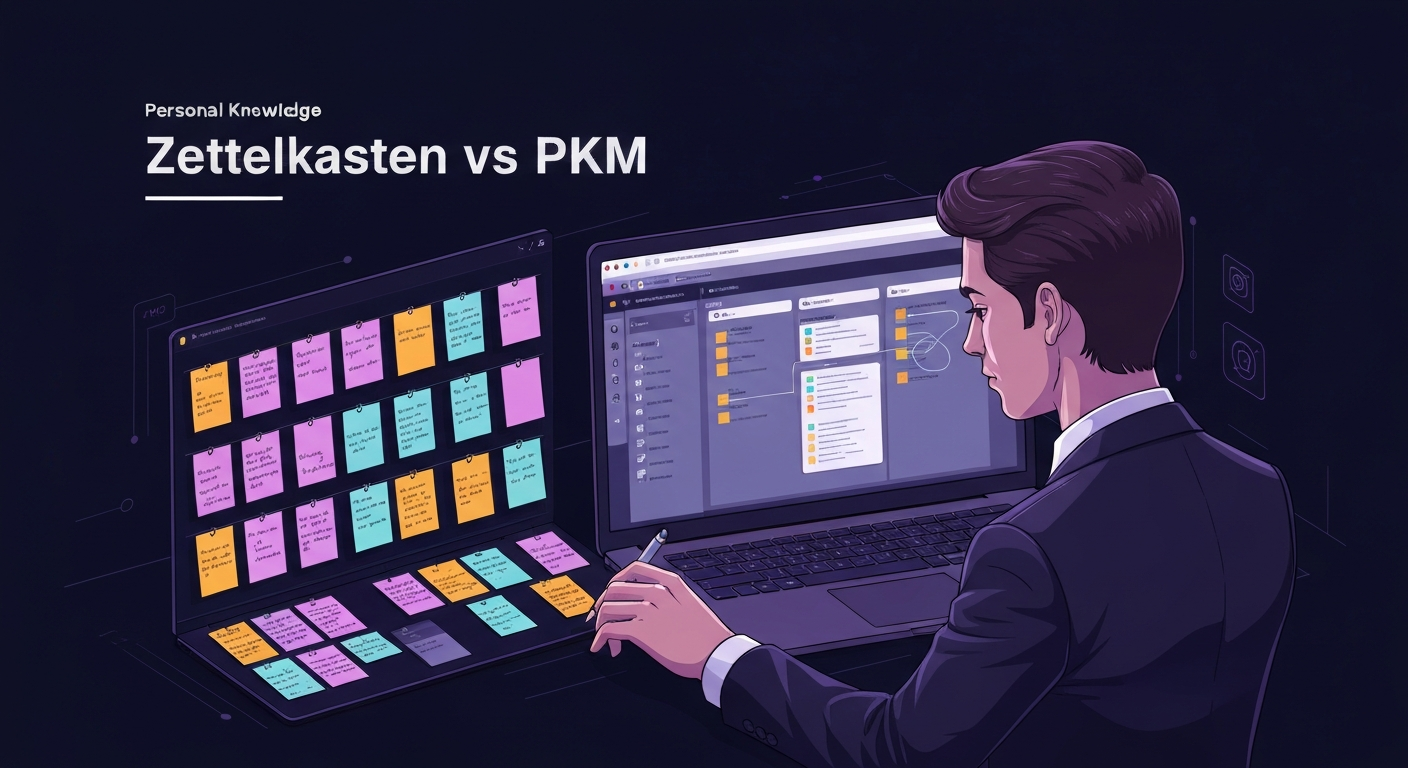
The common mistake in the "zettelkasten vs pkm" debate is treating them as mutually exclusive. In reality, Zettelkasten is a powerful methodology that can be implemented within a broader PKM system. PKM is the umbrella; Zettelkasten is a specific, highly effective technique for a particular aspect of knowledge management.
Let's break down their differences and synergies:
Scope and Goal
- PKM: Has a broader scope, encompassing all aspects of managing personal information - tasks, projects, daily notes, documents, media, as well as ideas. Its goal is overall efficiency, productivity, and leveraging diverse information for personal and professional growth.
- Zettelkasten: Has a more focused scope, primarily concerned with the development, connection, and synthesis of ideas. Its goal is deep understanding, original thought, and the generation of new insights, particularly useful for writing and research.
Structure and Organization
- PKM: Can be highly flexible. Systems might be hierarchical (folders in Notion, OneNote), tag-based (Evernote, Bear), project-oriented, or a mix. The structure serves the immediate needs of information retrieval and task management.
- Zettelkasten: Emphasizes a non-hierarchical, networked structure. Notes are connected through explicit links, creating a dense web of relationships. This structure is designed for discovery and emergent insights, rather than rigid categorization.
Learning Curve & Effort
- PKM: The learning curve can vary significantly. A simple PKM system (e.g., Apple Notes for quick captures) is easy to start. More complex systems (e.g., highly customized Notion workspaces) require more effort but offer greater flexibility.
- Zettelkasten: Generally has a higher initial learning curve. It requires a fundamental shift in how you think about and process information. The effort is front-loaded, but pays dividends in the long run through accelerated idea generation.
Best Use Cases
- PKM: Ideal for managing diverse information streams, organizing projects, tracking daily tasks, quick information retrieval, and general productivity. It's suitable for almost anyone who needs to manage digital information, from students to project managers to creatives.
- Zettelkasten: Best suited for academics, researchers, writers, deep thinkers, and anyone whose primary goal is to develop original ideas, produce long-form content, or gain a profound understanding of complex subjects.
Ultimately, the "zettelkasten vs pkm" debate is less about choosing one over the other, and more about understanding how a powerful methodology like Zettelkasten can elevate your overall PKM strategy. You can have a broad PKM system that incorporates Zettelkasten principles for your idea development.
Choosing Your Path in 2026: Which is Right for You?
Deciding between a general PKM approach or specifically adopting the Zettelkasten method (or both) depends heavily on your personal goals, existing habits, and the nature of your work.

When to Lean Towards a Broader PKM System:
- You need to manage a wide variety of information: This includes documents, media, web clips, tasks, project notes, meeting minutes, and personal reminders.
- You prioritize quick capture and easy retrieval: Your main goal is to get information in and out of your system efficiently.
- You work across many different projects: You need a flexible system that can adapt to changing contexts and priorities.
- You're comfortable with hierarchical or tag-based organization: You prefer clear categories and folders for your information.
- Your primary tools are: Notion, Evernote, OneNote, Apple Notes, Google Keep, Bear, or AI-powered general knowledge assistants like Mem AI or Reflect. These tools excel at broad information management.
When to Embrace the Zettelkasten Method:
- Your primary goal is to develop original ideas, write extensively, or conduct deep research: You're looking to create new knowledge, not just consume it.
- You enjoy making connections between disparate concepts: You thrive on discovering relationships and building a rich intellectual network.
- You're willing to invest time in learning a new, disciplined approach to note-taking: You see the long-term benefits of a structured system for intellectual growth.
- You struggle with starting new writing projects: A Zettelkasten provides a constant source of pre-developed ideas.
- Your primary tools are: Obsidian, Logseq, or Roam Research, which are specifically designed to facilitate the linking and graph visualization central to Zettelkasten.
The Hybrid Approach: Best of Both Worlds with Ainotely
In 2026, the lines between traditional PKM and specialized methods like Zettelkasten are blurring, thanks to advancements in artificial intelligence. Many users don't need to choose "either/or" but rather seek a "both/and" solution that intelligently combines the strengths of both. This is where modern tools like Ainotely (ainotely.com) shine.
Ainotely is designed to bridge the gap, offering a seamless experience that supports broad PKM needs while simultaneously facilitating the deep idea synthesis characteristic of Zettelkasten, often with less manual effort.
Why Ainotely Solves the Problem:
- AI-Powered Linking & Suggestions: This is a game-changer. Ainotely's advanced Natural Language Processing (NLP) and machine learning algorithms analyze your notes in real-time. It automatically suggests relevant links between your atomic ideas, significantly reducing the manual effort and learning curve typically associated with Zettelkasten. It can even prompt you with questions to deepen your understanding or identify potential connections you might have missed.
- Flexible Structure for Diverse Needs: Ainotely understands that not all knowledge fits neatly into one box. It supports both traditional hierarchical organization (folders, tags - great for general PKM) and dynamic, graph-based linking (perfect for Zettelkasten). You can organize project documents in a structured way while letting your creative ideas interlink freely.
- Seamless Multi-Modal Capture: Whether it's a quick text note, a voice memo, a web clip, or a summarized transcript from your meeting AI (like Fathom, Otter AI, or Fireflies), Ainotely offers robust capture capabilities. This ensures all your information flows into a single, intelligent hub.
Intelligent Retrieval Beyond Keywords: Forget remembering exact tags or keywords. Ainotely's semantic search capabilities understand the meaning* of your queries, not just the words. This means you can find relevant notes even if your query uses different phrasing, making retrieval faster and more intuitive than ever before.
- Proactive Idea Generation: Beyond passive storage, Ainotely actively assists in idea generation. It can surface "forgotten" connections, highlight emerging themes across your notes, and even suggest prompts to help you develop nascent thoughts into full-blown concepts. This turns your knowledge base into a true thinking partner.
- User-Friendly Interface: While powerful, Ainotely is designed to be intuitive and accessible. It demystifies complex knowledge management techniques, making advanced methods like Zettelkasten approachable for everyone.
For many, the "zettelkasten vs pkm" debate isn't about choosing one or the other, but about finding a system like Ainotely that intelligently combines their strengths. It allows you to manage your broad PKM needs while leveraging AI to simplify the rigorous demands of a Zettelkasten, pushing you towards deeper understanding and greater creative output.
Actionable Tip: Explore tools that offer AI assistance to bridge the gap between structured PKM and the demanding nature of Zettelkasten. Consider trying Ainotely's free tier to experience how intelligent linking and flexible organization can transform your knowledge workflow.
Quick Summary / Key Takeaways
- PKM (Personal Knowledge Management) is the broad discipline of managing all your personal information for growth and productivity.
Zettelkasten is a specific, highly effective note-taking methodology* focused on developing and connecting atomic ideas for deep understanding and idea generation.
Relationship: Zettelkasten is a powerful method that can be integrated into* a broader PKM system. It's not an either/or choice.
- PKM Strengths: Versatility, broad information management, quick capture, project organization.
- Zettelkasten Strengths: Deep learning, idea synthesis, original thought, long-form content creation.
- Choosing Your Path: Depends on your primary goals - general organization vs. deep intellectual work.
- Hybrid Solutions: Modern AI-powered platforms like Ainotely (ainotely.com) offer the best of both worlds, simplifying complex methods and automating connections.
Conclusion: Future-Proofing Your Knowledge in 2026
In an era defined by information overload and rapid technological advancement, effectively managing your personal knowledge is no longer optional - it's a cornerstone of success. The "zettelkasten vs pkm" discussion highlights a spectrum of approaches, from holistic information management to highly specialized idea development. The good news is that you don't have to choose just one.
As we move further into 2026, the most effective knowledge workers will be those who embrace flexible, intelligent systems that adapt to their needs. By understanding both broad PKM principles and the rigorous advantages of the Zettelkasten method, you can construct a personal knowledge system that truly empowers you. Tools like Ainotely represent the next generation of knowledge management, leveraging AI to simplify complex processes and unlock unprecedented levels of insight and productivity. Start building your future-proof knowledge system today.

Capture everything. Forget nothing.
Ainotely turns voice notes, text, images and PDFs into an organized, searchable second brain. AI does the heavy lifting so you don't have to.
Start Free Trial → 7-day free trial · No credit card needed · Cancel anytime