Sisense is the first pick on this list for embedded analytics in products. Listed starting prices: Tableau from $15 per user a month. Alternatives: GoodData for dashboards and agents on one foundation, and Looker for governed semantic layer with embedded BI. Details, prices and limits for the rest of the 5 tools are below.
If you are comparing Reveal, this page covers 5 tools in one place: what each is best for, what it costs to start, whether it has a free plan, and the main limit to know about.
Key takeaways
Sisense takes the first slot, best suited to embedded analytics in products.
Tableau fits visual exploration across numerous data sources.
Tableau is the only tool of the 5 with a free plan.
Tableau has the lowest monthly starting price in this list: $15 per user per month.
Sisense is designed for embedded analytics in products. Pick Sisense when analytics is a feature of what you sell, and consider a broader BI suite when the central audience is internal analysts.
Reasons to shortlist it: Pitched at turning data into revenue.
Drawbacks to consider: Embedded focus may not suit internal BI.
More specifically, since the emphasis is embedded delivery, teams that primarily need internal dashboards may prefer a general BI product. Worth adding: Sisense delivers AI-powered embedded analytics with the stated goal of turning data into revenue, offering pro-code, low-code and no-code adaptability. This comparison lists no price for Sisense; ask the vendor. As for free access: Free trial.
Think of GoodData for dashboards and agents on one foundation. GoodData presents analytics, AI and agents on one data serving plane, letting teams run dashboards, data applications and agents on a single governed foundation. It is described as aimed at continuous, high-concurrency agentic demand that traditional data products were not meant to serve, which fits organizations pushing heavy automatic and AI-driven workloads alongside conventional reporting.
Where it falls short: Narrower fit for straightforward reporting.
What works well: Made for high-concurrency demand. For everyday use, evaluate whether your workloads genuinely need that concurrency. From a buyer's view, choose GoodData when dashboards, apps and agents must share one governed serving layer, and look at more straightforward choices for entry-level BI. GoodData shows no starting price here, so confirm the cost on the vendor site. As for free access: Free trial.
Best for: Governed semantic layer with embedded BI
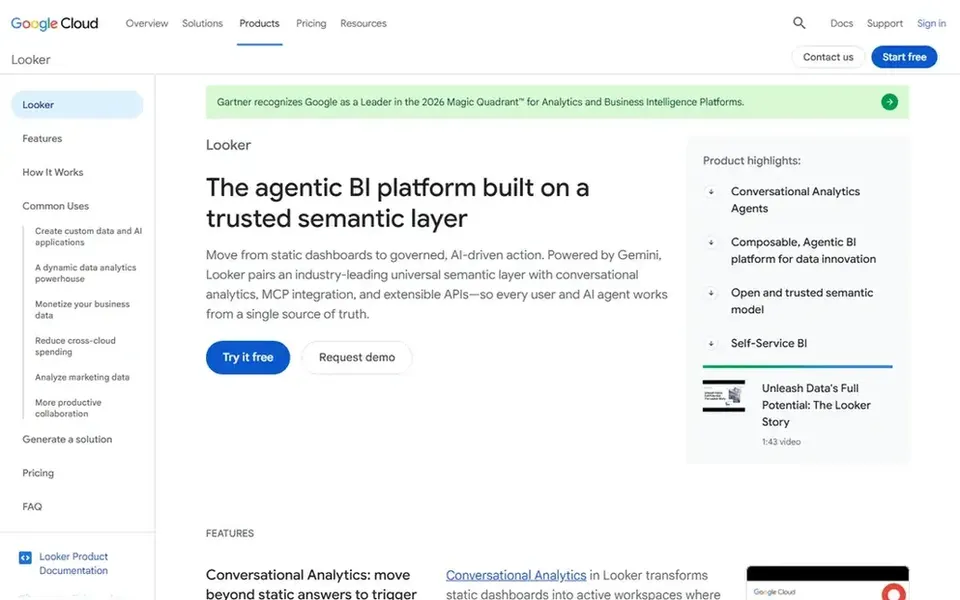
In short, Looker is for governed semantic layer with embedded BI. Looker is Google Cloud's agentic business intelligence and embedded analytics system.
The main drawbacks: Setup of the semantic model takes effort.
It centers on a trusted semantic layer that brings together metrics across teams, with Gemini agents layered on top for AI-assisted exploration. The semantic modeling approach rewards disciplined data teams but can slow down fast ad hoc exploration, and the product assumes a cloud-oriented stack. Looker does not show a starting price in this comparison, so check the vendor site for current pricing. Trial and free access: Not stated.
Domo is built with governed data pipelines for AI agents in mind. Domo positions itself around governed data for AI agents, with products that link and move data from any source, prepare and expand access for exploration, and accelerate business-critical insights. In daily use, choose Domo when the full data journey and AI-ready governance are central, and prefer a more straightforward tool when only charts and reports are required.
Watch-outs: Needs data governance planning.
More specifically, the breadth of the platform means adoption involves planning across data movement, preparation and governance instead of just dashboards. From a buyer's view, teams seeking a light visualization tool may find it more than they need. Pricing for Domo is not stated here, so ask the vendor for current figures. Trial and free access: Free trial.
Best for: Visual exploration across plenty of data sources
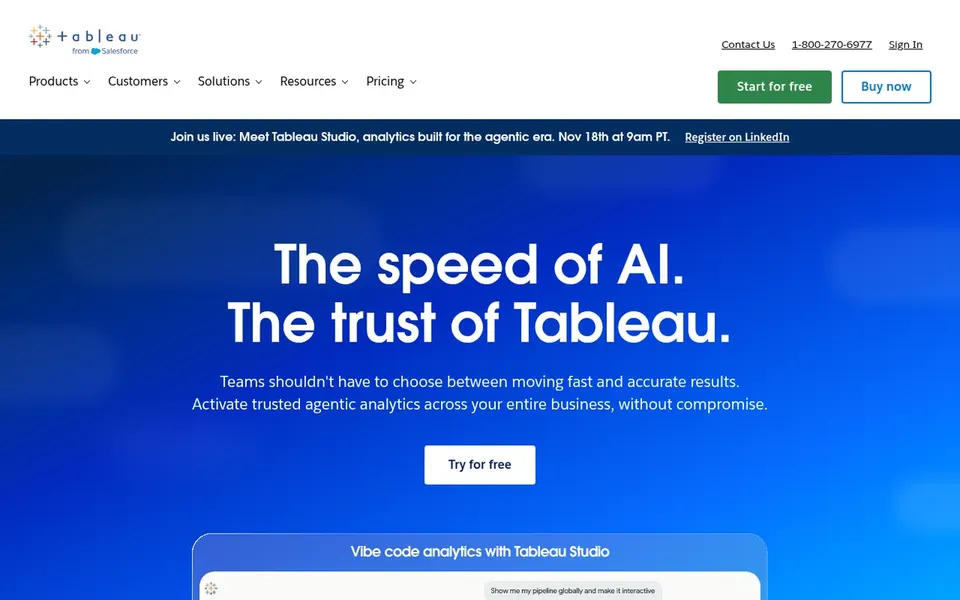
In short, Tableau is for visual exploration across numerous data sources. Tableau is a business intelligence and analytics system built around visual exploration. It links to almost any database, lets users drag-and-drop to produce visualizations, and shares results with a click.
Honest limits: Advanced modeling is less central.
As for the details, pick Tableau when visual discovery and broad connectivity are the priority, and consider a semantic-layer platform when metric consistency is the primary requirement. Since exploration is central, consistent metric definitions rely on how your team structures and governs its data instead of on a built-in semantic layer. The starting price for Tableau: $15 per user per month. Tableau includes a free tier.
Ask Sisense, GoodData, Looker and Domo for a written quote, since no starting price is shown.
Look at the free plan from Tableau closely: its caps decide whether it is usable for real work.
Take the trial from Sisense, GoodData and Domo and push a live task through it before you pay.
Read the limits listed for Sisense first: embedded focus may not suit internal BI.
Compare total cost, not headline price: for Sisense, add extra seats, add-ons and any usage-based charges.
Look at the help docs and support options for Domo before you commit.
How we picked
The comparison looks at four things: starting price, free access, how well the feature set matches Reveal, and the main limit of each tool. Where a vendor does not publish a price, the entry says quote. Where a price depends on seats or billing term, the entry says so. The sequence is a judgement call: typical use case first, then pricing transparency, then free access. Use the profiles to check fit.
Every price and plan detail on this page comes from the vendors’ own websites. We did not run hands-on tests unless the text says so, and we do not publish star ratings or review scores. See how we score and our disclosure.
Keep your shortlist in one place
Paste prices, trial dates and notes from this guide into Ainotely, our AI note app. It files them into a topic and pulls out tasks like “cancel trial by Friday”. Free 7-day trial, no card needed.
Often, yes. Tableau has a free plan and Sisense, GoodData and Domo offer a free trial. Use your own data and a real task during the test, and check what the free tier or trial limits before you rely on it.
How are the tools for Reveal ordered?
The order follows typical fit for Reveal, with Sisense first and Tableau last, then price clarity and free access. It is editorial judgement, not a score, so another team could rank the tools differently.
What should I look for in a Reveal alternative?
Start with how you will use analytics: internal dashboards, embedded product analytics or AI-driven workloads. Matching the system to those needs matters more than feature counts.
What is the cheapest option for Reveal in this list?
On published monthly entry prices, Tableau is the lowest here at $15 per user per month. Entry price is only part of the cost, because seats, add-ons and billing terms can change the total. The 5 tool cards above repeat this per product for Reveal alternatives, with the listed price or "pricing on request".
Which options for Reveal have a free plan?
Tableau is the only tool in this list with a free plan. Free plans usually cap users, projects or features, so check the limits on the vendor page. Several others offer a trial instead. Each of the 5 options in this Reveal alternatives guide has its own card above with the price, free plan and limits.